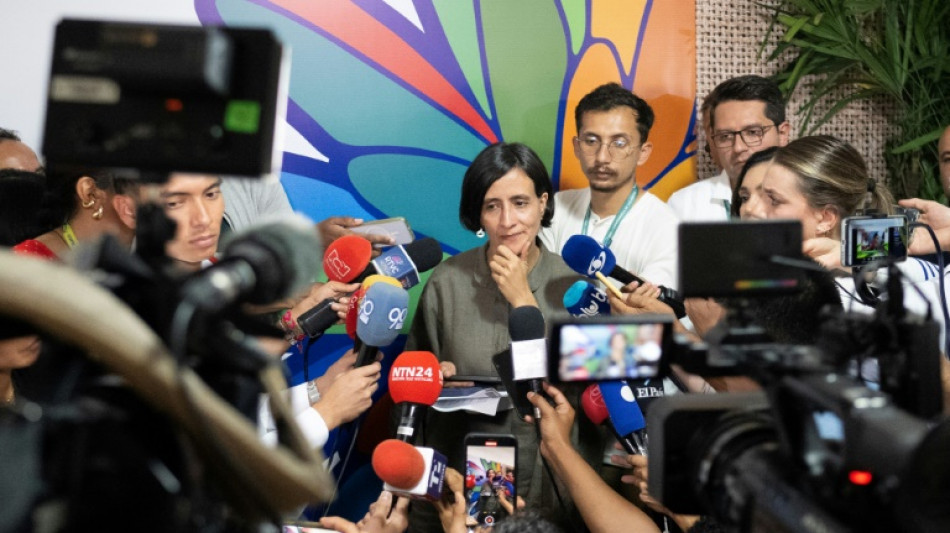
Last-ditch effort to solve funding deadlock at nature-saving summit / Photo: Luis ACOSTA - AFP

 All Blacks name veteran Taylor captain as Mo'unga seizes 10 jersey
 Race against time as Asian Games cricket quarter-finals washed out
 India turns to corals and seagrass to shield against rising seas

 Manchester City's Premier League charges: What comes next?

 Brazil's cellphone crime: a security nightmare in every pocket
 Russia pummels Kyiv in latest deadly attack
 NFL Giants obtain QB McCarthy from Vikings

 Deal for evicted Spanish pensioner as PM seeks new housing law

 Clippers apologize, warn fans of 'challenges' after Leonard scandal

 Turkish comedian convicted for Erdogan 'insult' freed pending appeal

 Trump announces 'biggest' US steel plant in battleground Iowa

 Olise wonder strike gives Zidane's France win in Belgium

 US stocks fall, bond yields rise as Middle East war drags on

 Trump denies offering to sell arms to China's Xi

 Wemby ready for NBA Spurs to move rivals in climb to top

 Ukraine to postpone some spending amid delays in aid: PM
 Tuchel says Czech Republic game 'not yet a must-win'

 MaXhosa puts South Africa on the Paris fashion map

 Rose, Scott among 2027 World Golf Hall of Fame finalists

 Brunson says NBA champion Knicks can't get satisfaction

 France puts out largest wildfire since 1949

 Real Madrid's Perez summoned over Barcelona referee payments comments

 Oil takes off again, Wall Street dips after Trump rejects Iran truce offer
 AlgoQuant Asset Management Selects Liquid Mercury to Enhance Digital Asset Trading Infrastructure
 UK to reopen refugee resettlement scheme to push 'safe' migration

Negotiators at the world's biggest nature conservation conference knuckled down in Cali, Colombia on Friday for a last-ditch effort to break a deadlock on funding for efforts to "halt and reverse" species loss.
The Colombian presidency of the summit, which opened on October 21 and was programmed to run until Friday, proposed a raft of late-night draft texts on possible ways out of the stalemate.
With some 23,000 registered delegates, the 16th Conference of Parties (COP16) to the UN's Convention on Biological Diversity is the biggest-ever meeting of its kind.
It is a follow-up to an agreement reached two years ago in Canada, the Kunming-Montreal Global Biodiversity Framework, which called for $200 billion per year to be made available to protect biodiversity by 2030.
Under the agreement, this was to include $20 billion per year going from rich to poor nations by 2025, and $30 billion by 2030.
The targets included placing 30 percent of land and sea areas under protection and 30 percent of degraded ecosystems under restoration, while reducing pollution and phasing out agricultural and other subsidies harmful to nature.
COP16 was tasked with assessing, and accelerating, progress.
But negotiations on funding have failed to advance, observers and delegates say, even as new research presented this week showed that more than a quarter of assessed plants and animals are now at risk of extinction.
Amid murmurs that the talks may drag into an extra day, the COP16 presidency proposed a compromise that would see talks continue after the summit -- and until the next one in Armenia in 2026 -- to find a "comprehensive financial solution to close the finance biodiversity gap."
Such talks would also assess the viability of creating a new, dedicated biodiversity fund -- a key demand from developing countries who say they are not represented in existing mechanisms, which are also too onerous.
- 'Cali Fund' -
Another point of contention at the summit is on how best to share the profits of digitally sequenced genetic data taken from animals and plants with the communities they come from.
Such data, much of it from species found in poor countries, is notably used in medicines and cosmetics that can make their developers billions.
COP15 in Montreal had agreed on the creation of a "multilateral mechanism" for sharing the benefits of digitally sequenced genetic information -- abbreviated as DSI -- "including a global fund."
But negotiators still need to resolve such basic questions as who pays, how much, into which fund, and to whom the money should go.
In a draft text for negotiators, the COP16 presidency proposed creating a new "Cali Fund" for the equitable sharing of DSI benefits.
Negotiators also remain stuck on the nature of a mechanism for monitoring progress toward the UN goals.
- 'Everyone has to cede' -
On Thursday, COP16 president Susana Muhamad, Colombia's environment minister, said the negotiations were "very complex," with "many interests, many parties... and that means everyone has to cede something."
UN chief Antonio Guterres, who stopped over in Cali for two days this week with five heads of state and dozens of ministers to add impetus to the talks, reminded delegates that humanity has already altered three-quarters of Earth's land surface and two-thirds of its waters.
Urging negotiators to "accelerate" progress, he warned: "The clock is ticking. The survival of our planet's biodiversity -- and our own survival -- are on the line."
Representatives of Indigenous peoples and local communities held demonstrations at COP16 to press for more rights and protections as delegates inside wrangled over a proposal to create a permanent representative body for them under the Convention on Biological Diversity.
On this, too, no agreement has been reached after nearly two weeks of talks.
The meeting has been held amid a massive security deployment, following threats from a Colombian guerrilla group with a base near Cali.
H.Jarrar--SF-PST