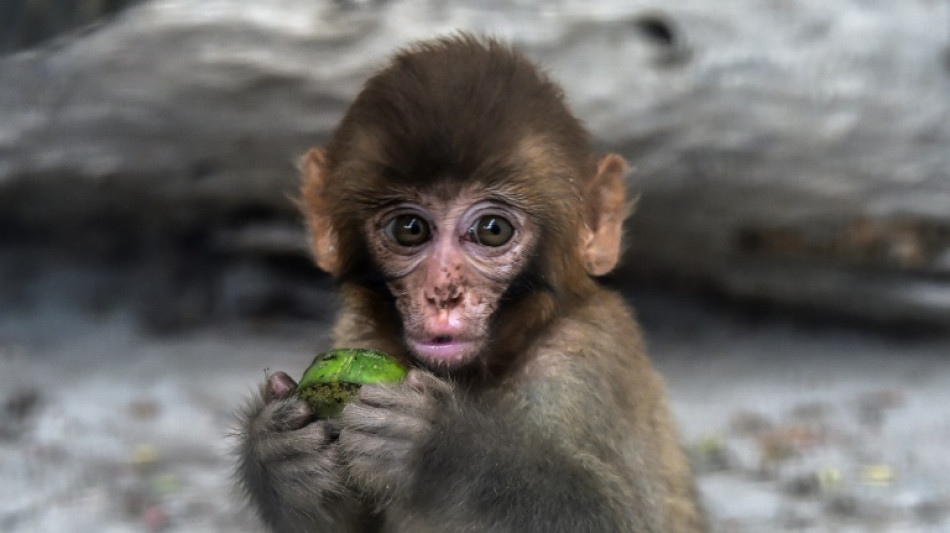
Not enough time in universe for monkeys to pen Shakespeare: study / Photo: Asif HASSAN - AFP

 All Blacks name veteran Taylor captain as Mo'unga seizes 10 jersey

 Race against time as Asian Games cricket quarter-finals washed out

 India turns to corals and seagrass to shield against rising seas

 Manchester City's Premier League charges: What comes next?

 Brazil's cellphone crime: a security nightmare in every pocket

 Russia pummels Kyiv in latest deadly attack

 NFL Giants obtain QB McCarthy from Vikings

 Deal for evicted Spanish pensioner as PM seeks new housing law

 Clippers apologize, warn fans of 'challenges' after Leonard scandal
 Turkish comedian convicted for Erdogan 'insult' freed pending appeal

 Trump announces 'biggest' US steel plant in battleground Iowa

 Olise wonder strike gives Zidane's France win in Belgium

 US stocks fall, bond yields rise as Middle East war drags on

 Trump denies offering to sell arms to China's Xi

 Wemby ready for NBA Spurs to move rivals in climb to top

 Ukraine to postpone some spending amid delays in aid: PM

 Tuchel says Czech Republic game 'not yet a must-win'

 MaXhosa puts South Africa on the Paris fashion map

 Rose, Scott among 2027 World Golf Hall of Fame finalists

 Brunson says NBA champion Knicks can't get satisfaction

 France puts out largest wildfire since 1949

 Real Madrid's Perez summoned over Barcelona referee payments comments

 Oil takes off again, Wall Street dips after Trump rejects Iran truce offer

 AlgoQuant Asset Management Selects Liquid Mercury to Enhance Digital Asset Trading Infrastructure

 UK to reopen refugee resettlement scheme to push 'safe' migration

If a monkey types randomly at a keyboard for long enough, it will eventually write the complete works of Shakespeare.
This thought experiment has long been used to express how an infinite amount of time makes something that is incredibly unlikely -- but still technically possible -- become probable.
But two Australian mathematicians have deemed the old adage misleading, working out that even if all the chimpanzees in the world were given the entire lifespan of the universe, they would "almost certainly" never pen the works of the bard.
The "infinite monkey theorem" has been around for more than a century, though its origin remains unclear. It is commonly attributed to either French mathematician Emile Borel or British anthropologist Thomas Huxley, and some even think the general idea dates back to Aristotle.
For a light-hearted but peer-reviewed study published earlier this week, the two mathematicians set out to determine what happens if generous yet finite limits were placed on the monkey typists.
Their calculations were based on a monkey spending around 30 years typing one key a second at a keyboard with 30 keys -- the letters of the English language plus some common punctuation.
The "heat death" of the universe was assumed to take place in around a googol of years -- that is a one followed by 100 zeroes.
Other more practical considerations -- such as what the monkeys would eat, or how they would survive the Sun engulfing Earth in a few billion years -- were set aside.
- Monkey labour falls short -
There was only around a five percent chance that a single monkey would randomly write the word "banana" in their lifetime, according to the study in the journal Franklin Open.
Shakespeare's canon includes 884,647 words -- none of them banana.
To broaden out the experiment, the mathematicians turned to chimpanzees, the closest relative of humans.
There are currently around 200,000 chimps on Earth, and the study presumed this population would remain stable until the end of time.
Even this massive monkey workforce fell very, very short.
"It's not even like one in a million," study co-author Stephen Woodcock of the University of Technology Sydney told New Scientist.
"If every atom in the universe was a universe in itself, it still wouldn't happen."
And even if many more chimps who typed much quicker were added to the equation, it was still not plausible "that monkey labour will ever be a viable tool for developing written works of anything beyond the trivial," the authors wrote in the study.
The study concluded by saying that Shakespeare himself may have inadvertently given an answer as to whether "monkey labour could meaningfully be a replacement for human endeavour as a source of scholarship or creativity".
"To quote Hamlet, Act 3, Scene 3, Line 87: 'No'."
J.AbuShaban--SF-PST