How harmful are microplastics to human health? / Photo: Ben Stansall - AFP/File

 All Blacks name veteran Taylor captain as Mo'unga seizes 10 jersey
 Race against time as Asian Games cricket quarter-finals washed out

 India turns to corals and seagrass to shield against rising seas

 Manchester City's Premier League charges: What comes next?

 Brazil's cellphone crime: a security nightmare in every pocket

 Russia pummels Kyiv in latest deadly attack

 NFL Giants obtain QB McCarthy from Vikings

 Deal for evicted Spanish pensioner as PM seeks new housing law

 Clippers apologize, warn fans of 'challenges' after Leonard scandal

 Turkish comedian convicted for Erdogan 'insult' freed pending appeal

 Trump announces 'biggest' US steel plant in battleground Iowa

 Olise wonder strike gives Zidane's France win in Belgium

 US stocks fall, bond yields rise as Middle East war drags on

 Trump denies offering to sell arms to China's Xi

 Wemby ready for NBA Spurs to move rivals in climb to top

 Ukraine to postpone some spending amid delays in aid: PM

 Tuchel says Czech Republic game 'not yet a must-win'

 MaXhosa puts South Africa on the Paris fashion map

 Rose, Scott among 2027 World Golf Hall of Fame finalists

 Brunson says NBA champion Knicks can't get satisfaction

 France puts out largest wildfire since 1949

 Real Madrid's Perez summoned over Barcelona referee payments comments

 Oil takes off again, Wall Street dips after Trump rejects Iran truce offer

 AlgoQuant Asset Management Selects Liquid Mercury to Enhance Digital Asset Trading Infrastructure

 UK to reopen refugee resettlement scheme to push 'safe' migration

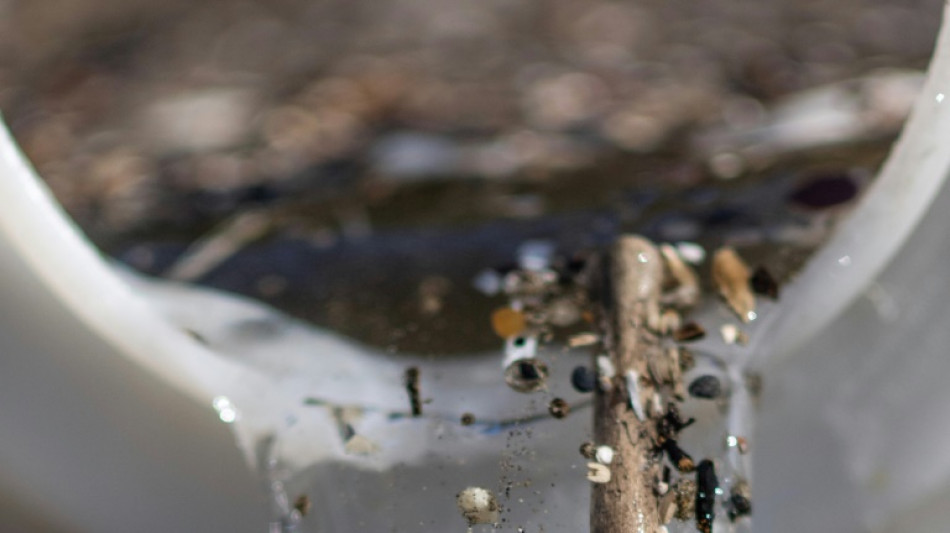
Microplastics have been found throughout the human body -- including inside lungs, blood and brains -- and while it is not yet clear how harmful they are to our health, some researchers are sounding the alarm.
These tiny pieces of plastic have been detected almost everywhere on Earth, from the deepest oceans to the highest mountains, as well as in the air, water, soil and food chain.
Every day humans ingest, inhale or otherwise come in contact with microplastics, which are less than five millimetres (0.2 inches) and mostly invisible to the naked eye.
"A human in 2024 has plastic in almost all the organs of their body," French specialist researcher Fabienne Lagarde recently told a hearing of France's parliament.
"And it will probably be even worse for the children born in 2040," she added.
Numerous studies have linked the presence of microplastics -- or nanoplastics which are 1,000 times smaller -- to a range of health problems.
In March, a study in the New England Journal of Medicine found an association between microplastics accumulating in people's blood vessels and an increased risk of heart attack, stroke or even early death.
- 'Red flag' -
"The body of research on microplastics is growing and it is already showing us that the health impacts are very concerning," said Tracey Woodruff, a researcher at the University of California, San Francisco.
Woodruff recently conducted a systematic review of 2,000 previous studies on animals, finding that microplastics "can harm fertility, are linked to increased cancer risk and can harm respiratory health," she told AFP.
It is a "red flag" that microplastics have been found in so many areas of the body "including the brain, testes and even crossing the placenta into the foetus," she added.
Many of the most worrying studies, such as the one from March, have been observational. This means they cannot prove microplastics are directly causing the health problems they have been linked to.
Others have been conducted in the lab, sometimes testing on animals, which some observers see as a limitation.
For the studies she reviewed, Woodruff said the biological systems of the animals were "quite similar to humans".
She added that "data from animals has been used to identify carcinogens and reproductive toxicants for decades."
Many things remain unknown about how microplastics could affect health, including the role played by their size, shape and composition.
Many plastics are a complex cocktail of polymers and chemicals, and there are fears they could smuggle in other contaminants in what is called the "Trojan Horse" effect.
- Plastic pollution treaty? -
Out of the more than 16,000 chemicals used or found in commercial plastic, more than a quarter are considered hazardous to human health, according to a group called the Scientists' Coalition for an Effective Plastics Treaty.
Linked health concerns include "infertility, obesity and non-communicable diseases including diabetes, cardiovascular disease and many cancers," the group said.
How damaging all this tiny plastic is to health also depends on how much humans are exposed to, which also remains unclear.
A report from the World Wildlife Fund made headlines in 2019 by estimating that people ingest around five grams of plastic a week, the equivalent of a credit card.
The methodology and results of the report have since been called into question, with numerous studies estimating lower levels of ingested plastic -- and showing that rates vary hugely across the world.
It is still early days for the field, with research into how microplastics impact health only beginning in the early 2000s.
"Despite the newness of the topic and the limitations that have been identified, the dangers linked to oral exposure and inhalation are there," Muriel Mercier-Bonin, a researcher at France's INRAE institute, told the French parliament.
And the problem is only growing. Plastic production has doubled in 20 years and at current rates could triple by 2060, according to the OECD.
The United Nations has agreed to work towards a world-first treaty to reduce plastic pollution, with negotiators meeting in a month for a final round of talks.
In the meantime, experts recommend people limit their exposure to microplastics by avoiding plastic bottles, not heating food in plastic containers, wearing clothes made of natural material and ventilating their home.
U.AlSharif--SF-PST