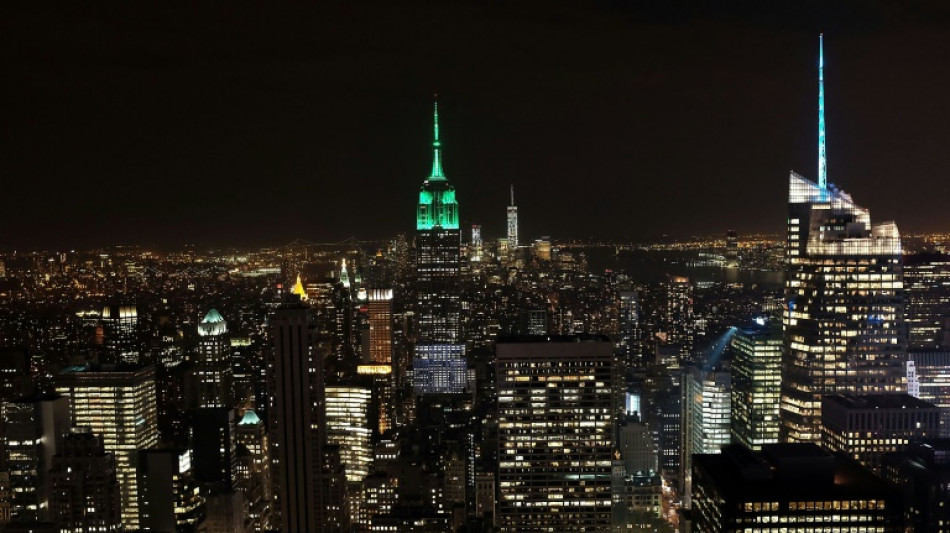
For climate activists, New York's lights shine too bright / Photo: SPENCER PLATT - GETTY IMAGES NORTH AMERICA/AFP/File

 All Blacks name veteran Taylor captain as Mo'unga seizes 10 jersey
 Race against time as Asian Games cricket quarter-finals washed out
 India turns to corals and seagrass to shield against rising seas

 Manchester City's Premier League charges: What comes next?
 Brazil's cellphone crime: a security nightmare in every pocket

 Russia pummels Kyiv in latest deadly attack
 NFL Giants obtain QB McCarthy from Vikings

 Deal for evicted Spanish pensioner as PM seeks new housing law

 Clippers apologize, warn fans of 'challenges' after Leonard scandal

 Turkish comedian convicted for Erdogan 'insult' freed pending appeal

 Trump announces 'biggest' US steel plant in battleground Iowa

 Olise wonder strike gives Zidane's France win in Belgium

 US stocks fall, bond yields rise as Middle East war drags on

 Trump denies offering to sell arms to China's Xi
 Wemby ready for NBA Spurs to move rivals in climb to top

 Ukraine to postpone some spending amid delays in aid: PM
 Tuchel says Czech Republic game 'not yet a must-win'

 MaXhosa puts South Africa on the Paris fashion map

 Rose, Scott among 2027 World Golf Hall of Fame finalists

 Brunson says NBA champion Knicks can't get satisfaction

 France puts out largest wildfire since 1949

 Real Madrid's Perez summoned over Barcelona referee payments comments
 Oil takes off again, Wall Street dips after Trump rejects Iran truce offer

 AlgoQuant Asset Management Selects Liquid Mercury to Enhance Digital Asset Trading Infrastructure

 UK to reopen refugee resettlement scheme to push 'safe' migration

New York's annual Climate Week is underway, bringing together activists, politicians and business leaders for hundreds of events aimed at addressing the planetary crisis.
But the bright lights that give the "city that never sleeps" its iconic glow have long been a source of frustration for campaigners, something at odds with the spirit of conservation embodied by the yearly summit, which takes place on the sidelines of the UN General Assembly.
"We have a long way to go until a brightly lit city is seen for what it is, which is just an egregious waste of energy -- and something that's having a direct impact on the natural world," Ruskin Hartley, director of the International Dark-Sky Association (IDA), told AFP.
According to US Department of Energy figures, outdoor lighting in the United States consumes enough energy annually to power 35 million homes. At any given time, only one percent of artificial light reaches human eyes, the department says.
City-wide energy estimates are hard to come by, but it's clear from satellite images that New York is among the worst offenders in the United States, which as a country is far more wasteful than Europe, according to studies.
As participants at Climate Week NYC -- now in its 15th year -- hold events on topics ranging from climate financing to lowering the carbon footprint of food systems, to the role of art in activism, reducing light pollution should be part of the discussion, said Hartley.
"People are looking for ways that we can make a meaningful difference in short order, given the magnitude of the crisis that is facing us. And one of the simplest things we can do is to look around and figure out where we can cut waste from the system," he argued.
Globally, the IDA estimates that outdoor lighting that escapes to space is responsible for one percent of annual greenhouse emissions.
- Birds, stargazing and human health affected -
It's not just an energy problem, either.
New York City lies along a bird migration pathway known as the Atlantic Flyway, with millions passing through every year, Dustin Partridge, director of conservation and science at the New York City Audubon, told AFP.
Artificial light draws the birds into the city. During the day, they crash into buildings because they see reflections of enticing vegetation in the glass and concrete jungle, while at night they fly into lighted windows.
"In New York, we have about a quarter million birds die each year with collisions," said Partridge, with Climate Week occurring in the middle of the fall migration.
The seeds these birds disperse are vital for the health of carbon-sequestering ecosystems all the way from Canada, where they began their journeys, to their destinations in South America.
"You can go outside in the evening in New York City and look out and see an easy solution to protecting biodiversity and helping fight against climate change," said Partridge.
That's to say nothing of the impact of light pollution on stargazing -- the reason the IDA was founded in the first place.
"The light that's been traveling millions of light years is being absorbed and hidden in the last nanosecond, and what a loss to society that is," said Hartley.
Other research has uncovered potential impacts on human health -- for example, increased incidents of certain cancers, which could be linked to disruptions of circadian rhythms. Artificial light also brings more mosquitoes, and the diseases they bring.
New York passed legislation in 2021 that required all city-owned buildings to turn off non-essential lights from 11:00 pm to 6:00 am during spring and fall migration.
But these account for a small fraction of all buildings, and a bill introduced this May that would extend similar rules to privately-owned and industrial buildings, remains pending.
Critics argue New York's nighttime skyline is an essential part of the city's identity -- a place of energy where people come to dream and achieve great things.
To this, the campaigners point to the examples of European cities that have begun flipping the switch when most are asleep -- including in Paris, the "City of Lights."
T.Samara--SF-PST