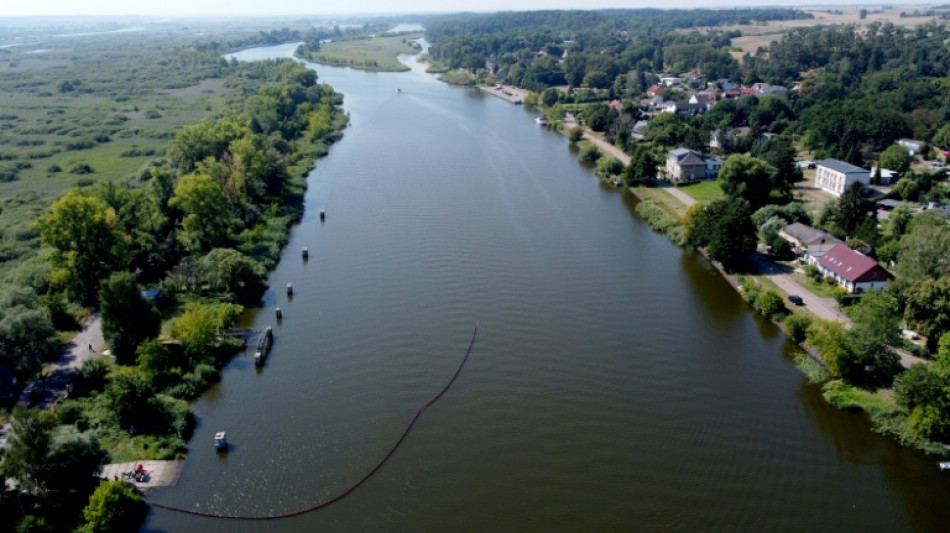
Greenpeace slams Poland's new river protection law / Photo: Marcin BIELECKI - AFP/File

 OpenAI cancels release of newest model due to safety concerns

 AI bosses head to White House as safety pressure builds

 Batista sacked as Costa Rica coach after six months

 Flooding, power cuts and evacuations as Hurricane Polo slams Mexico

 Dodgers eye three-peat, Red Sox face Yankees as MLB playoffs begin

 Certification of Boeing 737 MAX delayed by software bug

 Celine Dion wows Paris Fashion Week with surprise gig

 AMD buys firm founded by AI 'godmother' Fei-Fei Li

 Italy rebound in Turkey as France win late in Belgium

 Pope says concerns about AI 'should be taken seriously'

 Hurricanes to hoist title banner as NHL season begins

 Justice Alito steps aside from major US climate case

 Willis happy with England exile after retains Top 14 player award

 Spain housing protests keep heat on government as PM seeks new law

 Wissa spoils Zimbabwe homecoming as DR Congo win AFCON qualifier

 UK police release on bail five men held over airbase incident

 Ex-All Black Plummer 'sure' New Zealand will find Super Rugby solution

 Shein sees 1% revenue growth in first half of 2026

 Netherlands regrets Israel retaliation in settlements row

 Moscow seizes Russian assets of German food retailer Metro

 Bulgarian spirits inflamed by new rakia rules

 Documentary turns camera on architect Peter Zumthor

 UK police say releasing on bail five men held over airbase incident

 Trump admin finalizes reversal of US fuel economy standards

 US says no China arms sale plans after envoy cites Trump offer

Environmentalists on Friday slammed the passing of a controversial law in Poland on the revitalisation of the Oder river, which was hit by toxic algae growth last year that caused mass fish deaths.
A toxic algae bloom hit the river on the Polish border with Germany last summer, with at least 300 tonnes of dead fish pulled from the water as tensions spiked between the two countries.
In response to the environmental disaster, Warsaw passed a new law Thursday evening which includes provision for new water treatment plants, and is intended to put more stringent requirements on industrial sites.
But Greenpeace said the government had "ignored the voice of the public and scientists" in passing the law, in a statement on the social media site X, formerly known as Twitter.
They criticised what they said was a lack of consultation and said that the bill will "not protect the Oder" and will continue to be polluted.
The World Wildlife Fund (WWF) had previously criticised the bill for focusing on "further regulation of the Oder (and other rivers), which will further destroy the ecosystem and its ability to clean itself."
The law allows the building of new infrastructure including the modernisation of sewer systems and constructing new water treatment plants, estimated to cost some 9.5 billion zlotys ($2.3 billion).
The new law also forces large industrial sites, such as mines, to invest in systems to reduce saltwater discharges.
The toxic algae growth was sparked by the introduction of high levels of salt into the waters, according to the German environment ministry, which said that there was a "lack of available information" on the cause.
Poland also blamed toxic algae for the mass fish deaths, but said the disaster had most likely been caused by poor water quality as a result of high temperatures and very low water levels.
Polish and German authorities on either side of the river have said they are determined to stop future disasters happening, but have clashed over responsibility and the best way to keep the algae in check.
Q.Najjar--SF-PST