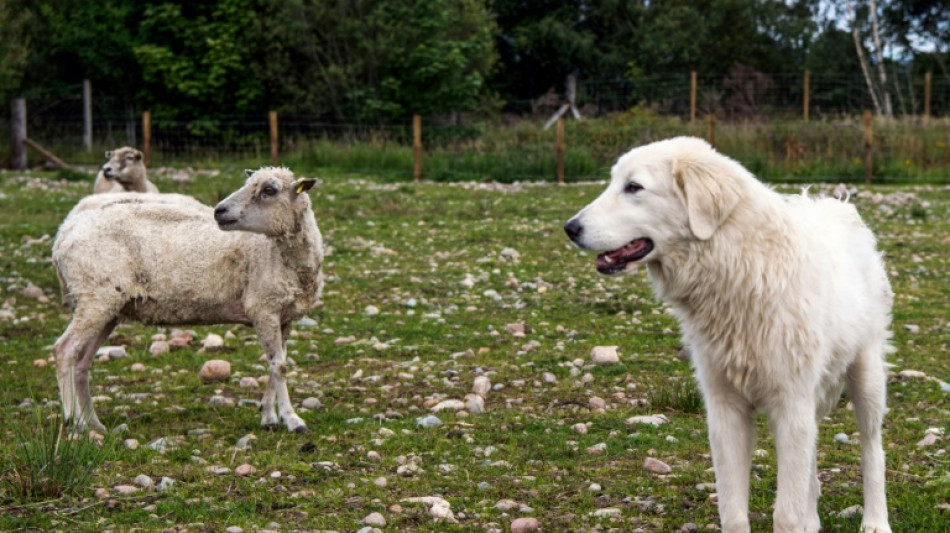
Scots train ancient dog breed to deter eagle attacks / Photo: Andy Buchanan - AFP

 Flooding, power cuts and evacuations as Hurricane Polo slams Mexico

 Dodgers eye three-peat, Red Sox face Yankees as MLB playoffs begin

 Certification of Boeing 737 MAX delayed by software bug

 Celine Dion wows Paris Fashion Week with surprise gig

 AMD buys firm founded by AI 'godmother' Fei-Fei Li

 Italy rebound in Turkey as France win late in Belgium

 Pope says concerns about AI 'should be taken seriously'

 Hurricanes to hoist title banner as NHL season begins

 Justice Alito steps aside from major US climate case

 Willis happy with England exile after retains Top 14 player award

 Spain housing protests keep heat on government as PM seeks new law

 Wissa spoils Zimbabwe homecoming as DR Congo win AFCON qualifier

 UK police release on bail five men held over airbase incident

 Ex-All Black Plummer 'sure' New Zealand will find Super Rugby solution

 Shein sees 1% revenue growth in first half of 2026
 Netherlands regrets Israel retaliation in settlements row

 Moscow seizes Russian assets of German food retailer Metro

 Bulgarian spirits inflamed by new rakia rules

 Documentary turns camera on architect Peter Zumthor

 UK police say releasing on bail five men held over airbase incident

 Trump admin finalizes reversal of US fuel economy standards

 US says no China arms sale plans after envoy cites Trump offer

 Dozens kidnapped in two weekend attacks in northern Nigeria

 Next stop the world: Pathirage wins Asian Games javelin gold

 Aster Launches Perpetual Grid Trading 2.0 with Up to 140,000 $ASTER Liquidity Mining Campaign

Dotted among a small flock of sheep in a field in the Scottish Highlands, Luigi and Peaches, two young working dogs with thick white coats, are busy being trained to keep watch on the skies above.
The pair, who descend from the Roman-era Maremma breed reared by shepherds to protect their livestock from wolves, are learning to guard against Scotland's resurgent sea eagles, formally known as white-tailed eagles.
Once driven to extinction across the British Isles, they have been successfully reintroduced in recent decades but are increasingly blamed for ravaging lambs left to roam the countryside.
The loss of the valuable livestock is sparking tensions with some farmers, devastated by the financial fallout and demanding the government issue licences to shoot the birds.
The worsening situation prompted Jonny and Daisy Ames to create the dog training programme at their falconry near Aviemore, in the hope it will allow farmers and eagles to better coexist.
"The last thing that we want is to see eagles being shot, for licences to be issued and to end up back at square one," Daisy Ames told AFP.
"There needs to be a solution that works for both sides."
Sea eagles were once a common sight across Scotland but were hunted to extinction throughout the 19th century, with the last bird shot in 1918.
A re-introduction programme in 1975 brought chicks from Norway to the island of Rum, one of Scotland's wildest places.
More were reintroduced in Wester Ross between 1993 and 1998 and on the east coast in 2007 and 2012.
- Drones and cheetahs -
The birds, an endangered species with only around 10,000 pairs across the globe, have since established a breeding population on Scotland's west coast and are now thriving -- but at a cost to some farmers.
Searching for a solution, Jonny Ames tapped into his experiences working with the Cheetah Conservation Project in Namibia, where Maremmas were trained to keep the big cats away from livestock.
To teach his latest canine recruits, he attaches a lure designed to resemble an eagle to a drone and hovers it over the dogs in a sheep field.
"The drone has a big eagle hanging on the bottom of it and it kind of dive bombs the dogs a little bit," he told AFP.
"If you can imagine an eagle in the wild, if it's coming in to a kill and there's a wolf there, it isn't going to land."
He and Daisy also allow a sea eagle kept at the falconry to feed from a carcass in front of the dogs in a controlled environment.
"They can't reach each other but we want to try and show the dogs that the eagle is a predator and if there is one near the lambs then you want to scare it off," Jonny explained.
One of the benefits of the dogs is that they are "completely soft" when it comes to humans, he noted.
"They don't make good guard dogs for people and the worst they are going to do is lick them to death."
- Devastating effect -
Jenny Love, a sheep farmer on Scotland's west coast, said the eagles have had a devastating effect, adding she frequently hears complaints from local farmers.
But she is sympathetic to Britain's biggest bird of prey, with a majestic wingspan stretching over two metres (six feet seven inches).
"Eagles are not the bad guys here," Love told AFP. "There is nothing else for these birds to eat, so they are eating lambs which are easy prey for them.
"But this is taking an enormous toll on farmers. Their livelihood is being taken away from them. The public perception is that farmers are the bad guys."
Farmers are eligible for a maximum annual payout of £5,000 ($6,383) for livestock killed, through the Sea Eagle Management Scheme.
However, the process is costly and arduous and only partially recoups the losses, according to Love, who argues compensation levels should be increased and application requirements simplified.
One farmer had lost £30,000 worth of lambs in a season, she said.
"I've had big tough guys breaking down in tears in front of me because they don't know what to do," she added.
Love is sceptical about the Maremmas, which she argues are trained to work in fields where the sheep are close together.
Thousands of dogs would be needed to guard sheep across the mountains, where nearly all the lambs are lost to the birds, Love lamented.
S.Abdullah--SF-PST