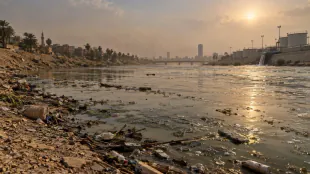
10 billion global population 'unsustainable': US climate envoy Kerry / Photo: Abrahan Teheran - AFP/File

 Trump denies offering to sell arms to China's Xi

 Wemby ready for NBA Spurs to move rivals in climb to top

 Ukraine to postpone some spending amid delays in aid: PM
 Tuchel says Czech Republic game 'not yet a must-win'

 MaXhosa puts South Africa on the Paris fashion map

 Rose, Scott among 2027 World Golf Hall of Fame finalists

 Brunson says NBA champion Knicks can't get satisfaction

 France puts out largest wildfire since 1949

 Real Madrid's Perez summoned over Barcelona referee payments comments

 Oil takes off again, Wall Street dips after Trump rejects Iran truce offer

 AlgoQuant Asset Management Selects Liquid Mercury to Enhance Digital Asset Trading Infrastructure
 UK to reopen refugee resettlement scheme to push 'safe' migration

 Pope urges Europe to help combat 'lies and deceit' in world affairs

 Iranian lawyer Nasrin Sotoudeh wins Council of Europe's rights prize

 French far-right's Bardella denies alleged 2013 antisemitic comments

 Oil up, Wall Street dips after Trump rejects Iran truce offer

 Gakpo withdraws from Netherlands squad

 SpaceX puts Starship megarocket in orbit for first time

 Iran denies link to suspected bomb plot at UK airbase used by US

 Ex-boss Mancini says City charges 'not my concern'

 Berlin Marathon winner Assefa finished race with torn Achilles

 Comedian convicted for Erdogan 'insult' but freed pending appeal

 French prosecutors seek two-year sentence for ex-minister Dati in graft case

 Eala makes fast start as weather and transport woes hit Asian Games

 Hurricane Polo approaches Mexico, threatens severe damage

US special climate envoy John Kerry told AFP that the world's population will not be tenable in 2050, when it is projected to hit nearly 10 billion, but refrained from asking Americans to give up steaks.
Since November, the global population has officially crossed eight billion, more than three times the figure in 1950.
This has already stretched food and energy needs and supplies. UN projections say the figure will balloon to 9.7 billion in the middle of the century.
"I don't think it's sustainable personally," he said in an interview on Tuesday.
"We need to figure out how we're going to deal with the issue of sustainability and the numbers of people we're trying to take care of on the planet."
Global warming is exacerbating the problem. The landmark 2015 Paris Agreement calls for capping global warming at "well below" two degrees Celsius and 1.5C if possible.
Producing food for eight billion mouths accounts for over a fourth of greenhouse gas emissions.
Cattle rearing for human consumption, food waste and deforestation further contribute to warming, which in turn is responsible for droughts, flooding and extreme weather conditions.
"I've been to a number of African countries where they're very proud of their increased birth rate but the fact is, it's unsustainable for life today, let alone when you add the future numbers," Kerry said.
"I'm not recommending the population go down," the 79-year-old added. "I think we have the life we have on the planet. And we have to respect life and we could do it in so many better ways than we're doing now."
Experts say Africa is one of the regions worst affected by climate change, with devastating droughts and flooding, although its citizens have had barely any impact on global warming compared to Western nations.
- Changing habits -
Avoiding air travel, consuming less meat and improving insulation of homes are all changes that can help protect the environment.
According to a report published by Norway's environment agency Friday, the country could reduce an equivalent of 4.5 million tonnes of carbon emissions between 2024-2030 if its population of 5.5 million followed nutrition guidance by health authorities.
That guidance would see the biggest meat eaters reduce their intake to under 500 grams of red meat per week.
But Kerry wasn't about to make an appeal for people to give up their hamburgers.
"I think that those choices are up to people on their own, what they want to do, how they want to do it," he said.
"What I would recommend is that we change our practices of how we feed livestock and what we feed them and how we use farming," he said referring to new technologies in farming that reduce the negative impacts to the environment.
The former secretary of state under Barack Obama, who lost the 2004 presidential election to George W. Bush, rejected the notion of prescribed, top-down changes to everyday life as a solution to the world's challenges.
"I don't think you have to ask for a sacrifice of lifestyle in order to accomplish what we need to do," Kerry said.
"I think you can have a better lifestyle, and you can eat better food and we can feed more people if we stop wasting as much food as we waste."
G.AbuHamad--SF-PST