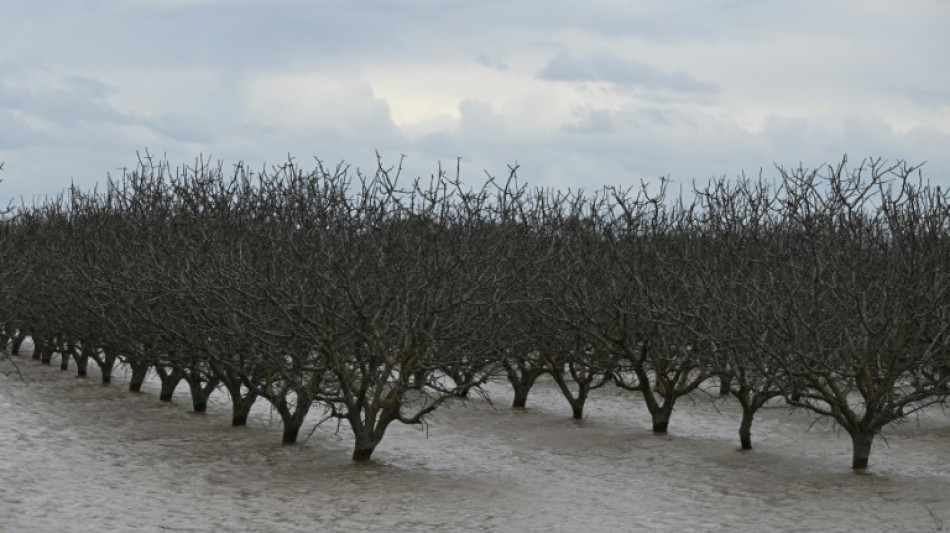
Ghost lake set to reappear as California hit again by rain / Photo: Patrick T. Fallon - AFP

 مصلحة مياه القدس توحّد جهودها مع بلديات الرام ومخماس لتعزيز استدامة المياه

 Saudi PIF Retains Top Sovereign Wealth Fund Brand Title for Third Year

 Binance Secures $6.5 Billion Asset-Freezing Order from Abu Dhabi Court

 Malta PM Abela Refuses Parliamentary Question on Maritime Borders Amid Turkey-Libya Deal

 محافظ طولكرم يدعو لمبادرة مجتمعية لخفض تكاليف الأعراس وتعزيز التكافل
A lake that dried up 80 years ago looked set on Tuesday to reappear, as monster rainfall accumulated over California's wet winter season overwhelms the state's rivers.
Even as spring appeared in the northern hemisphere, there was no let-up for America's most populous state, with forecasters predicting another 4 inches (10 centimeters) of rain and up to 4 feet (120 centimeters) of snow over the mountains.
"Another significant event... on top of everything that has come before is going to cause some major problems," meteorologist Daniel Swain said on Twitter.
In California's Central Valley, authorities issued evacuation orders for residents of communities in Tulare County, where a lake that dried up around World War II was set to reappear.
"Increasingly serious high water prospects in what is shaping up to possibly be a record Kings River runoff season have led the US Army Corps of Engineers (USACE) Sacramento District to announce plans to begin a rare flood release into old Tulare Lakebed," said a statement from the King's River Conservation District (KRCD).
"Releases growing to 1,500 cubic feet per second... will begin taking the flood flows to the former lakebed in Kings County.
"They are anticipated to continue indefinitely, USACE officials said, possibly lasting until sometime in the summer."
Tulare Lake was once the largest freshwater lake in the western United States, fed chiefly by snowmelt from the Sierra Nevada range.
But as the area was developed for agriculture and rivers were diverted for irrigation, the lake shrank, and by the middle of the 20th century, it had become farmland.
It has flooded periodically since, including in 1983 when record snowfall covered the mountains, with 2023 shaping up to rival those totals.
Calling it "the winter that just doesn't want to end," the National Weather Service (NWS) in Reno, on the eastern side of the Sierra, said Tuesday this year is the second snowiest season in 77 years.
The western United States has been pummeled by a train of atmospheric rivers -- moisture-laden ribbons that ferry water from the Pacific over land.
The region has been suffering from a decades-long drought, but so much rain and snow has fallen this winter that the once-parched soil is now saturated.
Each successive rain event brings the threat of flooding, with the ground unable to soak up any more water.
On Tuesday, the NWS issued flood warnings to parts of San Francisco and areas south of there, and urged people to be exceedingly careful when travelling.
"Water levels are extremely high on area rivers, creeks, and streams. Heavy rainfall below 4,000 feet could cause flooding or worsen ongoing flooding today into Wednesday night," the NWS in Hanford tweeted.
U.Shaheen--SF-PST



