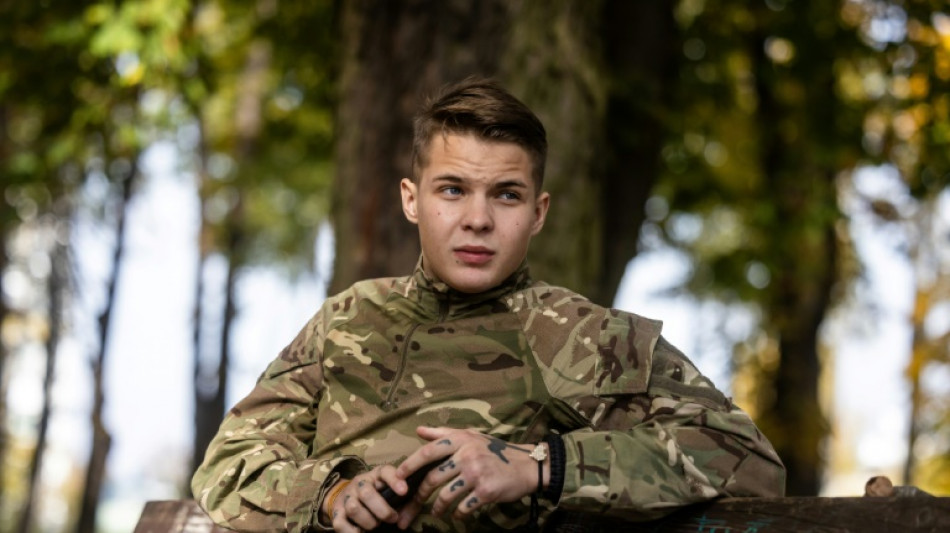
Teen fighter says no regrets despite Ukraine ordeal / Photo: Wojtek RADWANSKI - AFP

 El Nino’s Weakening Grip on Tamil Nadu Rainfall Hinges on Potential Cyclone

 South Africa Places 36 Hospitals on Standby for Possible Imported Ebola Cases

 Two A1 Crashes Create Kilometres of Rush-Hour Congestion

 Luxembourg City Plans €13 Million Abrigado Centre for 2029

 Luxembourg Housing Petition Passes Threshold for Parliamentary Consideration

 Raheem Sterling Receives Suspended Sentence After Lamborghini Crash

 Tamil Nadu Secures Rs 58,214 Crore in Investments at Vettri Conclave

 فرنسا تدعو لتجريم "الفصل العنصري القائم على الجنس" دولياً

 أزمة الصواريخ الاعتراضية في البنتاغون: استنزاف المخزونات يفرض تعبئة صناعية حتى 2030

 Huawei Found Guilty of Trade Secret Theft in Landmark US Case

 Indian Markets Set for Gain as Foreign Inflows Offset Tariff Fears
Belarusian teenager Gleb Gunko left the front line in Ukraine with shrapnel in his legs, constant nightmares and post-traumatic stress disorder -- but no regrets about volunteering to fight the Russians.
"I wanted to stay on but the doctor said no," the 18-year-old said. "I lost many friends there. My commander too."
The soft-spoken Minsk native is among many ordinary Belarusians who -- unlike their Kremlin-aligned leader -- chose to put their lives on the line to defend Ukraine.
"Before war I thought I was at peace with the fact that death is death and everyone dies eventually. But it was all too much," he told AFP in Grojec, Poland, where he is now living in exile.
When AFP first spoke to Gunko in early March, the day he left to go to war, he said he had volunteered in order to "fight for Ukraine but also to fight for Belarus.
"Because our freedom also depends on the situation there."
Gunko, whose knuckles are tattooed with the words "Born Free", left his homeland in 2020 after Belarusian President Alexander Lukashenko launched a ferocious crackdown on opponents.
The veteran leader, who has been in power for decades, has since drawn international condemnation for actively supporting and enabling Russia's invasion of Ukraine.
Even though he is opposed to the regime in Minsk, Gunko said he still feels responsible as a Belarusian citizen for what is happening.
- Guilt -
"I bear guilt for the fact that rockets are being fired on Kyiv from Belarus. I feel guilty about that," he said.
"I could have done more," he added of his four-month stint in Ukraine, which ended in July.
Gunko went to war through the Belarusian House Foundation in Warsaw, which helps Belarusian volunteers to go to Ukraine to fight.
"Belarusians cannot help Ukraine with weapons... but they cannot stand aside, so they are going to fight for (our) brotherly country's independence," the group said on Facebook.
After arriving in Ukraine, Gunko received two weeks of military training. He then fought alongside other international volunteers in Kyiv as well as in the trenches around Kherson.
He said he saw many dead civilians in Bucha, the Kyiv suburb where hundreds of bodies were discovered after the Russian army was driven out in March.
"We were driving in and I saw children at a bus stop... A child waves, smiles and I see that right alongside there's a person lying there with no head," Gunko said.
"That was hard," he added.
He recalled other traumatic moments, like being pinned down for hours under fire from the cannon of a Russian BMP-3 fighting vehicle, with shrapnel from one explosion still lodged in his limbs.
He also witnessed Russian troops pick off a volunteer British sniper outside Kherson, a comrade whose body he then helped carry.
Noticeably thinner and more subdued than when he left for war, Gunko recounted his experiences to AFP on a park bench in Grojec, the city just south of Warsaw where he has led a quiet life since returning in July.
"The military makes you a better person," said the teenager, who wore his combat fatigues for the interview. "I've changed, yeah. Everyone says so. I'm calm. I think a lot," he added.
"It's just like in war. I observe people, wait to see what happens. And I guess I expect it to be bad."
F.AbuShamala--SF-PST

