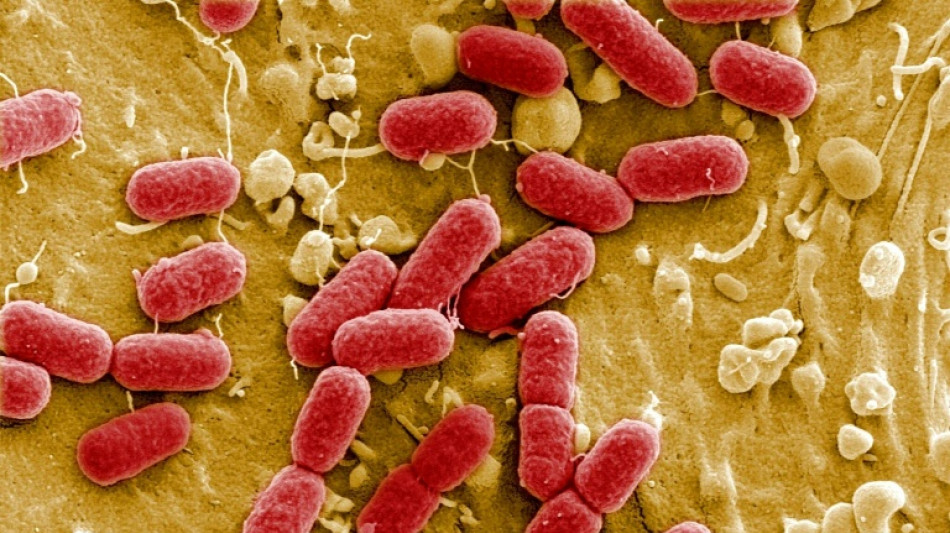
Drug-resistant superbugs projected to kill 39 million by 2050 / Photo: Manfred Rohde - Helmholtz-Zentrum für Infektions/AFP

 'Never again Bolsonaro': thousands march ahead of Brazil election runoff

 After botched execution, US woman was nearly taken off life support before revival

 Searing AIDS drama 'Elsinore' opens London film festival

 Evicted pensioner who sparked Spain housing protests dies: tenant union

 Golf star Rahm quitting LIV tour over 'unacceptable' terms

 Thousands march fearing return of a Bolsonaro presidency in Brazil

 French PM denies police ordered to confront student protesters

 Rubio touts US power, calls on Europe to emerge from 'slumber'

 Trump says 'we don't think' Russian plague is bio-weapon

 Five children among 26 killed in Ukraine after Russian strikes

 Man City should 'accept' punishment for rule breaches, says Lineker

 US woman who survived botched execution is awake and speaking

 From 1800s to modern pharma: a Nobel-winning chemistry quest

 Southampton boss Eckert given suspended ban over 'Spygate'

 Russia warns of 'false' information as second plague case reported

 IEA ready to release more oil reserves if necessary

 HSBC 'consults' over UK unit job cuts amid AI adoption

 UK court quashes five ex-traders' Libor rate rigging convictions
 XM Receives “Global Customer Experience Leader Award 2026” at the TrustFinance Performance Awards

 Stocks slide as oil climbs on Mideast flareup

 Heavy casualties in Ukraine after Russian strikes

 French wine harvest set to hit historic low

 Kyiv 'cannot agree' to EU membership limiting food exports: minister

 Arteta targets more Arsenal glory after signing new deal until 2030

 Russell hit with Singapore grid penalty for taking new power unit

Infections of drug-resistant superbugs are projected to kill nearly 40 million people over the next 25 years, a global analysis predicted on Monday, as the researchers called for action to avoid this grim scenario.
Superbugs -- strains of bacteria or pathogens that have become resistant to antibiotics, making them much harder to treat -- have been recognised as a rising threat to global health.
The analysis has been billed as the first research to track the global impact of superbugs over time, and estimate what could happen next.
More than a million people died from the superbugs -- also called antimicrobial resistance (AMR) -- a year across the world between 1990 and 2021, according to the study in The Lancet journal.
Deaths among children under five from superbugs actually fell by more than 50 percent over the last three decades, the study said, due to improving measures to prevent and control infections for infants.
However when children now catch superbugs, the infections are much harder to treat.
And deaths of over-70s have surged by more than 80 percent over the same period, as an ageing population became more vulnerable to infection.
Deaths from infections of MRSA, a type of staph bacteria that has become resistant to many antibiotics, doubled to 130,000 in 2021 from three decades earlier, the study said.
- 'This threat is growing' -
The researchers used modelling to estimate that -- based on current trends -- the number of direct deaths from AMR would rise by 67 percent to reach nearly two million a year by 2050.
It will also play a role in a further 8.2 million annual deaths, a jump of nearly 75 percent, according to the modelling.
Under this scenario, AMR will have directly killed 39 million people over the next quarter century, and contributed to a total of 169 million deaths, it added.
But less dire scenarios are also possible.
If the world works to improve care for severe infections and access to antimicrobial drugs, it could save the lives of 92 million people by 2050, the modelling suggested.
"These findings highlight that AMR has been a significant global health threat for decades and that this threat is growing," study co-author Mohsen Naghavi of the US-based Institute of Health Metrics said in a statement.
The researchers looked at 22 pathogens, 84 combinations of drugs and pathogens, and 11 infectious syndromes such as meningitis. The study involved data from 520 million individual records across 204 countries and territories.
It was released ahead of a high-level AMR meeting at the United Nations scheduled for September 26.
Antimicrobial resistance is a natural phenomenon, but the overuse and misuse of antibiotics in humans, animals and plants has made the problem worse.
B.Mahmoud--SF-PST