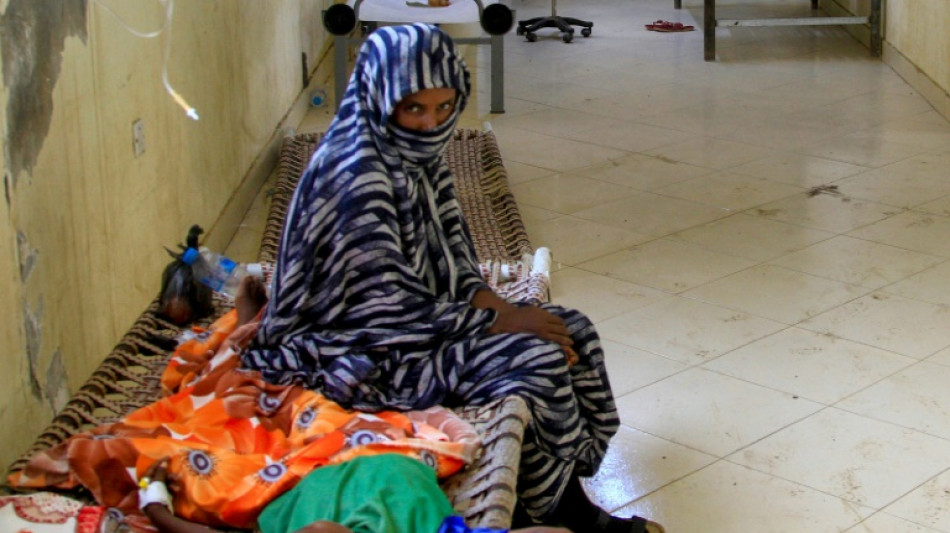
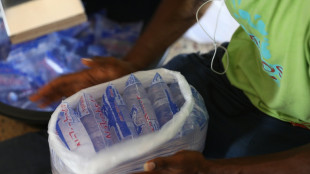
War-ravaged Sudan battles cholera epidemic / Photo: - - AFP

 EU trade chief seeks to dial down China tensions

 'Never again Bolsonaro': thousands march ahead of Brazil election runoff

 After botched execution, US woman was nearly taken off life support before revival
 Searing AIDS drama 'Elsinore' opens London film festival

 Evicted pensioner who sparked Spain housing protests dies: tenant union
 Golf star Rahm quitting LIV tour over 'unacceptable' terms

 Thousands march fearing return of a Bolsonaro presidency in Brazil
 French PM denies police ordered to confront student protesters

 Rubio touts US power, calls on Europe to emerge from 'slumber'

 Trump says 'we don't think' Russian plague is bio-weapon
 Five children among 26 killed in Ukraine after Russian strikes

 Man City should 'accept' punishment for rule breaches, says Lineker

 US woman who survived botched execution is awake and speaking
 From 1800s to modern pharma: a Nobel-winning chemistry quest

 Southampton boss Eckert given suspended ban over 'Spygate'

 Russia warns of 'false' information as second plague case reported
 IEA ready to release more oil reserves if necessary
 HSBC 'consults' over UK unit job cuts amid AI adoption

 UK court quashes five ex-traders' Libor rate rigging convictions
 XM Receives “Global Customer Experience Leader Award 2026” at the TrustFinance Performance Awards
 Stocks slide as oil climbs on Mideast flareup

 Heavy casualties in Ukraine after Russian strikes
 French wine harvest set to hit historic low

 Kyiv 'cannot agree' to EU membership limiting food exports: minister

 Arteta targets more Arsenal glory after signing new deal until 2030

Lying on a hospital bed, Aisha Mohammed said she is "suffering" from cholera symptoms, an increasingly common ailment in Sudan where a prolonged war has ravaged the healthcare system.
Cholera, caused by contaminated water or food, had been common in Sudan particularly during the rainy season even before war broke out in April 2023 between rival generals.
But more than 16 months of fighting have forced most hospitals out of service, leaving the country of 48 million people struggling to control the sometimes deadly but treatable disease.
In the southeastern Sudanese town of Wad al-Hulaywah, 40-year-old Mohammed receives intravenous medicine to ease her crippling symptoms.
"I'm suffering from acute diarrhoea," she whispered.
Sudanese authorities and the United Nations have reported a surge in cholera cases amid several weeks of torrential rains that have battered parts of Sudan and displaced thousands.
Rains and floods have contributed to a resurgence of the largely waterborne disease, which can cause severe dehydration and lead to death within hours if not treated.
The health ministry on Monday declared an epidemic, later reporting 556 cholera cases including 27 deaths, most in Kassala state where Wad al-Hulaywah is located.
Nearby Gedaref state has also been hit particularly hard, the ministry said.
The World Health Organization said Sudan has had at least 11,327 cholera cases, 316 of them deadly, since June 2023.
Sudan's Health Minister Haitham Ibrahim said "climatic conditions and water contamination" were behind the epidemic.
In Wad al-Hulaywah alone, "we've counted 150 cases so far, among them seven dead" since late July, local health official Adam Ali told AFP.
- 'Polluted water' -
Before the start of the war between Sudan's army and paramilitary forces, the UN had said that about 40 percent of Sudanese did not have access to clean water. Conditions have since worsened.
"Our problem is drinking water," said Ali.
Most residents of Wad al-Hulaywah "drink water directly from the river -- polluted water", he said.
During the rainy season, large amounts of silt are washed into the Setit river, which begins in neighbouring Ethiopia, increasing pollution levels, the health official added.
Near the local hospital, workers spray insecticide to fight the proliferation of flies, which Ali said was a symptom of poor sanitation.
Dam construction in 2015 on the Setit river had displaced "entire villages", he said, and their inhabitants "dug makeshift latrines, which attract flies because they are not maintained".
Access to clean water has been hampered across the country, in areas under either the army or the paramilitary Rapid Support Forces, both vying for control of Sudan.
- 'I will have no one' -
The paramilitaries have laid siege to entire areas, preventing the entry of fuel needed to pump clean water, while bureaucratic hurdles and fighting have blocked aid operations, putting key water stations out of service.
The war has killed tens of thousands of people, displaced more than 10 million and shuttered more than 70 percent of Sudan's healthcare facilities, according to the UN.
The rival forces have both been accused of war crimes, including targeting civilians and looting or obstructing humanitarian aid.
With Sudan facing what the UN has called "one of the worst humanitarian crises in recent memory" and aid groups unable to help, many feel they have to fend for themselves.
Sitting outside a hospital in Kassala, 49-year-old Hassan al-Junaid said he has been displaced by the war, and now "we are living in very bad conditions, which caused my sister to get cholera."
"I am the only one with her, but I can't go with her inside because she has been placed in quarantine," he said.
"So I'm staying here, worried for her and afraid that I might be infected myself," added Junaid.
"If that happens, I will have no one to buy me the medicine I would need."
Q.Bulbul--SF-PST