World on track to dangerous warming as emissions hit record high: UN / Photo: Narinder NANU - AFP

 Messi and Alcaraz love it, now padel takes step closer to Olympics

 Tolls mount in Thailand, Myanmar floods

 Why India's opposition wants top poll official out

 PU Prime Strengthens UAE Momentum with Strong Showing at Forex Expo Dubai 2026

 Eight dead in Thailand floods since mid-September

 Oil prices spike after Trump rejects Iran truce offer

 Taylor Swift sets new record at MTV VMAs

 Seoul seeks apology after Ukraine reveals transfer of North Korean POWs

 Messi on target again but Miami downed by Columbus

 In Washington's political cauldron, a fight over foie gras
 Flavio Bolsonaro: political heir in his father's shadow

 Ravens grab last-second win in Rio as Commanders stop Seahawks

 USA rallies to capture 11th consecutive Presidents Cup

 Phillies clinch, Astros wrap up division on final day of MLB season

 Commanders hand champion Seahawks their first loss

 Dupont scores twice to send Toulouse top of Top 14

 Ireland beat Israel but no handshakes due to war in Gaza

 Tense standoff over flashpoint N.Ireland parade lasts into night

 Stunned McNulty wins 'miracle' road race world title

 Re-released 'Avengers: Endgame' snaps-up N. America box office lead

 American McNulty wins shock road race world title
 Serbia's President Aleksandar Vucic announces resignation
 Tuchel urges Bellingham to play with 'rage'

 Russian strikes on Ukraine kill 8

 Bavuma, Miller hit centuries as South Africa clinch series

National commitments to slash heat-trapping pollution would limit global warming up to 2.5C this century -- nowhere near enough to avoid devastating climate impacts despite a sweep of new pledges, the UN warned Tuesday.
Scientists are in broad agreement that warming above 1.5C relative to pre-industrial times risks catastrophic consequences, and every effort must be made to stick as close as possible to this safer threshold.
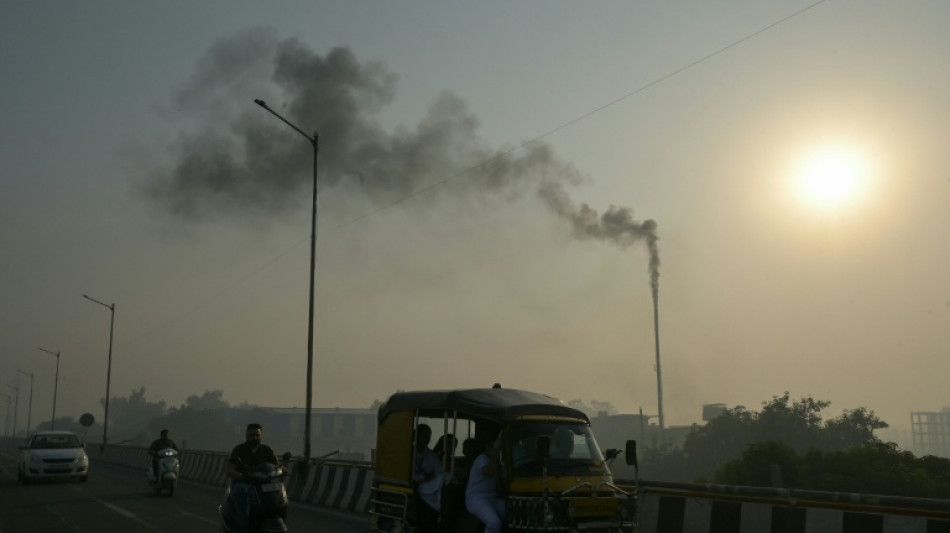
But the world is set to blow past 1.5C in a matter of years and planet-warming emissions keep rising, hitting a new record high in 2024, according to a report by the UN Environment Programme (UNEP).
The sobering assessment was published just days before world leaders gather in Brazil on Thursday and Friday ahead of the COP30 climate summit in the rainforest city of Belem.
With an overshoot of 1.5C now inevitable, focus has shifted to how quickly temperatures can be returned to less-risky levels.
"Our mission is simple, but not easy: make any overshoot as small and as short as possible," UN Secretary-General Antonio Guterres said Tuesday at the launch of UNEP's Emissions Gap report.
Big polluters most responsible for the crisis have been urged to pledge faster and deeper emissions cuts to bend the curve back to 1.5C by the end of the century.
Instead, the latest round of carbon-cutting targets announced ahead of the UN climate talks "have barely moved the needle", concluded UNEP's latest assessment.
"Ambition and action are nowhere near the levels needed globally or collectively," Anne Olhoff, the report's chief scientific editor, told AFP.
- 'Bleak picture' -
The latest assessment projects that the world's collective commitments to tackle climate change, if enacted in full, would result in 2.3C to 2.5C of warming by 2100.
That poses an unacceptable threat to the survival of nations most at risk by rising seas and extreme weather, and the global failure to rise to this challenge will loom over COP30.
Scientists have strong evidence that warming above 1.5C -- let alone a degree or more -- increases not only the intensity of hurricanes, floods and other disasters, but the likelihood of catastrophic climate tipping points.
At 1.4C above pre-industrial times, the Earth is already too warm for most tropical coral reefs to survive, while ice sheets and the Amazon rainforest could suffer severe and lasting changes below 2C, with consequences for the entire planet.
Under the Paris Agreement, each round of climate pledges is supposed to be more ambitious than the last to keep long-term warming "well below" 2C and as close as possible to 1.5C.
Despite being obligated to do so, only around one-third of countries announced a 2035 emissions reduction target by September 30, UNEP said.
This year's warming projections are 0.3C lower than last year, but Olhoff said little of that reduction was thanks to these latest pledges.
Updates to methodology accounted for 0.1C while another 0.1C was attributed to US commitments made under the Biden administration.
These gains are unlikely to materialise as President Donald Trump has vowed to pull the United States out of the Paris accord and ditch the climate policies of his predecessor.
"If we don't include the US, then the progress is quite limited," Olhoff said.
The dozens of other climate pledges made by governments in recent months "do not have a large effect on the temperature projections", she added.
"That is a very bleak picture, you can say."
- Record emissions -
Global emissions grew 2.3 percent in 2024 compared to the previous year, an increase driven by India followed by China, Russia and Indonesia.
This rise was quite high in the context of recent years "and comparable to the emissions growth in the 2000s", the report said.
Wealthy and powerful G20 economies accounted for three-quarters of global emissions and of the six largest polluters, the EU was the only one to cut greenhouse gases in 2024.
As they come under pressure to set new and ever-more ambitious targets, UNEP said most nations were not even on track to meet their earlier 2030 goals.
Based on just the current policies in place, Earth is expected to be 2.8C hotter in 2100.
COP30 will seek to allay fears that climate action is on the back burner as the United States shuns the process, collective targets are missed and governments prioritise other concerns.
"We still need unprecedented cuts to greenhouse gas emissions, in an ever-compressing timeframe, amid a challenging geopolitical context," wrote UNEP chief Inger Andersen in the report.
Z.AbuSaud--SF-PST