Inter-American court hears first abortion rights case / Photo: Randall CAMPOS - AFP

 Morikawa says LIV players face 'business decision' after Rahm exit
 Tenzing Norgay's son says Himalayas sending climate warning

 On your bike! Bottas opts for two wheels to reach Singapore GP

 Alcaraz, Sinner, Osaka commit to Australian Open '1 Point Slam'

 Dodgers beat Braves to advance in MLB playoffs, Rays oust Yankees

 'A sun as black as my lungs': how corruption crucified a polluted Albania city

 The British historian helping the French rediscover de Gaulle

 Dodgers beat Braves to advance, Guardians survive in MLB playoffs

 Latin American, Caribbean women top Nobel literature buzz
 US says Fiji-based Chinese official paid bribes for Beijing

 After botched US execution, Christa Pike was nearly taken off life support

 Guinea-Bissau junta urges military unit loyal to ex-president to disarm

 As species decline, green turtles offer glimmer of hope

 Brothers Scott and Beauden Barrett named to start for All Blacks

 EU trade chief seeks to dial down China tensions

 'Never again Bolsonaro': thousands march ahead of Brazil election runoff

 After botched execution, US woman was nearly taken off life support before revival
 Searing AIDS drama 'Elsinore' opens London film festival

 Evicted pensioner who sparked Spain housing protests dies: tenant union

 Golf star Rahm quitting LIV tour over 'unacceptable' terms

 Thousands march fearing return of a Bolsonaro presidency in Brazil

 French PM denies police ordered to confront student protesters

 Rubio touts US power, calls on Europe to emerge from 'slumber'

 Trump says 'we don't think' Russian plague is bio-weapon
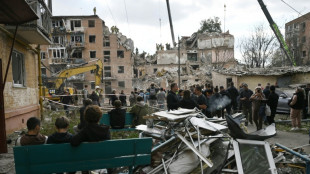 Five children among 26 killed in Ukraine after Russian strikes

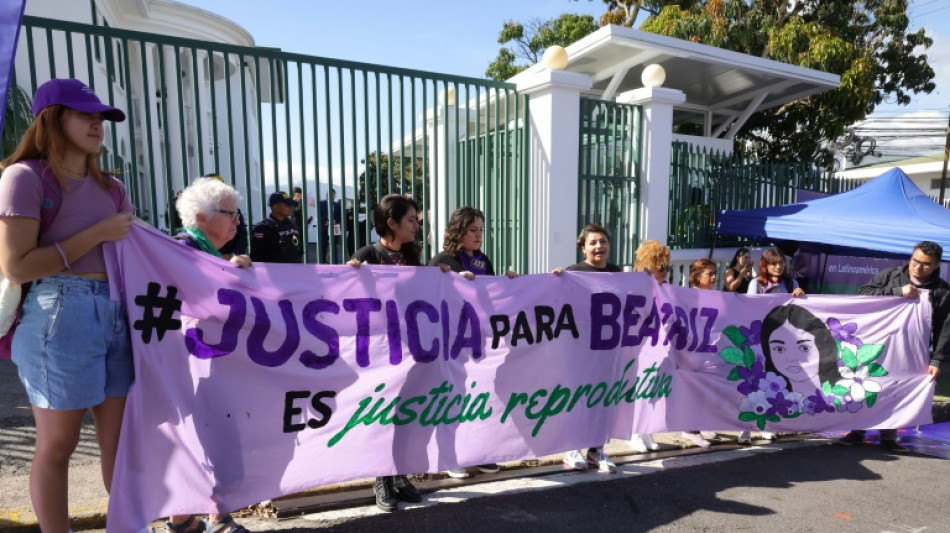
Women gathered outside the Inter-American Court of Human Rights (IACHR) in Costa Rica Wednesday, calling for "justice" as lawyers presented the tribunal's first-ever abortion rights case.
A woman identified only as "Beatriz" is symbolically squaring off against the Central American country of El Salvador which enforces an absolute ban on the procedure.
The country will be in the dock before the IACHR for alleged human rights violations and "torture" after Beatriz was forced to carry a non-viable fetus for nearly three months despite a risk to her health.
Women had been gathered outside the court building in San Jose since dawn to follow the hearing live on a big screen sporting purple accessories -- the symbolic color of the fight for gender equality.
They waved banners stating: "This fight is for Beatriz and for everyone," and asserting the case could "change the future of women in Latin America."
Across the street, about two dozen anti-abortion protesters also gathered, praying silently.
The case comes as some Latin American countries are taking cautious steps towards easing abortion restrictions even as the United States -- which has signed but not ratified the IACHR founding convention -- is rowing back on access to the procedure.
"The fact that the Court has agreed to hear this case strongly indicates... that the denial of any health service, including those that are controversial such as abortion, is a human rights violation," said Maria Antonieta Alcalde of the Ipas reproductive rights NGO, which is among the plaintiffs.
Beatriz, who died in a traffic accident in 2017 after the case was filed, is taking El Salvador to task for denying her an abortion despite doctors knowing she was carrying a non-viable fetus at great risk to herself.
Her mother, who cannot be named to maintain Beatriz's anonymity, said outside the court that "doctors told her that she could not see her pregnancy through," yet they could not help her end it.
- 'A form of torture' -
In El Salvador, abortion has been prohibited since 1998 under penalty of jail time of up to eight years.
Courts frequently find women guilty of the crime of aggravated homicide instead, imposing sentences that can go up to 50 years.
Beatriz suffered from an auto-immune disease when she fell pregnant for the second time in 2013 at age 20, after already going through a previous complicated birth.
The fetus was found to be unviable due to a severe developmental defect, and according to court documents, Beatriz was told she could die if the pregnancy progressed.
She sought legal recourse to be allowed to get an abortion, but saw her case thrown out by the country's Constitutional Court.
She went into premature labor and the fetus died.
Gisela de Leon of the Center for Justice and International Law (Cejil), a rights NGO also among the plaintiffs, said the state had "violated (Beatriz's) rights to life and personal integrity" by forcing her to carry the fetus for 81 days knowing it could not survive.
"We are claiming that the suffering to which she was subjected, knowing that her right to life was at risk, is a form of torture," said De Leon.
Beatriz's family decided to pursue the case after her death so that "no other woman will go through what she went through," according to her brother Humberto, 30.
He said his sister was a victim of a poor, marginalized upbringing which causes "such situations happening to women because they do not have access to a system that guarantees reproductive health."
In Latin America, elective abortion is legal in Argentina, Colombia, Cuba, Uruguay, and some states in Mexico.
In several countries it is allowed in certain circumstances, such as rape or health risks, while outright bans apply also in Honduras, Nicaragua, Haiti and the Dominican Republic.
Several states in the United States have banned or curtailed abortion access since a Supreme Court ruling last June overturned the landmark Roe v. Wade decision that had long protected abortion rights.
The IACHR will hear testimony from relatives of Beatriz and doctors who treated her.
The case will be heard over two days, with judgment expected in about six months.
X.AbuJaber--SF-PST