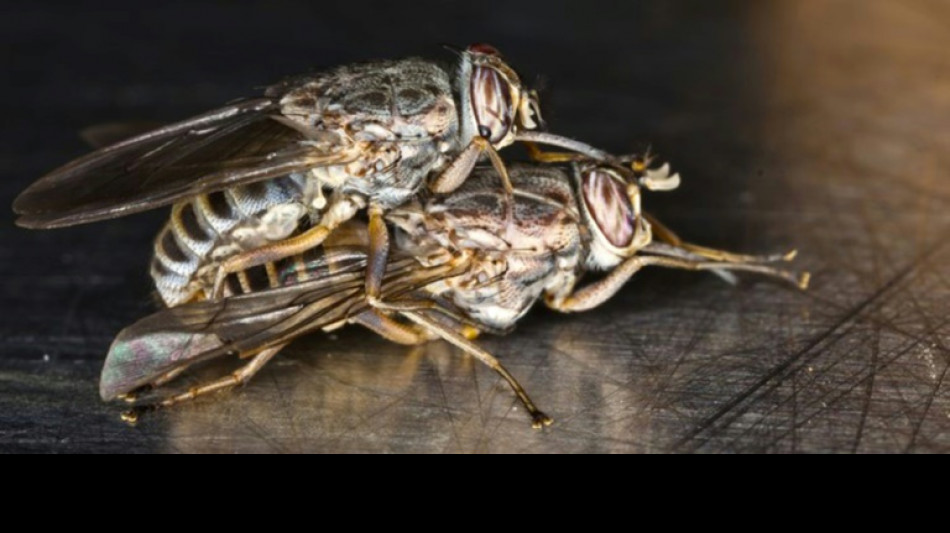
Discovery of tsetse fly mating behavior may help curb sleeping sickness / Photo: Geoffrey Attardo - EUREKALERT!/AFP

 Dodgers beat Braves to advance in MLB playoffs, Rays oust Yankees

 'A sun as black as my lungs': how corruption crucified a polluted Albania city

 The British historian helping the French rediscover de Gaulle

 Dodgers beat Braves to advance, Guardians survive in MLB playoffs

 Latin American, Caribbean women top Nobel literature buzz

 US says Fiji-based Chinese official paid bribes for Beijing

 After botched US execution, Christa Pike was nearly taken off life support

 Guinea-Bissau junta urges military unit loyal to ex-president to disarm

 As species decline, green turtles offer glimmer of hope

 Brothers Scott and Beauden Barrett named to start for All Blacks

 EU trade chief seeks to dial down China tensions

 'Never again Bolsonaro': thousands march ahead of Brazil election runoff

 After botched execution, US woman was nearly taken off life support before revival

 Searing AIDS drama 'Elsinore' opens London film festival

 Evicted pensioner who sparked Spain housing protests dies: tenant union

 Golf star Rahm quitting LIV tour over 'unacceptable' terms

 Thousands march fearing return of a Bolsonaro presidency in Brazil

 French PM denies police ordered to confront student protesters

 Rubio touts US power, calls on Europe to emerge from 'slumber'

 Trump says 'we don't think' Russian plague is bio-weapon

 Five children among 26 killed in Ukraine after Russian strikes
 Man City should 'accept' punishment for rule breaches, says Lineker

 US woman who survived botched execution is awake and speaking

 From 1800s to modern pharma: a Nobel-winning chemistry quest

 Southampton boss Eckert given suspended ban over 'Spygate'

Researchers have identified chemicals in tsetse flies that control their mating behavior, a discovery that may well aid the fight against the disease-causing insects in sub-Saharan Africa.
"It could be used in traps to make them more effective in trapping tsetse flies," said John Carlson, a biology professor at Yale University and one of the authors of a study published Thursday in the journal Science.
Trypanosomiasis, also known as sleeping sickness, is caused by parasites transmitted by the tsetse fly. It affects humans and domestic animals.
The disease threatens millions of people in dozens of countries in sub-Saharan Africa.
Animal trypanosomiasis, known as Nagana, kills some three million cattle each year, an annual cost of $1.2 billion, according to a companion article in Science.
It is considered a major cause of rural poverty and the authors warned that the geographic range of the tsetse fly is expected to grow as a result of climate change.
For the study, the researchers focused on pheromones, chemical compounds an animal releases that affect the behavior of others of the same species.
Pheromones allow insects to identify each other in an environment where there are potentially thousands of other species.
The Yale researchers identified volatile sex pheromones that had not previously been isolated in tsetse flies despite more than a century of study.
Pheromones are currently used to control a wide variety of other insect pests such as moths.
Pantry moths, for example, can be caught using sticky traps baited with a plastic disc soaked with an attractive pheromone.
- 'The flies stop moving' -
For the study, the researchers soaked tsetse flies in liquid and then used a gas chromatograph-mass spectrometer to identify specific chemicals.
One of them, methyl palmitoleate (MPO), acted as an aphrodisiac, attracting male tsetse flies.
In tests, male tsetse flies were attracted to decoys -- knots in yarn doused with MPO -- and, unusually, to females of another tsetse fly species.
Olfactory neurons on the antennae of the flies were found to increase their firing rates in response to MPO.
"Not only is MPO an attractant, but it causes tsetse flies to freeze -- the flies stop moving," Carlson said.
Current traps for tsetse flies use animal odors but MPO tends to last longer and could "enhance the effectiveness of traps," he said.
Carlson said field tests using MPO were getting underway in Kenya.
The type of pheromone identified in the study may not be effective against all types of tsetse flies, however.
The study focused on the species Glossina morsitans, a major vector of the disease in cattle, not on Glossina fuscipes, which causes the most human cases of the disease.
But Carlson said he was optimistic that the research methods used could lead to identifying pheromones from other tsetse species.
K.Hassan--SF-PST