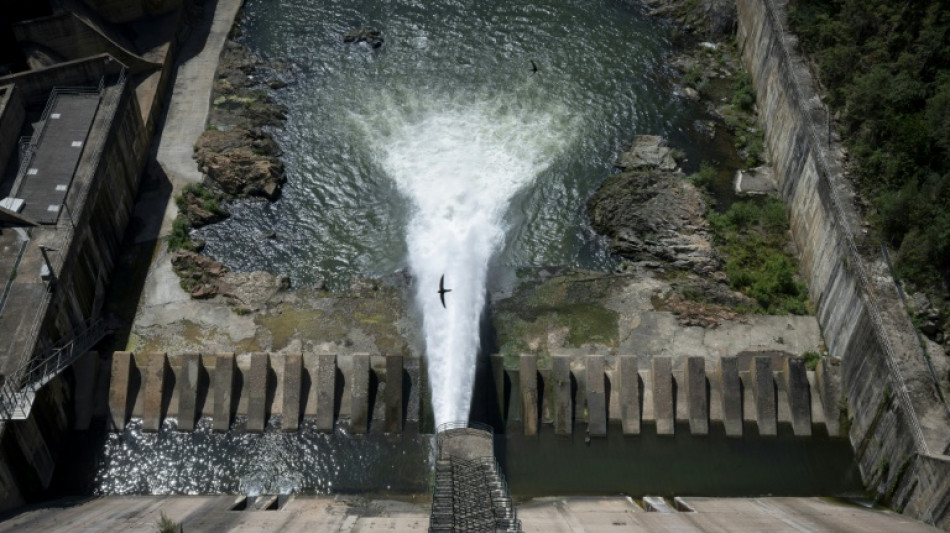
Dams, housing, pensions: Franco disinformation flourishes online / Photo: Josep LAGO - AFP

 Netanyahu orders West Bank closure as attack wounds Israelis before election
 Asian stocks mixed ahead of weekend as tech recovers early losses

 How five Boeing 777s linked Madagascar's power elite to Iran
 South Korea proposes holding border talks with North
 Ukraine's young figure skaters twizzle on despite Russian threat

 Asian football endorses Infantino re-election as FIFA president
 Complete Kane hopes for 'special night' as Ballon d'Or rumours swirl

 Rooney calls United squad 'selfish babies' after Fernandes criticism

 Teddy Wilson, son of World Cup-winner David, gets Wallabies call-up

 New Zealand military chief resigns over 'inappropriate relationship'

 Man Utd's Carrick on borrowed time, free-scoring Brighton face Liverpool
 Asian stocks head into weekend on a low as tech extends losses

 'Generational rage': Young Europeans fight to be heard

 Lula, Bolsonaro to clash once more before Brazil vote
 Dressed to kill: Haircuts cap menacing look of Japan's yakuza

 Napa Valley's wineries feel Trump's tariff squeeze
 Venezuela protests demand return of Nobel winning leader Machado

 Marquez tops incident-packed opening practice for Australian MotoGP

 New York votes to ban Central Park horse carriages after decades of debate

 Australia face selection headaches after 'shambolic' South Africa defeat

 Around 150,000 rally in Belgrade as Serbia heads to pivotal poll

 Hamilton sets sights on racing in African grand prix
 Bournemouth hammer 10-man Milan, Juventus denied at the death
 Judge orders Trump to give deposition in BBC lawsuit by Dec 11
 'Fake' pollsters hit US midterms

Half a century after the death of Francisco Franco, disinformation on social media has credited the Spanish dictator with social achievements that present his iron-fisted rule in a nostalgic light.
Experts warn that misleading comparisons and inaccuracies in viral messages can beguile citizens with minimal understanding of the 1939-1975 period.
"There is little knowledge of our history," lamented Jordi Rodriguez Virgili, professor in political communication at the University of Navarre.
That ignorance, applied to a "very emotional, divisive and polarising" subject such as Franco, cultivates a breeding ground for disinformation, he added.
AFP uncovers the reality of the general's supposed feats that have fuelled the popularity of the phrase "Life was better under Franco".
- Reservoirs and dams -
Many Spaniards attribute the construction of water infrastructure almost exclusively to the dictator.
This information "spreads easily because it is a collective myth about which there is huge ignorance", said Rodriguez Virgili.
"There is some truth to it -- for disinformation that is important. He did not build all the dams," the expert said.
A General Plan for Irrigation Canals and Reservoirs already existed in the early 20th century, while another dictator, Miguel Primo de Rivera (1923-1930), created water management bodies that still exist today.
Franco also maintained or resumed projects by the short-lived Second Republic that he overthrew in a 1936-1939 civil war that killed hundreds of thousands of people.
And history lecturer Matilde Eiroa San Francisco said the creation of some dams and reservoirs during the dictatorship flooded many villages and depended heavily on the labour of political prisoners.
- Social security -
Social media users have posted portraits of Franco with the claim that "Spain established a solid social security system in 1942, guaranteeing workers access to healthcare and pensions."
But not all worker rights, associated with modern social protection models, were bestowed by the dictatorship.
The first incarnations of social protection in Spain date to a 1900 law, said Daniel Perez del Prado, secretary general of the Spanish Association of Labour Law and Social Security.
A string of benefits predated Franco: a 1919 pension scheme, an obligatory maternity cover in 1923 and an unemployment payment introduced in 1931.
Different professions progressively created specific protection schemes for their workers.
Under Franco, all the previous existing measures were grouped together under the name "Social Security" in 1963.
Paid holidays were also granted well before the regime, the Second Republic having already established seven days of paid leave per year for workers in 1931.
It was only in 1976 -- after Franco's death -- that Spaniards won the right to 21 days of annual paid leave.
- Housing -
Scarce and unaffordable housing has been a hot topic in Spain for years -- leading some to compare today's crisis with the allegedly more favourable situation under Franco.
One message circulating on social media claimed Franco built four million homes benefiting from government support and that current Prime Minister Pedro Sanchez's leftist governments had achieved none.
Alfonso Fernandez Carbajal, a professor in applied economics at the University of Oviedo, said housing aid under Franco went to all types of homes "without demanding that your income did not exceed a certain threshold", unlike today's schemes.
Fernandez Carbajal wrote an article that found that 3.4 million homes benefiting from government support were built between 1943 and 1975. Of them, 735,400 -- less than 22 percent -- went to those on low incomes.
Under the governments led by Sanchez, in power since 2018, 66,723 homes have been classified as "protected" up to the first quarter of 2025, according to official data. Protected, in this context, means a government-subsidised home that has price controls for rental or sale.
But Fernandez Carbajal warned against comparing the policies of two radically different political systems: dictatorship and democracy.
And responsibility for housing policy also depends to a significant extent on regional governments in modern Spain's decentralised political system -- the opposite of Franco's iron grip on the country.
S.Abdullah--SF-PST