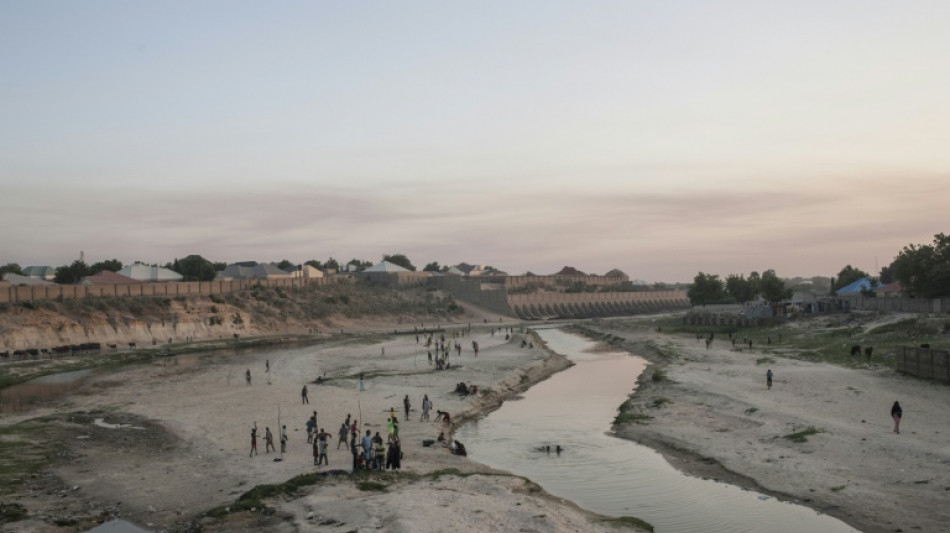
Home in Nigeria, ex-refugees find themselves in a war zone / Photo: STEFAN HEUNIS - AFP/File

 Netanyahu orders West Bank closure as attack wounds Israelis before election

 Asian stocks mixed ahead of weekend as tech recovers early losses
 How five Boeing 777s linked Madagascar's power elite to Iran

 South Korea proposes holding border talks with North
 Ukraine's young figure skaters twizzle on despite Russian threat

 Asian football endorses Infantino re-election as FIFA president

 Complete Kane hopes for 'special night' as Ballon d'Or rumours swirl

 Rooney calls United squad 'selfish babies' after Fernandes criticism

 Teddy Wilson, son of World Cup-winner David, gets Wallabies call-up

 New Zealand military chief resigns over 'inappropriate relationship'

 Man Utd's Carrick on borrowed time, free-scoring Brighton face Liverpool
 Asian stocks head into weekend on a low as tech extends losses

 'Generational rage': Young Europeans fight to be heard

 Lula, Bolsonaro to clash once more before Brazil vote
 Dressed to kill: Haircuts cap menacing look of Japan's yakuza
 Napa Valley's wineries feel Trump's tariff squeeze

 Venezuela protests demand return of Nobel winning leader Machado
 Marquez tops incident-packed opening practice for Australian MotoGP

 New York votes to ban Central Park horse carriages after decades of debate

 Australia face selection headaches after 'shambolic' South Africa defeat

 Around 150,000 rally in Belgrade as Serbia heads to pivotal poll

 Hamilton sets sights on racing in African grand prix
 Bournemouth hammer 10-man Milan, Juventus denied at the death

 Judge orders Trump to give deposition in BBC lawsuit by Dec 11

 'Fake' pollsters hit US midterms

Abdulhamid Mohammed fled his home in northeast Nigeria in 2015, chased into neighbouring Chad by jihadists who torched homes and shot civilians in his lakeside village.
A decade later, little has changed in the fishing community of Doron Baga -- though that didn't stop the government from trying to send him back there earlier this year.
As jihadist violence has ticked down from its peak a decade ago, Nigeria has closed down most displacement camps on its own soil and repatriated refugees living abroad, in an effort to repopulate the countryside and restore "dignity" for people driven from their homes.
A deal struck in February between Nigeria, Chad and the UN refugee agency, UNHCR, saw nearly 8,000 refugees return voluntarily to Nigeria.
But many like Mohammed are considering returning to life as a refugee.
The 40-year-old fisherman came home only to find parts of Lake Chad were still under jihadist control.
"You can't go there," he told AFP in Maiduguri, the Borno state capital, where he is now living. "I have the intention to go back to Chad, because in Chad... I can continue catching fish."
In May, an attack a village just 10 kilometres (6 miles) away from Doron Baga, left 17 farmers and fishermen dead.
"There's nothing left in my hometown," said Mohammed Abubakar, 46, another ex-refugee from Doron Baga.
- Border town cut off -
Nigeria has been fighting a jihadist insurgency since Boko Haram's uprising in 2009, in a conflict that has spread across borders and birthed deadly splinter groups like the rival Islamic State West Africa Province.
Suicide bombings and gun fights no longer rock the Borno state capital Maiduguri, where markets now throng and restaurants stay open late.
But while the city has found safety, it lacks jobs: Abubakar strings together piecemeal work as a day labourer, but he said he's also considering trying his luck in Chad.
Both men described similar situations: being promised a better life in Nigeria, waiting in a camp for displaced people once they crossed over from Chad, then arriving in their largely deserted village, still on the front lines of war.
People have been returning to Malam Fatori, a once-thriving border town a stone's throw away from Niger, since 2022, when the government organised a return of refugees.
But years of insecurity have wiped out the town's economy. The Nigerian army sometimes closes the border crossing to Niger.
Many of the returned farmers lack start-up capital, leading to food shortages, residents say.
Fishermen and traders who venture into the bush meanwhile must pay off jihadists at makeshift checkpoints. Civilians describe living in fear, worried that fighting could flare up between militants and the nearby military base.
"We were happy to come back to our ancestral home," said Falmata Mohammed, 35, a mother of four and former IDP.
But she and her fellow returnees "have no money to buy food. Sometimes we sleep hungry."
Others have paid with their lives: in September, a jihadist attack on the recently repopulated town of Darul Jamal left scores dead.
- Returning to Chad -
Babagana Zulum, governor of Borno -- the epicentre of the Boko Haram conflict -- earlier this year warned that security forces were "losing ground" to jihadists.
But he has kept steady the government's policy of shutting down IDP camps.
The government has described them as crowded, costly and unsustainable, especially as international funding has withered in recent years.
"We are not denying that insecurity still persists in some areas. The fact remains that Borno state remains largely peaceful," Dauda Iliya, a spokesman for Zulum, said in a statement, noting that more than one million people have been resettled under his administration.
But some returnees have already returned to life as a refugee.
"The money finished quickly. There was no work. No lake. No way to survive," Mala Abdallah, 55, said of his return to Nigeria.
Living in Chad the first time, he had been able to sell firewood work as a small-time trade. It wasn't easy work, but it paid the bills.
Just months after returning to Nigeria, Abdallah made the painful decision to leave again, this time not to escape violence, but poverty.
"In Chad, at least I can eat," he told AFP, speaking on the phone from Chad.
Z.Ramadan--SF-PST