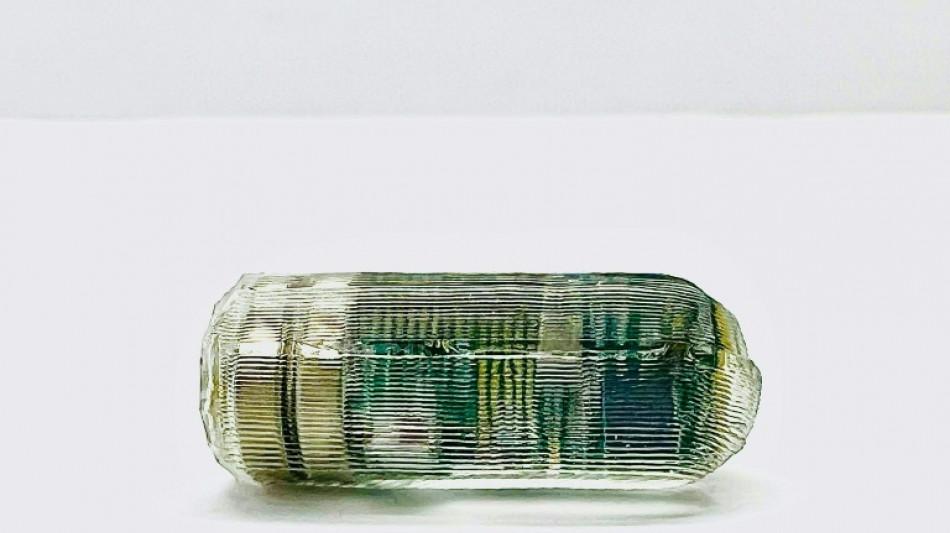
Vibrating pill, ingestible sensor: mini robots tackle gut disorders / Photo: Handout - Caltech/AFP

 Dodgers beat Braves to advance in MLB playoffs, Rays oust Yankees

 'A sun as black as my lungs': how corruption crucified a polluted Albania city

 The British historian helping the French rediscover de Gaulle

 Dodgers beat Braves to advance, Guardians survive in MLB playoffs

 Latin American, Caribbean women top Nobel literature buzz

 US says Fiji-based Chinese official paid bribes for Beijing

 After botched US execution, Christa Pike was nearly taken off life support

 Guinea-Bissau junta urges military unit loyal to ex-president to disarm

 As species decline, green turtles offer glimmer of hope

 Brothers Scott and Beauden Barrett named to start for All Blacks

 EU trade chief seeks to dial down China tensions

 'Never again Bolsonaro': thousands march ahead of Brazil election runoff

 After botched execution, US woman was nearly taken off life support before revival

 Searing AIDS drama 'Elsinore' opens London film festival

 Evicted pensioner who sparked Spain housing protests dies: tenant union

 Golf star Rahm quitting LIV tour over 'unacceptable' terms

 Thousands march fearing return of a Bolsonaro presidency in Brazil

 French PM denies police ordered to confront student protesters

 Rubio touts US power, calls on Europe to emerge from 'slumber'

 Trump says 'we don't think' Russian plague is bio-weapon

 Five children among 26 killed in Ukraine after Russian strikes

 Man City should 'accept' punishment for rule breaches, says Lineker

 US woman who survived botched execution is awake and speaking

 From 1800s to modern pharma: a Nobel-winning chemistry quest

 Southampton boss Eckert given suspended ban over 'Spygate'

A pill that vibrates to relieve constipation, a sensor that can be tracked in the gut -- medical researchers are turning to tiny robots to treat or diagnose gastrointestinal disorders.
"This is a very booming field," said Saransh Sharma, a doctoral student at the California Institute of Technology (Caltech) involved in the development of the ingestible diagnostic sensor.
"You have medical robots that are so small you can just send them inside a person using the oral passage and they can do a lot of sensing and actuation inside the gut," Sharma told AFP.
About 16 of every 100 adults in the United States suffer from symptoms of constipation, according to the US health authorities, and the number doubles for Americans over the age of 60.
Researchers at the Massachusetts Institute of Technology (MIT) and Caltech have developed an ingestible sensor that can be monitored as it travels through the digestive tract.
The device, 20 millimeters in length and eight mm in diameter, could help physicians diagnose gastrointestinal motility disorders that prevent food from moving normally through the digestive tract.
The capsule's location reveals where a slowdown is taking place.
"That gives the doctor a lot of the essential information to do a better job in the curing and the diagnosis and the treatment plan," Sharma said.
The sensor could also provide an alternative to invasive procedures such as endoscopy or other diagnostic techniques such as nuclear imaging, X-rays or catheters.
It has been tested on pigs and the team behind the research hopes to eventually obtain the approval of the US Food and Drug Administration for human clinical trials.
"If we can demonstrate a device inside large animals like pigs up to a very high confidence, we can say that it will scale very well in human anatomy as well," Sharma said.
The authors published the results of their research on Monday in the journal Nature Electronics.
They said the sensor works by detecting a magnetic field produced by an electromagnetic coil located outside of the body.
The strength of the magnetic field varies with distance from the coil and the sensor's position within the digestive tract can be calculated to within millimeters based on measurement of the magnetic field.
- Vibrating capsule -
While the ingestible sensor is still in the development phase, an Israeli company called Vibrant Gastro recently began marketing a vibrating capsule in the United States designed to relieve chronic constipation.
The drug-free Vibrant capsule is intended for constipation sufferers who have not received bowel relief after a month of laxative treatments. It has been FDA-approved.
In a Phase 3 clinical trial of 300 people, participants who took Vibrant had bowel movements significantly more frequently than those who took a placebo.
The Vibrant capsule produces gentle vibrations to stimulate the colon and increases the number and frequency of bowel movements, according to the manufacturer.
F.AbuZaid--SF-PST