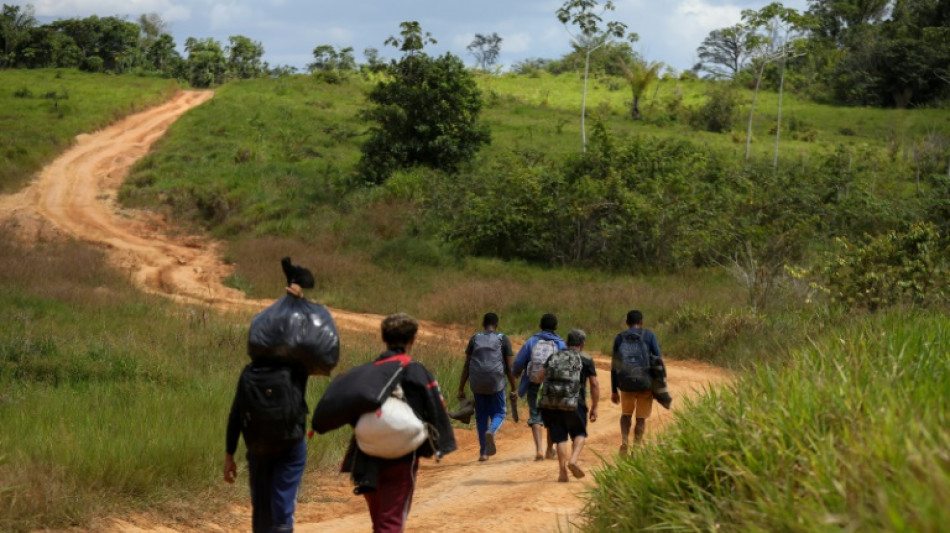
'Operation Exodus': Brazil miners flee Yanomami land / Photo: MICHAEL DANTAS - AFP

 Dodgers beat Braves to advance in MLB playoffs, Rays oust Yankees

 'A sun as black as my lungs': how corruption crucified a polluted Albania city

 The British historian helping the French rediscover de Gaulle
 Dodgers beat Braves to advance, Guardians survive in MLB playoffs

 Latin American, Caribbean women top Nobel literature buzz

 US says Fiji-based Chinese official paid bribes for Beijing

 After botched US execution, Christa Pike was nearly taken off life support

 Guinea-Bissau junta urges military unit loyal to ex-president to disarm

 As species decline, green turtles offer glimmer of hope

 Brothers Scott and Beauden Barrett named to start for All Blacks

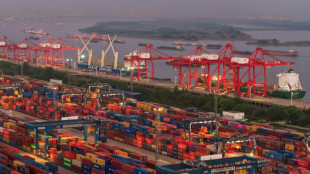 EU trade chief seeks to dial down China tensions

 'Never again Bolsonaro': thousands march ahead of Brazil election runoff

 After botched execution, US woman was nearly taken off life support before revival
 Searing AIDS drama 'Elsinore' opens London film festival

 Evicted pensioner who sparked Spain housing protests dies: tenant union

 Golf star Rahm quitting LIV tour over 'unacceptable' terms

 Thousands march fearing return of a Bolsonaro presidency in Brazil

 French PM denies police ordered to confront student protesters

 Rubio touts US power, calls on Europe to emerge from 'slumber'

 Trump says 'we don't think' Russian plague is bio-weapon

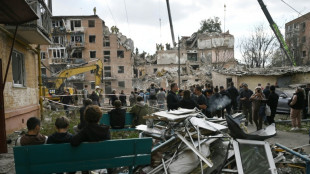
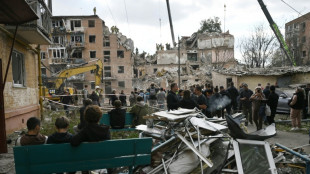 Five children among 26 killed in Ukraine after Russian strikes

 Man City should 'accept' punishment for rule breaches, says Lineker

 US woman who survived botched execution is awake and speaking
 From 1800s to modern pharma: a Nobel-winning chemistry quest

 Southampton boss Eckert given suspended ban over 'Spygate'

Wearing broken flip-flops held together by a frayed cord, Joao Batista, an illegal gold miner in the Brazilian Amazon, has been walking for days to escape the jungle, fleeing a looming security-force crackdown.
The wiry 61-year-old with deep creases in his leathery skin is one of thousands of mine workers rushing to leave the Yanomami Indigenous reservation, as Brazil sends in the police and army to wrest back control of the remote territory from invaders accused of sparking a humanitarian crisis.
Indigenous leaders say illegal miners have poisoned the water with mercury, destroyed the rainforest, raped and killed inhabitants, and triggered a food emergency that is devastating the reservation's 30,000 Yanomami.
Batista, who spent the last seven months working at an illegal mine, does not see himself as a criminal. But he says life left him few options other than "garimpo" -- wildcat mining.
"Look, I never went to school. At my age, what else am I going to do to survive?" he told AFP as he walked down a dirt road outside the town of Alto Alegre, in the northern state of Roraima.
He still had around 85 kilometers (53 miles) to go before returning to his home in the state capital, Boa Vista.
Up the road, a family fleeing a mine camp was trying to hitch a ride to the capital -- a 23-year-old mother, 15-year-old father and their three small children.
They caught malaria in the rainforest, and were too sick to walk, they said.
"Our kids are sick, too. I need to get to Boa Vista," said the young father.
- Reverse gold rush -
There has been an exodus of mine workers from the Yanomami reservation since President Luiz Inacio Lula da Silva ordered Brazil's military to establish a no-fly zone there last week, cracking down on the bush planes the mines rely on for food and supplies.
Some are making the gruelling trek out on foot. Others are fleeing down the Uraricoera river, crowding more than 30 people onto long, narrow boats.
Justice Minister Flavio Dino said Monday the government had begun deploying more than 500 police and soldiers for an operation to evict the miners, along with the mine-camp cooks, prostitutes and others drawn to the rainforest gold rush.
Dino said the government expected at least 80 percent of the estimated 15,000 people who have invaded the Yanomami reservation would leave on their own before authorities began "coercive" measures, which he said would come this week.
As a first step, environmental agency IBAMA said Wednesday it had started destroying heavy equipment seized at the mines, including a helicopter, plane and bulldozer.
The Yanomami territory, Brazil's biggest Indigenous reservation, is one of several to suffer a massive influx of illegal miners under far-right ex-president Jair Bolsonaro (2019-2022), whom activists accuse of encouraging the incursions.
- 'Real criminals' -
The crackdown is stoking tension in the region, where an entire economy has developed around the illegal gold industry.
Gold sells for 280 reais (around $55) a gram on the black market in Roraima. AFP met miners carrying up to 30 grams.
But the money risks running out fast.
At a local truck stop, an illegal bush pilot flashed a handful of gold -- his payment for a recent flight. He said he worried it would be his last: he has had to stop working because of the no-fly zone.
Locals fear the impact of a massive influx of newly jobless workers.
Military police in Roraima launched what they called "Operation Exodus" to "intensify" their presence in the region and "preempt disturbances."
Authorities have encouraged the miners to leave the reservation voluntarily -- though Dino vowed to prosecute "all those who committed crimes such as genocide, environmental crimes, financing illegal gold mining and money laundering."
One 58-year-old miner, who asked to be identified only as "Parmalat," his nickname, said he resented being treated like a criminal, when crimes like corruption often go unpunished.
"We're treated like we're worthless," he said.
"All we want to do is work, and we're called criminals. The real criminals aren't treated that way."
V.Said--SF-PST