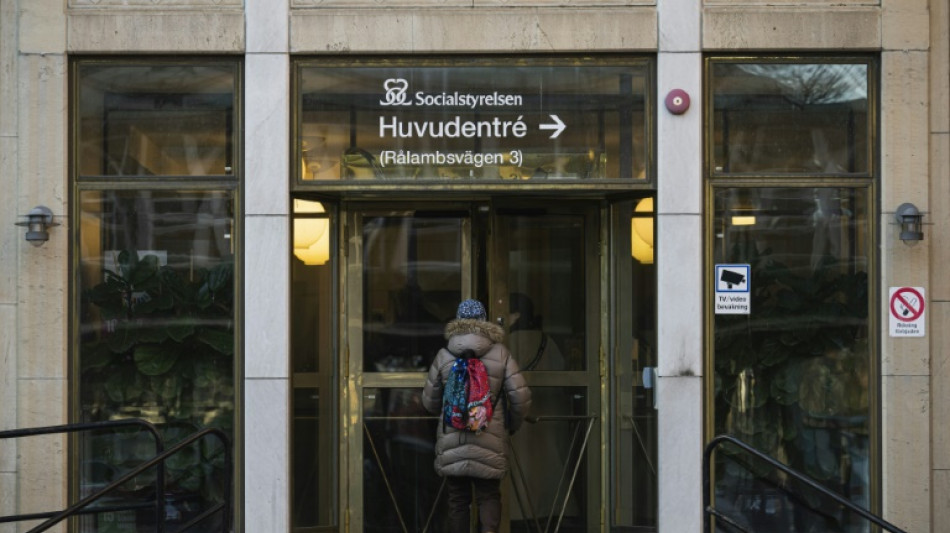
Sweden puts brakes on treatments for trans minors / Photo: Jonathan NACKSTRAND - AFP

 Dodgers beat Braves to advance in MLB playoffs, Rays oust Yankees

 'A sun as black as my lungs': how corruption crucified a polluted Albania city

 The British historian helping the French rediscover de Gaulle

 Dodgers beat Braves to advance, Guardians survive in MLB playoffs

 Latin American, Caribbean women top Nobel literature buzz

 US says Fiji-based Chinese official paid bribes for Beijing

 After botched US execution, Christa Pike was nearly taken off life support

 Guinea-Bissau junta urges military unit loyal to ex-president to disarm

 As species decline, green turtles offer glimmer of hope

 Brothers Scott and Beauden Barrett named to start for All Blacks

 EU trade chief seeks to dial down China tensions

 'Never again Bolsonaro': thousands march ahead of Brazil election runoff

 After botched execution, US woman was nearly taken off life support before revival

 Searing AIDS drama 'Elsinore' opens London film festival

 Evicted pensioner who sparked Spain housing protests dies: tenant union

 Golf star Rahm quitting LIV tour over 'unacceptable' terms

 Thousands march fearing return of a Bolsonaro presidency in Brazil
 French PM denies police ordered to confront student protesters
 Rubio touts US power, calls on Europe to emerge from 'slumber'

 Trump says 'we don't think' Russian plague is bio-weapon

 Five children among 26 killed in Ukraine after Russian strikes

 Man City should 'accept' punishment for rule breaches, says Lineker

 US woman who survived botched execution is awake and speaking
 From 1800s to modern pharma: a Nobel-winning chemistry quest

 Southampton boss Eckert given suspended ban over 'Spygate'

Sweden, the first country to introduce legal gender reassignment, has begun restricting gender reassignment hormone treatments for minors, as it, like many Western countries, grapples with the highly-sensitive issue.
With the number of diagnoses soaring, the medical community faces the dilemma of weighing precaution against the risks associated with not offering treatment to those suffering from "gender dysphoria".
Sweden decided in February 2022 to halt hormone therapy for minors except in very rare cases, and in December, the National Board of Health and Welfare said mastectomies for teenage girls wanting to transition should be limited to a research setting.
"The uncertain state of knowledge calls for caution," Board department head Thomas Linden said in a statement in December.
So-called puberty blockers have been used in young teens contemplating gender transition to delay the onset of unwanted physical changes.
Like many other countries, Sweden has seen a sharp rise in cases of gender dysphoria, a condition where a person may experience distress as a result of a mismatch between their biological sex and the gender they identify as.
According to the Board of Health and Welfare, approximately 8,900 people were diagnosed with gender dysphoria in Sweden between 1998 and 2021, in a country of around 10 million.
In 2021 alone, about 820 new cases were registered.
The trend is particularly visible among 13- to 17-year-olds born female, with an increase of 1,500 percent since 2008.
"It used to be a male phenomenon and now there is a strong female over-representation," psychiatrist Mikael Landen, chief physician at Sahlgrenska University Hospital in Gothenburg, told AFP.
Landen, who contributed to the scientific study on which the Board of Health based its decision, said the reasons for this increase remain largely a "mystery".
"Tolerance has been high in Sweden for at least the last 25 years, so you can't say it has changed," he said when asked if it was simply a result of a more accepting society.
- Western debate -
The profile of those diagnosed is often complex, according to Linden, as gender dysphoria often occurs in those also suffering from other diagnoses, such as attention deficit and eating disorders or autism.
In May 2021 -- before the Swedish authorities' decision to restrict gender reassignment hormone treatments -- the prestigious Karolinska Hospital in Stockholm chose to restrict such hormone treatments to research projects only.
Other countries are weighing the same questions.
Neighbouring Finland took a similar decision in 2020, while France has called for "the utmost reserve" on hormone treatments for young people.
The UK meanwhile saw a high-profile court case in 2020.
Keira Bell, who regretted her transition from female to male, filed a complaint against the public body responsible for gender dysphoria treatments, claiming she had been too young at age 16 to consent to the treatments.
She ultimately lost her case.
Sweden's recent rollback is all the more notable as it was first in the world to authorise legal gender transition in 1972, paving the way for sex reassignment surgery to be covered by its universal healthcare system.
Rights groups have expressed concern.
Elias Fjellander, president of the youth branch of RFSL, the country's main organisation championing LGBTQ rights, says Sweden's decision risks leading to increased suffering.
"These people might need more care and invasive procedures in the future, because the decision could not be made earlier, even though the medical need was there," he said.
Twenty-year-old Antonia Lindholm, a trans woman who began her transition as a teenager, agreed.
"I think hormones save a lot of people," she told AFP.
"If I were 13 today, I wouldn't have a chance" of getting this treatment, Lindholm added.
- Regret -
But others who have had hormone treatment support the Swedish position.
Mikael Kruse, 36, changed his gender in his late 20s but had a change of heart and finally "detransitioned".
"I think it's good to take a break to understand what's going on," he told AFP.
For seven years, the Swede lived as a woman, but that never resolved his discomfort.
A new diagnosis revealed he had Asperger's Syndrome as well as Attention Deficit Disorder, and the suffering he thought was related to his gender was due to different factors.
"All the pieces of the puzzle fell into place," Kruse said.
For Carolina Jemsby, co-director of the Swedish documentary The Trans Train which brought the care of adolescents into the limelight in 2019, the current debate shows it is "more complex than the healthcare system and society had hoped".
"One aspect of this dilemma is that it has become a political issue," she told AFP.
"It does a disservice to this group who need scientifically proven medical care to help them and give them a better life, and a better ability to live who they are."
In 1972 Sweden introduced an act to allow people to legally change their gender thus becoming, according to the government, "the first country in the world to introduce a formal option in law to be assigned with a new legal gender".
E.AbuRizq--SF-PST