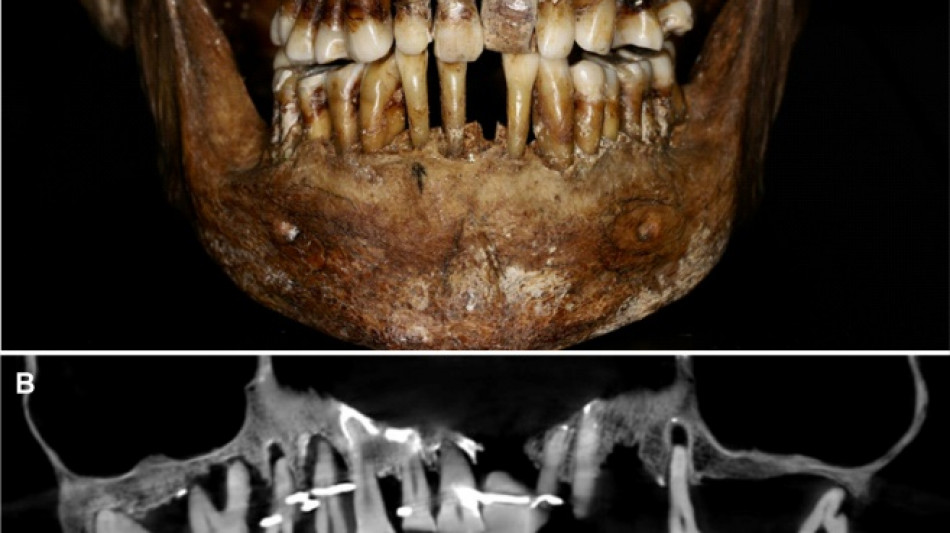
French aristocrat's golden dental secret revealed 400 years on / Photo: Handout - INRAP/Rozenn Colleter/AFP/File

 The British historian helping the French rediscover de Gaulle

 Dodgers beat Braves to advance, Guardians survive in MLB playoffs

 Latin American, Caribbean women top Nobel literature buzz

 US says Fiji-based Chinese official paid bribes for Beijing

 After botched US execution, Christa Pike was nearly taken off life support

 Guinea-Bissau junta urges military unit loyal to ex-president to disarm

 As species decline, green turtles offer glimmer of hope

 Brothers Scott and Beauden Barrett named to start for All Blacks

 EU trade chief seeks to dial down China tensions

 'Never again Bolsonaro': thousands march ahead of Brazil election runoff

 After botched execution, US woman was nearly taken off life support before revival

 Searing AIDS drama 'Elsinore' opens London film festival

 Evicted pensioner who sparked Spain housing protests dies: tenant union

 Golf star Rahm quitting LIV tour over 'unacceptable' terms

 Thousands march fearing return of a Bolsonaro presidency in Brazil

 French PM denies police ordered to confront student protesters

 Rubio touts US power, calls on Europe to emerge from 'slumber'

 Trump says 'we don't think' Russian plague is bio-weapon

 Five children among 26 killed in Ukraine after Russian strikes

 Man City should 'accept' punishment for rule breaches, says Lineker

 US woman who survived botched execution is awake and speaking

 From 1800s to modern pharma: a Nobel-winning chemistry quest

 Southampton boss Eckert given suspended ban over 'Spygate'

 Russia warns of 'false' information as second plague case reported

 IEA ready to release more oil reserves if necessary

Scientists have discovered the long-buried secret of a 17th-century French aristocrat 400 years after her death: she was using gold wire to keep her teeth from falling out.
The body of Anne d'Alegre, who died in 1619, was discovered during an archaeological excavation at the Chateau de Laval in northwestern France in 1988.
Embalmed in a lead coffin, her skeleton -- and teeth -- were remarkably well preserved.
At the time the archaeologists noticed that she had a dental prosthetic, but they did not have advanced scanning tools to find out more.
Thirty-five years later, a team of archaeologists and dentists have identified that d'Alegre suffered from periodontal disease that was loosening her teeth, according to a study published in the Journal of Archaeological Science: Reports this week.
A "Cone Beam" scan, which uses X-rays to build three-dimensional images, showed that gold wire had been used to hold together and tighten several of her teeth.
She also had an artificial tooth made of ivory from an elephant -- not hippopotamus, which was popular at the time.
But this ornate dental work only "made the situation worse", said Rozenn Colleter, an archaeologist at the French National Institute for Preventive Archaeological Research and lead author of the study.
The gold wires would have needed repeated tightening over the years, further destabilising the neighbouring teeth, the researchers said.
D'Alegre likely went through the pain for more than just medical reasons. There was huge pressure on aristocratic women at a time when appearance was seen as related to value and rank in society.
Ambroise Pare, a contemporary of D'Alegre's who was the doctor for several French kings and designed similar dental prosthetics, claimed that "if a patient is toothless, his speech becomes depraved", Colleter told AFP.
A nice smile was particularly important for d'Alegre, a "controversial" twice-widowed socialite "who did not have a good reputation," Colleter added.
- War and widowhood -
D'Alegre lived through a troubled time in French history.
She was a Huguenot, Protestants who fought against Catholics in the French Wars of Religion in the late 1500s.
By the age of 21, she was already widowed once and had a young son, Guy XX de Laval.
When the country plunged into the Eighth War of Religion, D'Alegre and her son were forced to hide from Catholic forces while their property was seized by the king.
Her son then converted to Catholicism and went to fight in Hungary, dying in battle at the age of 20.
After being widowed a second time, D'Alegre died of an illness aged 54.
D'Alegre's teeth "shows that she went through a lot of stress," Colleter said.
The researcher said she hopes that the research "goes a little way towards rehabilitating her".
Severe periodontal diseases are estimated to affect nearly a fifth of the world's adults, according to the World Health Organization.
I.Yassin--SF-PST