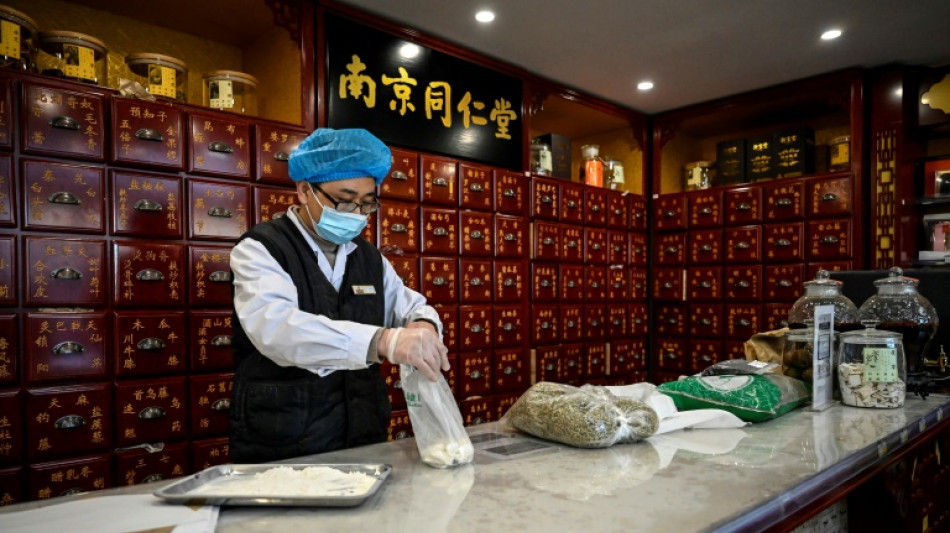
Chinese turn to traditional remedies to fight Covid / Photo: Jade Gao - AFP

 The British historian helping the French rediscover de Gaulle

 Dodgers beat Braves to advance, Guardians survive in MLB playoffs

 Latin American, Caribbean women top Nobel literature buzz

 US says Fiji-based Chinese official paid bribes for Beijing

 After botched US execution, Christa Pike was nearly taken off life support

 Guinea-Bissau junta urges military unit loyal to ex-president to disarm

 As species decline, green turtles offer glimmer of hope

 Brothers Scott and Beauden Barrett named to start for All Blacks

 EU trade chief seeks to dial down China tensions

 'Never again Bolsonaro': thousands march ahead of Brazil election runoff

 After botched execution, US woman was nearly taken off life support before revival

 Searing AIDS drama 'Elsinore' opens London film festival

 Evicted pensioner who sparked Spain housing protests dies: tenant union

 Golf star Rahm quitting LIV tour over 'unacceptable' terms
 Thousands march fearing return of a Bolsonaro presidency in Brazil

 French PM denies police ordered to confront student protesters

 Rubio touts US power, calls on Europe to emerge from 'slumber'

 Trump says 'we don't think' Russian plague is bio-weapon

 Five children among 26 killed in Ukraine after Russian strikes

 Man City should 'accept' punishment for rule breaches, says Lineker

 US woman who survived botched execution is awake and speaking
 From 1800s to modern pharma: a Nobel-winning chemistry quest
 Southampton boss Eckert given suspended ban over 'Spygate'
 Russia warns of 'false' information as second plague case reported

 IEA ready to release more oil reserves if necessary

As Covid-19 rips through China's vast population, making millions sick and fuelling a shortage of drugs, many are turning to old-school traditional medicines to battle the aches and pains of the virus.
President Xi Jinping has promoted traditional Chinese medicine (TCM) since the start of the pandemic, while health officials have hailed its "important role" in fighting the coronavirus.
Encompassing a range of treatments from herbal remedies and massages to acupuncture and diets, TCM has been used for thousands of years to treat all manner of ailments.
Critics say it is pseudoscientific and ineffective in treating actual illness, and there is little peer-reviewed data to back claims of its efficacy.
But millions in China use it, often in conjunction with modern medicine to alleviate symptoms.
Beijing consultant Yu Lei, 38, had a fever after catching Covid, so he made a herbal tea with reputed anti-inflammatory properties featuring cassia twig -- a kind of Chinese cinnamon -- peony roots, liquorice, jujubes and ginger.
"In our family, we often use Chinese medicines," he told AFP, adding that his fever subsided after drinking the brew.
According to followers like Yu, TCMs have fewer side effects and work slower to regulate the body, rather than Western medicines that "fight the symptoms but rarely the source of the illness".
Beijing has urged local authorities to "actively and objectively publicise the role and efficacy of TCM brews in the treatment of Covid-19".
However, Ben Cowling, chair of epidemiology at the University of Hong Kong's School of Public Health, told AFP: "We don't know whether these treatments are effective or not, because they haven't been studied in clinical trials."
"I wouldn't rule out the possibility that some of them are effective, but I also wouldn't rule out the possibility that some of them might even be harmful."
The World Health Organisation only recommends Covid treatments that are based on chemical drugs. When contacted by AFP about TCM, the body said it advised countries to "gather reliable evidence and data on traditional medicine practices and products".
- 'Same logic' –
Western medicine remains the preferred mode of care in China, but proponents of TCM say combining the two is effective in treating Covid-19.
Liu Qingquan, director of the Beijing Traditional Chinese Medicine Hospital, says they "complement each other and can solve fever, sore joints, fatigue, sore throat, cough and other symptoms".
Experts have taken to television to praise TCM since the start of the pandemicwith one product in particular -- Lianhua Qingwen -- benefiting from intense promotion by authorities.
Many users are convinced of its usefulness, with some studies suggesting it can help alleviate symptoms. Capsules of the medicine were given to all Hong Kong residents when a Covid wave hit the city last year.
But some online critics in China charge that Lianhua Qingwen is no more effective than peaches in syrup -- a staple comfort food for sore throats in China -- and social media users have complained of being handed the TCM instead of ibuprofen or paracetamol.
Lan Jirui, a doctor of Chinese medicine in Beijing, told AFP: "It's the same logic as Western medicine.
"If the drug is bought on the prescription of the doctor, it will probably be effective. If it is bought randomly from the pharmacy, then maybe not."
- 'Cannot kill the virus' -
Throughout the pandemic, TCM doctors and self-taught practitioners have taken to the internet to share recipes and health protocols.
Li Wen, a 68-year-old retired acupuncturist, has been pricking himself with needles to combat his flu-like condition. He also bought two Chinese medicines, including a bamboo-based anti-fever remedy.
"I supplement that with a nutritious diet of pears, turnips and ginger," he told AFP.
"Chinese medicines can be helpful to fight the virus, but cannot kill the virus," he said.
"But I remain cautious about Western drugs. Their side effects should not be overlooked."
Hoping to treat a cough and sore throat, Danni, a 39-year-old Beijinger, has been taking Pei Pa Koa, a syrup derived from plant extracts.
"It's not because I can't find Western medicine," she told AFP, "but because it's effective and soothing."
"I also make myself a hot soup of pears and hot water with lemon, to boost vitamin C and my immunity."
Some people AFP spoke to were unconvinced.
"We young people know little about traditional medicine," said Grace Hsia, a 30-year-old director. "We usually prefer Western medicines because they have immediate results."
Li Na, a 36-year-old Beijing woman, said: "I took paracetamol for a fever and it worked very quickly.
"Chinese medicines are ineffective. People take them more to reassure themselves that they are taking something."
T.Ibrahim--SF-PST