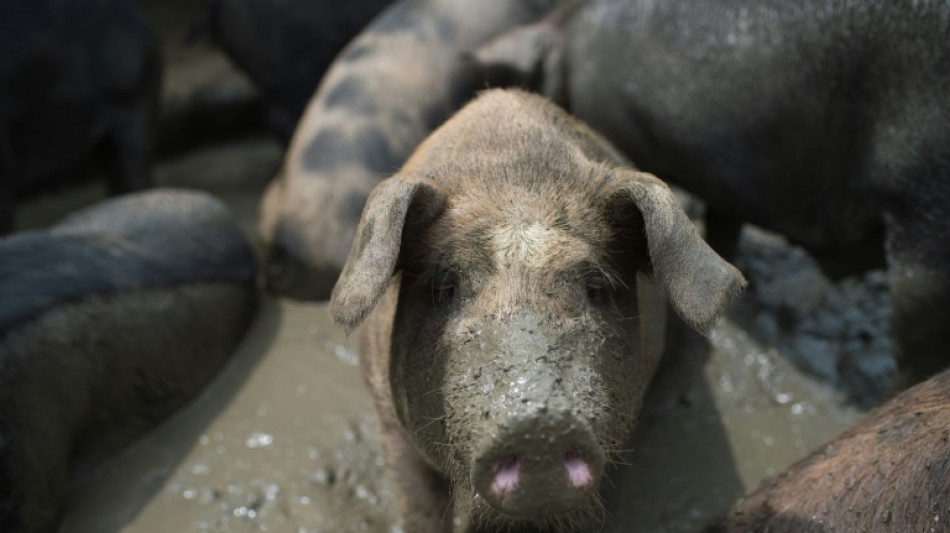
Bionic penis: Synthetic tissue restores erections in pigs / Photo: NICOLAS ASFOURI - AFP

 The British historian helping the French rediscover de Gaulle

 Dodgers beat Braves to advance, Guardians survive in MLB playoffs

 Latin American, Caribbean women top Nobel literature buzz

 US says Fiji-based Chinese official paid bribes for Beijing

 After botched US execution, Christa Pike was nearly taken off life support

 Guinea-Bissau junta urges military unit loyal to ex-president to disarm

 As species decline, green turtles offer glimmer of hope

 Brothers Scott and Beauden Barrett named to start for All Blacks

 EU trade chief seeks to dial down China tensions

 'Never again Bolsonaro': thousands march ahead of Brazil election runoff

 After botched execution, US woman was nearly taken off life support before revival

 Searing AIDS drama 'Elsinore' opens London film festival

 Evicted pensioner who sparked Spain housing protests dies: tenant union

 Golf star Rahm quitting LIV tour over 'unacceptable' terms

 Thousands march fearing return of a Bolsonaro presidency in Brazil

 French PM denies police ordered to confront student protesters

 Rubio touts US power, calls on Europe to emerge from 'slumber'

 Trump says 'we don't think' Russian plague is bio-weapon

 Five children among 26 killed in Ukraine after Russian strikes

 Man City should 'accept' punishment for rule breaches, says Lineker

 US woman who survived botched execution is awake and speaking

 From 1800s to modern pharma: a Nobel-winning chemistry quest

 Southampton boss Eckert given suspended ban over 'Spygate'

 Russia warns of 'false' information as second plague case reported

 IEA ready to release more oil reserves if necessary

Researchers in China have used artificial tissue to restore erectile function in pigs, a promising development for repairing penile damage in humans.
"This is an area that has received little attention, yet the related need is huge," said Xuetao Shi, an author of the study published on Wednesday in the science journal Matter.
An estimated 50 percent of men between the ages of 40 and 70 experience some form of erectile dysfunction, the researchers said, and about five percent suffer from Peyronie's disease.
Peyronie's disease, commonly caused by injury during sex, involves damage to the fibrous sheath of penile tissue known as the tunica albuginea that allows for the maintaining of an erection.
Scar tissue called plaque can cause curved or painful erections or penis shortening and may require surgical treatment.
The Chinese researchers said other tissues from the body have been used to make patches to replace a damaged tunica albuginea but those are sometimes rejected by the immune system.
Instead, the research group created an artificial tunica albuginea (ATA) that mimics the elasticity of the natural tissue with a substance called hydrogel.
Hydrogels can be natural or synthetic and are being used for a growing number of biomedical applications, including contact lenses and tissue engineering.
For the study, the researchers tested the artificial tissue on Bama miniature pigs with injuries to the tunica albuginea.
The ATA patches and a saline injection restored erectile function "similar to that of normal penile tissue," they said.
"The erection of the penis returned to normal after suturing the ATA at the injured part, and the long-term prognosis was satisfactory," they said.
Shi, a researcher at the South China University of Technology in Guangzhou, said "the results one month after the procedure showed that the ATA group achieved good, though not perfect, repair results."
The researchers said the findings "show promise for repairing penile injuries in humans" and can potentially be "extended to many other load-bearing tissues."
"Our work at this stage focuses on the repair of a single tissue in the penis," Shi said.
"The next stage will be to consider the repair of the overall penile defect or the construction of an artificial penis from a holistic perspective."
The researchers will also explore techniques to repair other tissues, including the heart and bladder, Shi said.
X.AbuJaber--SF-PST