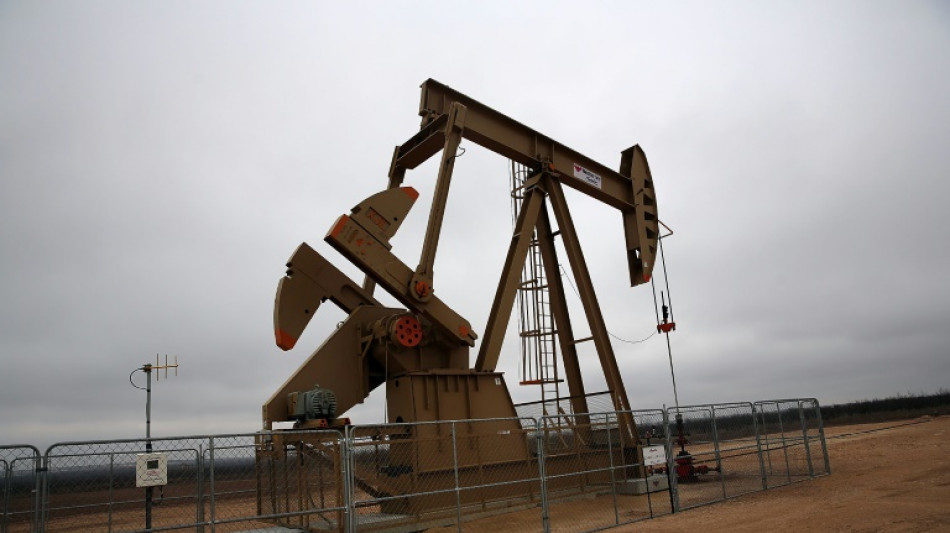
Texas Republicans take aim at climate change -- in textbooks / Photo: SPENCER PLATT - GETTY IMAGES NORTH AMERICA/AFP

 Hotel Blacklist Launches New Accommodation Industry Risk Assessment Tool

 Bangladesh nuclear plant draws hope -- and worry

 US beat Canada 1-0 to wrap up four-win international break

 Turkey, Australia's joint COP31 leadership raises doubts

 For Turkish NGOs, COP31 offers rare space for action

 Sleep, appetite, gene-editing experts contend for Nobel chemistry prize
 Nobel Peace Prize haunted by the 'spectre' of Trump

 Africa launches own credit agency in bid for cheaper borrowing

 US, China, EU: three paths to regulating AI

 Australia's High Court rules against coal mine in landmark climate case
 Australia touts new funds for Pacific infrastructure at Fiji 'pre-COP'

 Eva Marie Saint, Oscar winner of Hollywood classics, dies at 102

 Australia probes app used in cheap smart glasses over privacy fears

 England needed to 'move on' from World Cup pain, says Tuchel

 O'Neill to stay at Celtic after period of "reflection"

 Kane marks 125th England cap with Wembley Nations League double
 Quebec's incoming separatist leader wants to block Crown from swearing-in

 Emmys gala will now stream its premier television awards

 Paramount completes Warner Bros takeover, creating Skydance
 Trump blames France unrest on Islam, migration

 Apple's Cook praises EU over efforts to protect children online

 Nobel winner Halzen says years of October 'misery' finally over

 Quebec separatist win rattles Carney's unity push

 'Itching' for change: Shiffrin cuts back slaloms this season

 'Gen Z has risen up': Tens of thousands mass for tense France school protests

The scorching summer in Texas this year was the second hottest on record -- but students in the southwestern US state might have a hard time understanding why.
That's because a slew of science textbooks submitted to the state Board of Education (BOE) were rejected last week, as the Republican-dominated body moves to curtail education materials deemed too "one-sided" on climate change.
Many of the rejected books taught that "humans are negatively impacting the environment. And the scare tactics that come with that, that is my main issue," Evelyn Brooks, a Republican board member, told AFP.
She claimed, counter to scientists and the federal government, that "the science is not settled on global warming."
America's decentralized education system leaves curriculum management mostly up to individual states, with local school districts also having a degree of autonomy.
That has led to fraught battles across the country as each jurisdiction debates how to teach climate change and other politically charged issues, such as racism and sexuality.
It also leaves room for officials like Brooks in Texas, which produces 42 percent of the nation's crude oil, to push back against the "political ideology" of climate change -- a concept she considers "a blatant lie."
- Increasingly polarized -
Science textbooks from publisher Green Ninja were among those voted down by the Texas BOE.
"It was because of our inclusion of climate change," director Eugene Cordero told AFP in an email, adding that one board member took particular issue with a prompt asking students to "create a story warning friends and family about possible future weather and climate extremes."
Textbooks from eight of 22 publishers that submitted materials to the board were rejected last week, according to a count from Glenn Branch, deputy director of the National Center for Science Education (NCSE), a nonprofit which promotes the teaching of climate change.
Some were eventually accepted, after revisions to sections on climate change and evolution -- another controversial subject in the largely Christian Texas.
The rejected books are not necessarily banned from classrooms, but using approved books is typically tied to getting government funding.
As broiling summers are supercharged by climate change, some fear that students won't see the bigger picture.
"If kids don't understand what all of that means, and they're just going to continue to perpetuate the problem," said Marisa Perez-Dias, one of five Democratic members of the board.
Staci Childs, another Democratic board member, charged that some of her colleagues "felt like some of the materials negatively reflected how oil and gas impacts our society."
In a show of just how powerful the industry is in Texas -- even as the state becomes a growing hub for renewables -- two of the 10 Republican members work directly for the sector.
Though the state has long been conservative, debate seems to have gotten more polarized recently, Perez-Diaz told AFP.
Where previously a consensus "could be met across party lines before, we don't see that as much anymore."
- Getting better? -
In neighboring Oklahoma, the state's Energy Resources Board -- which is entirely funded by the oil and gas industry -- has distributed free education materials aligned with the sector's interests, often to underfunded schools.
Former governor Mike Huckabee, of neighboring Arkansas, has created a "Kids Guide to the Truth About Climate Change."
The monthly series of lessons, available for sale online, promises to counter an agenda on climate change "that promotes fear and panic" pushed by "teachers and the media."
Like other conservative complaints about climate change, the guides try to thread a needle -- avoiding outright climate denialism, while at the same time rejecting the leading scientific consensus.
"Everyone agrees that the Earth's climate is always changing and that industrial development has negatively impacted the environment," the curriculum reads.
"But that does not mean the planet is doomed," it says. "Some very smart people have not been able (to) predict what will happen with the earth. So we really don't know."
Earlier this year, the free-market think tank the Heartland Institute sent its own climate change-skeptical book -- which AFP factcheckers found to be misleading -- to 8,000 teachers.
Despite the setbacks in Texas, Branch, of the NCSE, says climate change education across the country "is generally improving."
"That's partly because it's starting from a very low level."
U.Shaheen--SF-PST