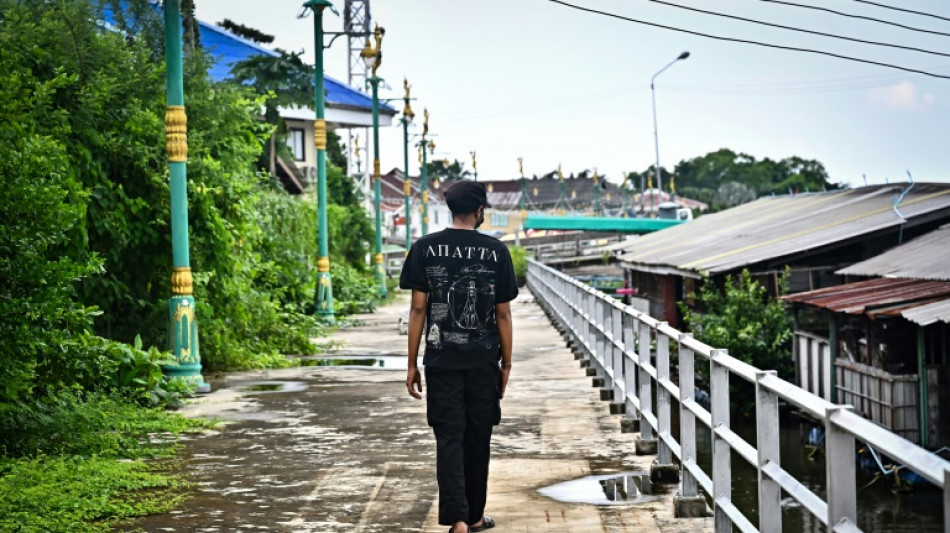
Thai students at rival colleges turn to gang violence / Photo: Lillian SUWANRUMPHA - AFP

 Hotel Blacklist Launches New Accommodation Industry Risk Assessment Tool

 Bangladesh nuclear plant draws hope -- and worry

 US beat Canada 1-0 to wrap up four-win international break

 Turkey, Australia's joint COP31 leadership raises doubts

 For Turkish NGOs, COP31 offers rare space for action

 Sleep, appetite, gene-editing experts contend for Nobel chemistry prize

 Nobel Peace Prize haunted by the 'spectre' of Trump

 Africa launches own credit agency in bid for cheaper borrowing

 US, China, EU: three paths to regulating AI

 Australia's High Court rules against coal mine in landmark climate case

 Australia touts new funds for Pacific infrastructure at Fiji 'pre-COP'

 Eva Marie Saint, Oscar winner of Hollywood classics, dies at 102

 Australia probes app used in cheap smart glasses over privacy fears

 England needed to 'move on' from World Cup pain, says Tuchel

 O'Neill to stay at Celtic after period of "reflection"

 Kane marks 125th England cap with Wembley Nations League double

 Quebec's incoming separatist leader wants to block Crown from swearing-in

 Emmys gala will now stream its premier television awards

 Paramount completes Warner Bros takeover, creating Skydance
 Trump blames France unrest on Islam, migration

 Apple's Cook praises EU over efforts to protect children online

 Nobel winner Halzen says years of October 'misery' finally over

 Quebec separatist win rattles Carney's unity push

 'Itching' for change: Shiffrin cuts back slaloms this season

 'Gen Z has risen up': Tens of thousands mass for tense France school protests

Pae was getting off the bus when a student from a rival Bangkok college shot him simply for wearing his uniform.
He survived but carries a deep scar as a permanent reminder of the attack -- just one episode in a wave of violent feuding blighting vocational colleges in Thailand.
Students regularly meet up to clash with guns, knives or just their bare hands, fired up by a culture of macho pride and longstanding rivalries between different colleges.
"I didn't report it to the police because nothing would happen," Pae told AFP, even though he recognised his attacker's face.
Pae, who only gave his nickname because of safety fears, has turned his back on violence but admitted to carrying a handgun for self-defence in the past -- bought from another student for 3,000 baht ($80).
Reporting of the clashes is patchy and police are little interested, but a few high-profile incidents highlight the intensity of the violence.
In September, a 16-year-old student died after being shot three times outside his home, with a student from a rival college the main suspect, according to media reports.
And two years ago, a gun battle in broad daylight at a petrol station, involving a motorbike chase, left one student dead and two other people wounded.
Au, a 19-year-old studying to be a car mechanic at Thonburi Technical College, was one of those who fought at the petrol station.
"It's not about politics. The fight is just to prove that we are better than them. It's about dignity. We can't stand their insults," he told AFP.
Prosecutors decided that Au and his friends acted in self-defence, so no case was brought against them.
Police have little appetite for tackling violence among students.
"I think the education institution should be more responsible. It only concerns us if it impacts citizens. We are looking into it," Royal Thai Police spokesman Archayon Kraithong told AFP.
- Social divisions -
The culture of defending so-called "honour" runs deep, passed on from one cohort of students to the next.
"We were taught by our seniors to hate them," said 23-year-old Im, an engineering student at King Mongkut's University of Technology North Bangkok.
"When they did to one of our school members, we have to defend our honour by getting back at them."
Krissadang Nutcharat, a legal and political expert and human rights lawyer, said violence between vocational students dates back at least 70 years, blaming inequality and alienation.
"The system doesn't allow them to believe that they are respected," Krissadang told AFP, saying students would traditionally steal trophies such as belts or shirts from rivals to boost their standing.
"They are neglected by the society and state. They are heavily insulted."
The violence is focused in vocational colleges, where students train for careers in trades such as construction and auto repair, and which are looked down upon by some in Thailand's deeply stratified society.
"They are treated as second-class citizens. They are seen as inferior to other students at different colleges and universities," Puangthong Pawakapan, professor of political science at Chulalongkorn University, told AFP.
Poverty limits some students' access to sport, music and other activities, denying them a chance to express themselves, she said -- heightening the appeal of the camaraderie of gang life.
Don Mueang Technical College in Bangkok director Pichet Sukhon said vocational students form a deep bond as they navigate difficult economic conditions and juggle part-time work to pay their school fees.
"Some of my students help each other pay for food when they can't afford a meal," he told AFP.
- 'I don't want to fight -
Former technical student Mild, who only gave his nickname, said feeling excluded from society as a schoolboy 13 years ago drove him to seek a sense of belonging in a gang.
"They never cared about us, so we thought we could do anything we wanted," Mild told AFP.
Mild recalled being chased through a public park in Bangkok with a knife while trying to escape a rival student gang.
Whenever there was trouble, his gang friends had his back, he said, adding they were like family.
The youth-led pro-democracy protests of 2020 brought a short respite as rival gangs came together to join the demonstrations.
The violence soon returned when the protests fizzled out, but some of those involved are now desperate for a way out.
"I don't know why are we fighting, but my seniors told me to do it. If we attack a school, it's like we are collecting a trophy for each one of them," Nut, a 20-year-old studying to be an electrician, told AFP.
"But deep inside, I don't want to fight. I just want to return home peacefully."
B.Khalifa--SF-PST