Long-banned Alsatian finally allowed in French schools / Photo: FREDERICK FLORIN - AFP

 Hotel Blacklist Launches New Accommodation Industry Risk Assessment Tool

 Bangladesh nuclear plant draws hope -- and worry

 US beat Canada 1-0 to wrap up four-win international break

 Turkey, Australia's joint COP31 leadership raises doubts

 For Turkish NGOs, COP31 offers rare space for action
 Sleep, appetite, gene-editing experts contend for Nobel chemistry prize

 Nobel Peace Prize haunted by the 'spectre' of Trump

 Africa launches own credit agency in bid for cheaper borrowing

 US, China, EU: three paths to regulating AI

 Australia's High Court rules against coal mine in landmark climate case

 Australia touts new funds for Pacific infrastructure at Fiji 'pre-COP'

 Eva Marie Saint, Oscar winner of Hollywood classics, dies at 102

 Australia probes app used in cheap smart glasses over privacy fears

 England needed to 'move on' from World Cup pain, says Tuchel

 O'Neill to stay at Celtic after period of "reflection"

 Kane marks 125th England cap with Wembley Nations League double

 Quebec's incoming separatist leader wants to block Crown from swearing-in

 Emmys gala will now stream its premier television awards

 Paramount completes Warner Bros takeover, creating Skydance
 Trump blames France unrest on Islam, migration

 Apple's Cook praises EU over efforts to protect children online

 Nobel winner Halzen says years of October 'misery' finally over

 Quebec separatist win rattles Carney's unity push

 'Itching' for change: Shiffrin cuts back slaloms this season

 'Gen Z has risen up': Tens of thousands mass for tense France school protests

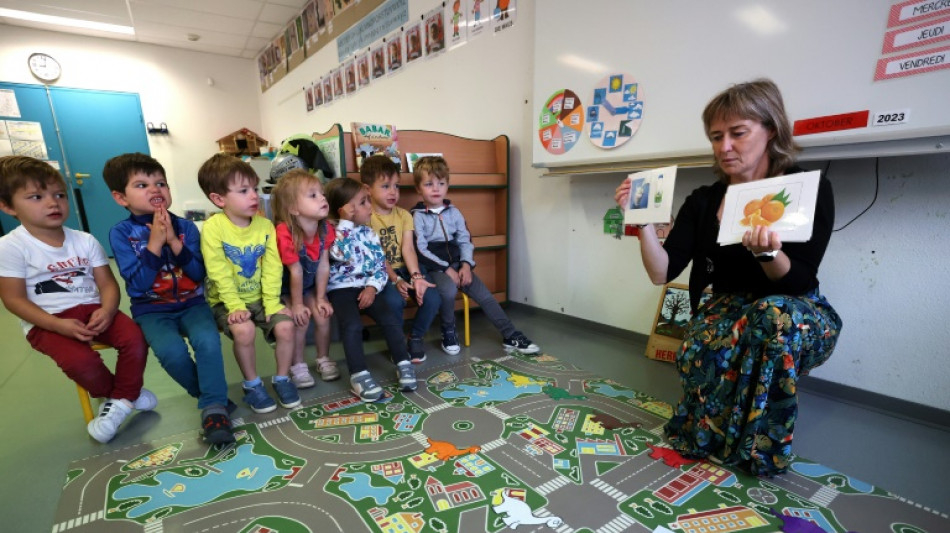
In a school in eastern France, teacher Sandra Cronimus greets her pupils every morning with a lusty "Guede morje!"
She is speaking Alsatian, the German dialect spoken widely in Alsace, a wealthy border region that France and Germany have fought over three times since 1870.
Long forbidden, the language that legendary Arsenal manager Arsene Wenger grew up speaking, is now being taught for the first time in French state schools.
"Clap your hands if you like going to school," Cronimus urged her class of three and four year olds, who responded to the roll with "Ich bin do" -- "I'm here" in Alsatian.
The 15 children at the Rainbow nursery school in Brumath, north of Strasbourg, are taught three-quarters of the time in either Alsatian or German, with the rest in French.
Three other schools near the city on the Rhine have also started teaching in Alsatian, a rarity in a country where regional languages have been pushed to the verge of extinction by a centralising state, ever-vigilant of threats to French national identity.
- 'They forbade us from speaking' -
Brumath's mayor Etienne Wolf is delighted by the change.
"When I was a child they forbade us from speaking Alsatian," said the 68-year-old.
"I want to defend Alsatian, which is falling away" particularly among young people, he added. "Often people understand it but don't speak it anymore."
Classroom assistant Corinne Husser is equally overjoyed to be able to speak her first language with the children. "It's great, it's the first time I have been able to work in Alsatian," she said.
While Alsatian is spoken by around half a million people, the dialect in Brumath is not exactly the same as the one spoken by Cronimus, who comes from a village in the northern Vosges.
And it is different again to what is spoken 150 kilometres (93 miles) to the south at the other end of the region. "In Altkirch it's completely different," said the teacher, who switches easily between German, Alsatian and French with the children.
Cronimus got extra training from language experts to take on "this new challenge".
Alsatian is already taught with German in a dozen community schools across Alsace run by the private ABCM network. Several take an immersive approach, with no French at all spoken in class.
- Rapid decline -
Pierre Klein, the president of the Alsace Bilingual Federation, said it was a pity that the state schools did not follow their lead as "they could have fully benefitted from the advantages of immersion".
Even so he welcomed the belated official "recognition of the value of being bilingual given the rapid decline in the use of the dialect... particularly among the under 50s."
However, Wolf said that the big problem with the completely immersive approach "is finding the people capable of teaching it".
Local education officials are already struggling to recruit teachers for bilingual French-German classes, in which one in five children in the Strasbourg area are taught.
Parents too were clearly worried about signing up for an experimental project.
"At the beginning only three pupils were signed up but before others were won over," said Cronimus.
Those that have signed up don't seem to be disappointed.
Celine Babin, 40, admitted that she "hesitated a little" before putting her son Paul into the class. Now, however, she is convinced it will help him with other languages. "And also, Alsatian is part of our culture," she added.
J.Saleh--SF-PST