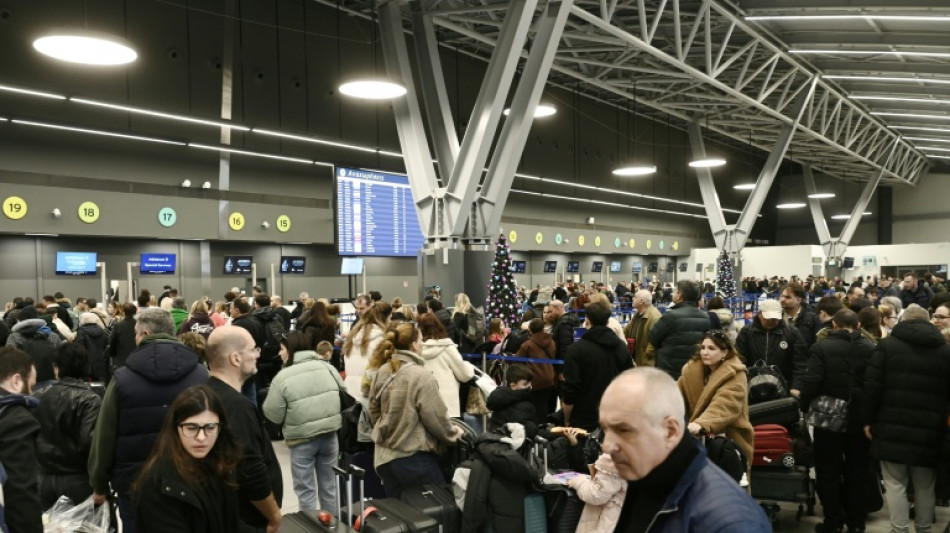
Greece airspace shutdown exposes badly outdated systems / Photo: Sakis Mitrolidis - AFP

 West must embrace 'national power' or face decline: Rubio

 Shell refining margins reach record highs as wars hit supply

 Former Spain, Barca winger Pedro retires from football

 Arteta signs new Arsenal deal until 2030

 Stocks decline as oil climbs on Mideast flareup

 Gauff says online abuse was 'draining' after China Open exit

 As sector struggles, Porsche puts luxury ahead of volume

 'It's personal': Fiji minister pushes better climate finance at pre-COP

 Russia glosses over dark Soviet past in reinvented museum

 UK tax body opened probe into Man City in 2018: FT

 Yemen's Houthis claim new attacks on Saudi airports as conflict deepens

 Germany factory production at highest level for 18 months
 Thailand floods death toll rises to 60 since mid-September

 US pushes Russia for information on plague reports

 Myanmar leader lands in Malaysia for migrant return talks

 Indian central bank hikes rates for first time since 2023

 US military on Okinawa face curfew, alcohol ban after murder case

 Fierce lobbying in EU over 'forever chemicals'

 Dodgers beat Braves and Padres avoid sweep in MLB playoffs

 Mourning, war and elections as Israel marks October 7

 Messi says Argentina retirement is 'saddest day of my career'
 Oil rises and stocks fall as Hormuz worries flare

 Pacific presses world for help 'surviving' climate change at pre-COP summit

 Verstappen revival to be put to the test in steamy Singapore
 US woman who survived botched execution is conscious, speaking: lawyers

A deeply embarrassing systems failure which forced Greece to close its airspace for several hours with pilots unable to speak to air traffic control, has exposed badly outdated communication systems at Athens International Airport -- one of the world's top travel destinations.
Flights had to be diverted to neighbouring countries with thousands of travellers hit after the "unprecedented" technical malfunction on January 4, which baffled experts.
Even more than a week after the chaos, questions as to what sparked the glitch -- and how the system returned online -- remain unanswered, with a report expected this week.
According to the Greek civil aviation authority, the YPA, the malfunction began at 8:59 am (0659 GMT) when multiple radio frequencies serving Athens airspace were hit by continuous "noise" interference.
The agency's transmitters began sending out "involuntary signal emissions", YPA said.
As technicians raced to radio relay stations on top of mountains near Athens and further afield to locate the problem, planes were essentially flying blind, experts said -- unable to communicate with air traffic controllers -- until the incident began to gradually abate four hours later.
"Hundreds of flights were directly affected -- those in contact with air traffic control or already in the air that changed their route," Foivos Kaperonis, a board member of the Greek air traffic controllers association (EEEK), told AFP.
Athens International Airport handled over 280,000 flights last year, an average of over 760 a day.
Officials have insisted that Athens airspace was quickly cleared of traffic, and that flight safety was not compromised.
The system returned to full operation at 5 pm (1500 GMT), with flights restored 45 minutes later, the YPA said.
No signs of a cyberattack or intentional sabotage were detected, YPA said. And nothing suspicious was found at the relay stations.
Government spokesman Pavlos Marinakis later confirmed there was "no sign" of a cyberattack.
- 'Flying deaf' -
"We have an exact picture of what happened. What we don't yet know is how it happened," Michael Bletsas, one of Greece's top computer engineers and head of the Greek cybersecurity authority, told state TV ERT.
Planes "may have flown 'deaf' for a short while... but under no circumstances was there a flight safety problem," he said, with pilots still having their radar.
"Every system fails at some point," said Bletsas, who is on the committee investigating the incident.
Kaperonis is much less sanguine.
"Air traffic controllers could see the aircraft on the radar display, but they could neither hear the pilots nor speak to them," he said.
"In other words, if two aircraft had been on a collision course, controllers would not have been able to give them instructions," he said.
George Saounatsos, the head of the YPA, said a report on the incident by a hurriedly-convened investigative committee would likely be delivered this week.
"It was a rare event -- it's hard for this to happen again, even statistically," he told Open TV.
A major infrastructure overhaul costing 300 million euros ($350 million) is currently underway, which includes digital transmitters that will be delivered this year, Saounatsos said.
- 'Outdated' systems -
Greece's junior transport minister has admitted the airport's communications systems should have been upgraded "decades" earlier.
"These are systems we know are outdated," Konstantinos Kyranakis told Action24 TV.
The Athens airport tower radar dates from 1999, air traffic controllers note.
"Clearly, systems that should have been replaced decades ago, cannot be replaced in nine months," Kyranakis said, who was appointed in March.
Four different transport ministers have held the portfolio since 2019 when conservative Prime Minister Kyriakos Mitsotakis came to power.
Bertrand Vilmer, an aeronautics expert and consultant at Paris-based Icare Aeronautique, said Athens' largely analog-based systems "are robust, but ones for which there's no longer really any possible maintenance because they're old."
Last month the European Commission referred Greece to the EU Court of Justice for failing to put in place measures to design and publish performance-based navigation (PBN) procedures at Greek airports that should have been in place five years ago.
Air traffic controllers, who have clashed with YPA for years over staff and infrastructure shortages, insist that the January 4 incident was a debacle waiting to happen.
They say that the incident is particularly concerning in a country heavily reliant on tourism that has seen record visitor numbers in recent years.
"The air traffic control unit where the problem appeared handles up to nearly 5,000 flights per day during the summer season," Kaperonis said.
Air traffic controllers require "long rest periods" due to the difficulty of their job, Vilmer said.
YPA and the transport minister's office did not respond to questions.
Athens International Airport last year handled nearly 34 million passengers, an increase of 6.7 percent over the previous year.
Critics have also noted that Greece's worst rail disaster, when two trains collided in 2023, killing 57 people -- which brought hundreds of thousands onto the streets to protest -- was also partly caused by chronic infrastructure and staffing failings.
R.Shaban--SF-PST