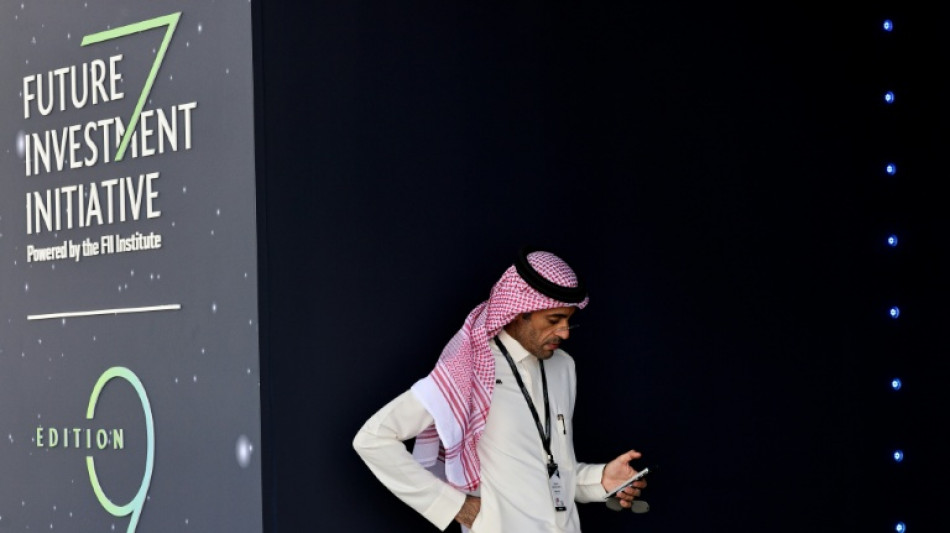
Saudi chases AI ambitions with homegrown firm pitched to global investors / Photo: Fayez Nureldine - AFP

 WhiteBIT Launches Bitcoin Lightning Network Support, Powered by Voltage

 Oil surges, stocks sink as US reportedly eyes fresh Iran strikes
 Anne Carson: modern takes on Greek classics

 Canada's Anne Carson wins Nobel literature prize
 Ethiopia drones hit Eritrean troops in Tigray

 Russian strike on buses kills 30 in frontline Ukrainian city
 Thailand begins extradition process against Chinese journalist

 Quarantine, unease and rumours: Russian city grapples with plague scare

 Taiwan says exports hit record in September on AI demand
 Marc Marquez vows to 'attack' Martin's lead at Indonesian MotoGP
 Diplomats, schools in Saudi take safety measures after blasts heard: sources to AFP

 In Beijing, EU trade envoy says deficit with China 'unsustainable'

 Sri Lanka's de Silva quits as Test captain
 Alcaraz feeling 'mentally fresh' ahead of Shanghai return
 Israel drastically reduces British diplomatic presence in Jerusalem
 Stocks fall further as oil surge fans fresh inflation worries

 North Korea demands South show 'utmost respect' to restore relations

 Saudi says three dead in airport attacks claimed by Houthis

 'Mad dream': New showcase for African film opens in London

 All Blacks coach Rennie says Wallabies exit 'part of the game'

 The growing protests against India's poll body - and PM Modi

 Stocks fall further as oil spike fans fresh inflation worries
 Bad COP, worse COP? EU tempers hopes for UN climate summit

 Rookie Henry named in Wallabies midfield to face All Blacks

 Housing crisis set to dominate Spain's snap election

Powered by its sovereign wealth fund of nearly $1 trillion, Saudi Arabia is backing its new AI firm Humain, entering a highly competitive sector some fear is a bubble ready to burst.
The company, launched in May, is bankrolled by Saudi's powerful Public Investment Fund, which has played a key role in financing the kingdom's so-called gigaprojects -- major developments aimed at boosting and diversifying its oil-reliant economy.
Humain this week signed a number of deals during the Future Investment Initiative conference (FII) in Riyadh, where its CEO doubled down on the stated goal of Saudi Arabia becoming the third-largest provider of AI infrastructure, behind the United States and China.
But Riyadh's ambitions to become a global AI hub face fierce competition from the neighbouring United Arab Emirates, which have invested in AI for years, as well as challenges over acquiring advanced US technology, including powerful chips.
"Our ambition is really, really massive," Humain's CEO Tareq Amin told delegates at the FII conference.
Humain has vowed to offer a wide range of AI services, products and tools, along with a powerful Arabic large language model.
In August, the company unveiled its debut Arabic chatbot that boasted of being able to comprehend the language's myriad dialects while also being mindful of Islamic values.
- Deals -
On Tuesday, state-backed oil giant Saudi Aramco announced plans to acquire a "significant minority stake" in Humain to scale up operations and "accelerate its growth in the AI sector", according to a joint press release.
Aramco's President and CEO Amin Nasser gushed over the potential of AI, saying the technology and digitalisation had the ability to double an oil well's productivity.
Humain also signed a $3 billion deal with private equity giant BlackStone's AirTrunk to build data centres in Saudi Arabia and struck an agreement with US chipmaker Qualcomm.
For Robert C. Mogielnicki, a senior resident scholar at the Arab Gulf States Institute in Washington, Humain, like other "nascent" Saudi tech entities, seeks "to assure audiences that the kingdom's tech ambitions are very real, feasible, and exciting".
"The fast pace of the tech agenda in the neighboring UAE, which is a key regional investment hub, heightens the need to do this," he added.
- 'Our goal' -
AI-related spending is skyrocketing across the globe, with total investments in 2025 alone expected to reach nearly $1.5 trillion, according to US research firm Gartner.
The Gulf's two largest economies, Saudi Arabia and the UAE, are vying to secure access to US technology.
The oil-producing countries have an advantage in the race to build sprawling data centres -- offering ample land, abundant energy supplies and ready access to finance along with backing from authorities.
But many challenges remain.
"The kingdom's capital means little if it doesn't have permission from Washington buy the advanced chips needed for its data center ambitions -- either for training or operating AI," Vivek Chilukuri, a senior fellow at the Center for a New American Security, told AFP.
Chilukuri added that Saudi is also facing an acute shortage of AI talent and is competing not only with "more established and well-capitalized US firms" but also with the UAE.
There are also concerns over the impact of AI, with companies across the globe shedding tens of thousands of jobs, while economic returns remain uncertain.
The spending spree has also prompted painful memories of the dotcom bubble of the late 1990s, when vast investments were wiped out.
Yet optimism was in no short supply this week in Riyadh.
"It's exciting to be in this region now because there is so much motivation from the very top levels of government to want to be leaders in AI," said Adam Jackson, the head of Middle East operations with the tech firm CIQ.
"We are not in the AI race to compete," added a female employee from Humain, who spoke to AFP on condition of anonymity because she did not have permission to speak to the press.
"We are there to be at the top with the US and China. That's our goal and vision."
A.AlHaj--SF-PST