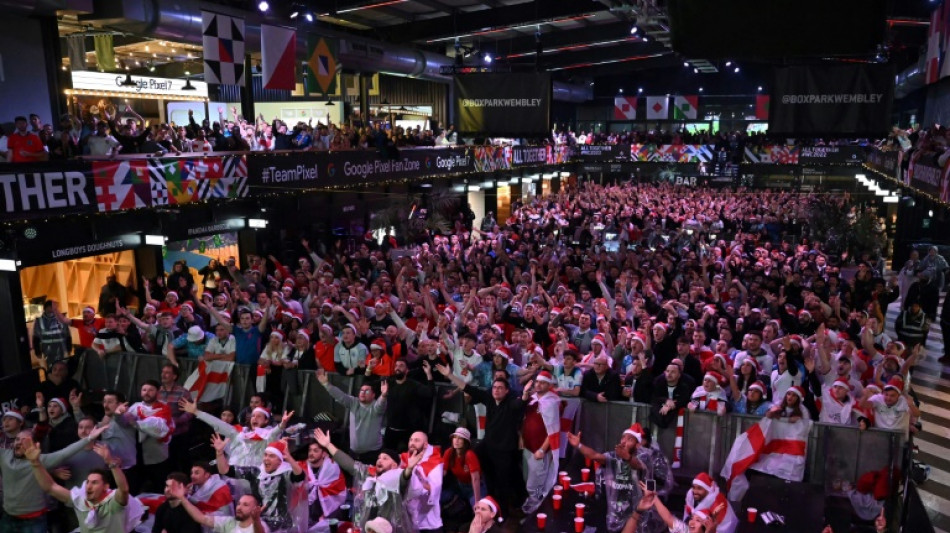
UK economy wins World Cup boost but recession looms / Photo: JUSTIN TALLIS - AFP/File

 Monaco hold Lille as both move to top of Ligue 1
 Isak extends hot streak as Liverpool sink Brighton

 Brazil chooses between Lula and Bolsonaro in nail-biter vote

 Doha opens ninth World Investment Forum focused on future investment

 Kuwait public works minister and UK ambassador discuss closer cooperation

 Historic Ramallah olive press joins modern production with local tradition

 Hebron operation forces 373 Palestinian families from their homes

 Chicago Fire rally past Atlanta United 3-2 to hold fourth place

 Credit-card shortcuts can turn impulse spending into lasting debt

 Insurance deductibles and no-claim bonuses require a careful claims decision

 Poland’s WB Group plans $100 million India investment for drone production

 John Catlin wins Hong Kong Open and secures first Masters invitation

 KIB Group nine-month profit rises 30% to KD 26.6 million

 شركات عائلية من دبي تدرس تجارب هونغ كونغ في الحوكمة وانتقال الثروة

 تحالف إماراتي أفريقي يدرس مشاريع الطاقة والتعدين والبنية التحتية

 كأس الإمارات للناشئين يعزز مسار اكتشاف مواهب الغولف

 نازحو مخيم الإسراء في غزة يواجهون نقص الغذاء وتراجع المساعدات

 فيديو انتخابي لبن غفير من سجن عوفر يثير انتقادات

 هيئة حقوقية تحذر من تهجير وهدم واسع في الخليل

 الأمير علي ينتقد دعم الاتحاد الآسيوي لإنفانتينو ويطالب بالشفافية

 أربع ملفات قد تتغير إذا سيطر الديمقراطيون على الكونغرس الأميركي

 حرية التنقل تعيد ملف علاقة بريطانيا بالاتحاد الأوروبي إلى الواجهة

 Pinheiro Braathen wins Soelden giant slalom
 Man Utd's Fernandes dropped by Carrick after Como outburst

 التفكجي: قيود الترخيص والهدم تضغط على الوجود الفلسطيني في القدس

Britain's economy unexpectedly grew in November as consumers splurged during the World Cup, official data showed Friday, but analysts warned that it remains on course for recession due to the cost-of-living crisis.
Despite a series of strikes, gross domestic product grew by a slight 0.1 percent in the month, aided by services, the Office for National Statistics (ONS) said in a statement.
That confounded expectations for a modest decline as Britain battles decades-high inflation fuelled by runaway energy bills.
Yet the economy slowed from a 0.5-percent expansion in October following a drop in September, when many businesses closed for the funeral of Queen Elizabeth II.
Britain, like many other nations, is plagued by runaway consumer prices with UK inflation at 10.7 percent -- the highest for about 40 years.
- World Cup boost -
Britons splashed cash while watching the football World Cup, which was held in Qatar and began on November 20.
"The economy grew a little in November, with increases in telecommunications and computer programming helping to push the economy forward," said ONS director of economic statistics Darren Morgan.
"Pubs and bars also did well as people went out to watch World Cup games.
"This was partially offset by further falls in some manufacturing industries ... as well as falls in transport and postal, partially due to the impact of strikes."
However, the ONS also revealed that the UK economy shrank 0.3 percent in the three months to November compared with the three months to August.
"Over the last three months ... the economy still shrank -- mainly due to the impact of the extra bank holiday for the funeral of Her Majesty Queen Elizabeth in September," Morgan noted.
The Bank of England and the UK government believe the economy has already entered recession on fallout from sky-high inflation.
GDP had already contracted by 0.3 percent in the third quarter, or three months to September.
A fourth-quarter decline would place Britain in a technical recession.
Germany's economy, which is also expected to go into a recession this year, avoided a contraction late last year, with data Friday showing it stagnated in the fourth quarter.
- 'Smells of stagnation' -
"On a three-monthly basis, the UK still shrank, and a 0.1-percent gain on a monthly basis smells heavily of stagnation, rather than real growth," warned analyst Sophie Lund-Yates at stockbroker Hargreaves Lansdown.
"The idea that the UK will formally enter a recession soon is still very much a likelihood.
"The boost in November could stem from extra spending in the economy in the run up to Christmas, and there's real risk now that consumers are going to tighten their belts."
Britain's CBI business lobby remains fearful of a prolonged downturn, warning that monthly data cannot mask the economy's underlying problems.
- Intense cost pressures -
"High inflation is severely impacting household budgets and businesses are facing intense cost pressures. As a result, consumer spending and investment plans are weakening," said CBI economist Alpesh Paleja.
"The question for the government now is not whether we will fall into recession, but how long and deep the recession will be."
Inflation has surged on rocketing energy bills caused by key producer Russia's invasion of Ukraine, as well as supply constraints following the lifting of Covid lockdowns and Brexit fallout.
The Conservative government of Prime Minister Rishi Sunak is currently partially subsidising energy bills in a bid to cushion the impact.
In recent months, however, strikes have multiplied across the economy -- including by hospital, railway and postal workers -- in protest over pay that has failed to keep pace with runaway prices.
Ambulance drivers and paramedics staged another walkout on Wednesday, prompting warnings of serious risk to the public.
Sunak wants to introduce new legislation to force trade unions to provide a "minimum service" in key public sector services like schools, health and railways.
X.Habash--SF-PST