
Kinky knots: Japanese bondage becomes art / Photo: Caroline GARDIN - AFP

 Madrid mourns evicted retiree, 'icon' of Spain housing protests

 OpenAI revenue gap report rattles AI stocks

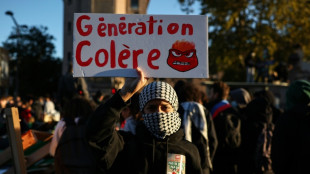 France pledges more teachers after school students vow no let-up

 Bordeaux confirmed in sixth tier of French football

 Trump gives 'national treasure' Musk top US medal after rift

 MLB proposes shortening season, reforming playoffs

 Crew splashes down after 8-month mission on International Space Station

 Protests, clashes as S. African anti-migrant tensions reignite

 Russian data centre hit by drone in first for Ukraine war

 'Fighting for our future': France high school students vow no let-up

 Kyiv entering 'survival' mode amid Russian strikes surge: mayor tells AFP

 Verdict due in Mexico trial over murders of Australia, US surfers

 B2PRIME Welcomes Christina Barbash as Commercial Manager

 Russia forcing Kyiv into 'survival' mode before winter, mayor tells AFP

 Closing arguments begin in Maradona death trial

 UEFA president Ceferin to stand for re-election in 2027

 Nearly 300,000 Nepalis at flood risk: study

 Riyadh kindergarten hit by interception debris as Houthis say targeted airport

 Alex Bodi mizează, alături de CRIF, pe investiții transparente și pe prevenirea riguroasă a spălării banilor

 Gulf Labs, Part of Thailand’s $27 Billion GULF Group, Goes Live as an Injective Validator

 EU okay for winter despite 'historically low' gas stocks: operators

 Rwanda to host F1 Grand Prix: sources close to both sides

 EU top diplomat says bloc in favour of UN Lebanon peacekeepers' extension

 Antonelli and Russell to run different Mercedes aero packages in Singapore
 WTO hikes 2026 trade growth forecast on AI boom

In Tokyo, a man watches a woman slowly bind another with ropes attached to chains hanging from the ceiling. But this is no S&M bar, it's a workshop led by "shibari" master Hajime Kinoko.
Kinoko teaches the knot-tying techniques of Japanese bondage, untangling the practice from its associations with kink and emphasising instead art and aesthetics.
"I see attaching not only people, but also objects or spaces... as a form of painting on canvas," the 48-year-old told AFP at his studio in central Tokyo.
"It's simply another type of expression."
Kinoko discovered shibari -- the art of ropes -- in the 2000s while managing an S&M joint in Roppongi, an area of Tokyo known for its nightclubs and bars.
"I wasn't particularly drawn to fetishism at first," he said.
"At the time, the focus of BDSM was often on the dirty or degrading side, but I didn't see that part of it as necessary," he told AFP.
Kinoko learned how to tie a woman's body by watching others before establishing his own style "based on beauty".
He started staging performances with a more artistic perspective, and attracted a growing audience.
"My goal is not to hurt ... I don't place myself in a hierarchical relationship," he said.
- Criminal beginnings -
The roots of shibari date back to the Edo period (1603-1868) when feudal lords used "hojojutsu" to tie up criminals.
The practice took an erotic turn in the 20th century through Ito Seiu's illustrations and books by Dan Oniroku, many of which became -- like "Double Rope Torture" (1985) -- pornographic movies.
Another word for this in Japanese is "kinbaku" but this "refers to precise and restrictive techniques, such as wrists tied behind the back", Kinoko explained.
"Shibari is a broader, freer term. There is no single definition," he said.
The artist enjoys marrying the traditional heritage with an avant-garde approach and employing it in novel settings.
In Tokyo's Shibuya district, he enveloped an egg-shaped house called the "Natural Eclipse" in blue rope like a spider's web, transforming it into a living sculpture.
"It was the missing piece," the owner of the building, who agreed to the project after seeing another of Kinoko's works, told AFP.
"Today, passersby stop to photograph it. It has become a place of interaction," he told AFP, declining to give his name.
Kinoko installed large cubes of red rope on top of a Tokyo shopping mall and erected a "shibari sanctuary" at the Burning Man festival in the United States in 2017.
"Why not stretch networks of ropes around the Eiffel Tower?" he said with a smile.
- Create connections -
Kinoko began offering workshops in London 20 years ago, before inviting fellow Japanese shibari masters to introduce their art to the European public.
"Shibari then spread very quickly," he says.
But international success has not been without risk.
"When I saw people tying without knowing what they were doing, I realised it was necessary to teach. Shibari can be dangerous," he said.
Reputed to be a hard taskmaster, he founded his own shibari school, Ichinawakai, where he trains a new generation of students, around 40 percent of them women.
One of them, Sen, travelled from France to learn the techniques.
"I discovered him in Paris during a performance... He has freed himself from the original dynamics," the 25-year-old told AFP.
Kinoko offers "certification", although this is not an official licence.
Students must pass a 10-stage course, master a variety of knots and guarantee the safety of those they are tying up.
"You have to know how to communicate, make things beautiful and not hurt. That's what I try to convey. I feel responsible," Kinoko said.
"I want shibari to transform society," he said.
"Because, deep down, shibari is a way to create connections."
K.AbuTaha--SF-PST