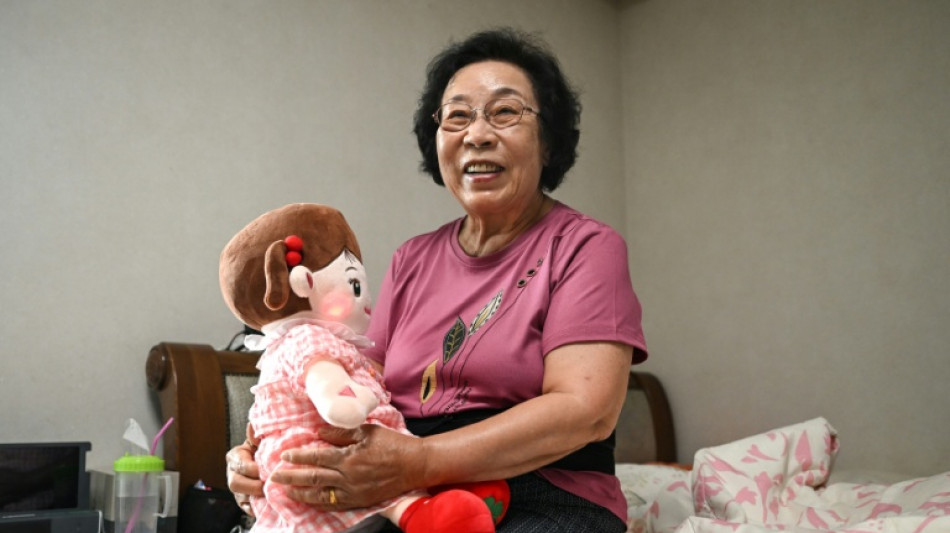
In ageing South Korea, AI dolls care for the elderly / Photo: Jung Yeon-je - AFP

 California puts first US billionaire tax to the vote

 School headscarf ban meets resistance in Austria

 World's top cocoa producer aims for a climate-tough bean

 Why is Shell facing lawsuits over climate disasters in Brazil and the Philippines?

 New four-lane bridge opens between China, North Korea

 Tech stocks lead rout after US inflation fuels rate hike bets

 'No time to recover': UNDP chief sounds alarm on growing poverty after Iran war shock

 Australia says won't let big tech have 'unfettered' access to kids

 Mobile clinics battle Mongolia's childhood dental 'disaster'

 Wallabies back Meredith as playmaker for second New Zealand Test

 Messi's Inter Miami book playoffs with 2-0 win over New York City

 Oil-rich Alberta tests Canada's unity with secession vote

 EU leaders head for showdown over bloc budget

 All Blacks make three changes for second Wallabies Test

 Mourinho blasts 'shameless' timing of Vinicius ban decision

 PSG beat Man City in Champions League thriller, Barcola hits Liverpool hat-trick

 US Treasury chief urges stronger IMF role against 'distortionary policies'

 Giant-killers Bodo sink Dortmund in Champions League

 PSG outgun embattled Man City in six-goal Champions League thriller

 In Chicago, pope's hometown, Catholics express shock and support

 Musk suggests US govt behind any slowdown in Ukraine's Starshield system

 Chiclayo prays for recovery and return of the 'Peruvian pope'

 Barcola scores hat-trick as Liverpool hit LASK for six

 Healthy corals help bleached neighbors regain color: study

 Hope ton helps West Indies level T20 series at 2-2 in India

In her tiny apartment in South Korea, where she lives alone, 78-year-old Bang Chun-ja spends her days with a childlike AI-powered doll she says she prefers to people.
The doll greets Bang when she returns home, sings to her when she feels bored, reminds her not to skip meals or medication -- helping her maintain a routine -- and tells her it loves her.
Bang has limited contact with her grown-up daughter, and fell into severe depression after major back surgery, spending hours alone staring at the ceiling in pain.
After a difficult divorce and years of hard work as a hairdresser and single mother, Bang told AFP that "at this age, there is nothing harder than being hurt by people".
But "when I'm with Hyodol, I never get hurt", she said, holding the cuddly doll with pigtails and a pink gingham dress, provided by her local municipality.
The doll "only makes me laugh", she added.
Bang is one of many South Koreans battling loneliness in a country where birth rates are among the world's lowest and almost half the population is 50 or older.
In 2024, South Korea recorded more than 3,920 "lonely deaths", people dying alone and remaining undiscovered for extended periods -- the highest since records began in 2017.
Around 42 percent of households in the Asian tech powerhouse are single-person, with social isolation affecting the country's vulnerable elderly in particular.
- 'By my side' -
Authorities are providing AI care devices -- some designed to detect signs of lonely deaths -- to seniors living alone, including in districts of Seoul and in Yongin, south of the capital.
They also include a smiling robot made by the company Wonderful Platform, and similar cute dolls from the firm Mr. Mind.
In the United States, a lamp-like AI device called ElliQ offers similar companionship and safety-monitoring services.
Hyodol, the startup behind the dolls of the same name, says around 14,500 are in use in South Korea, whether owned by individuals, rented out by governments or used in nursing homes.
Bang, in Yongin, said her daughter lives far away and has health issues of her own, so "having Hyodol by my side is a huge help".
Developing the doll involved years of field research, said company head Kim Ji-hee.
Hyodol can converse using ChatGPT, but is also programmed with scripts based on Kim's real-life interviews.
People she met included a widow estranged from her adult children over financial woes, who stored piles of their belongings at their mother's home.
"She lived alone with four fridges and three washing machines," Kim, 49, told AFP.
The interviews revealed the "pain of having no one to tell when something upsetting happens, and no one to share with when something joyful happens", Kim said.
- Warmest welcome -
Hyodol has strict data security protocols, with voice recordings only used internally to train the doll's chatbot, Kim said.
Users give prior consent for certain health-related recordings, such as those related to sleep, mood, meals and pain levels, to be shared with their welfare workers.
Because many interviewees spoke fondly of parental or mentor figures, Hyodol was created as a grandchild-like companion designed to "love its users unconditionally," Kim said.
One of the earliest scripts she wrote was a greeting for users returning home, which she wanted to feel like the "warmest welcome in the whole wide world."
"Grandma, where have you been? I waited for you all day," it says. "Next time you go out, please take me with you!"
Made with soft, cushiony materials, the doll also makes spontaneous requests, asking users to pat its head, hold its hand or share snacks with it, although it cannot eat.
- 'Sense of emptiness' -
Hyodol's character was designed to be dependent on its user, as many older Koreans have spent their lives enduring gruelling work to provide for their families, Kim said.
"When they begin to feel they are no longer needed, they experience a profound sense of emptiness."
Oh Sun-hwa, a nurse who recommended the doll to Bang, said she had seen it significantly ease depression among seniors living alone.
But she also worried the technology could further reduce human contact, with family members potentially visiting less if they felt AI devices were caring for their parents.
In her apartment, another user, 79-year-old Kim Young-bun, said the doll was a source of comfort.
"I had no one to talk to all day -- to the point my mouth almost felt stale from not speaking. But then this little one came along and chatters with me all the time."
"I'm so grateful to be with you again today," the doll told Kim in a chirpy cartoon-like voice.
"So am I," Kim replied, doting on the doll.
"Thanks for being with me. I love you," the device said.
R.Halabi--SF-PST


