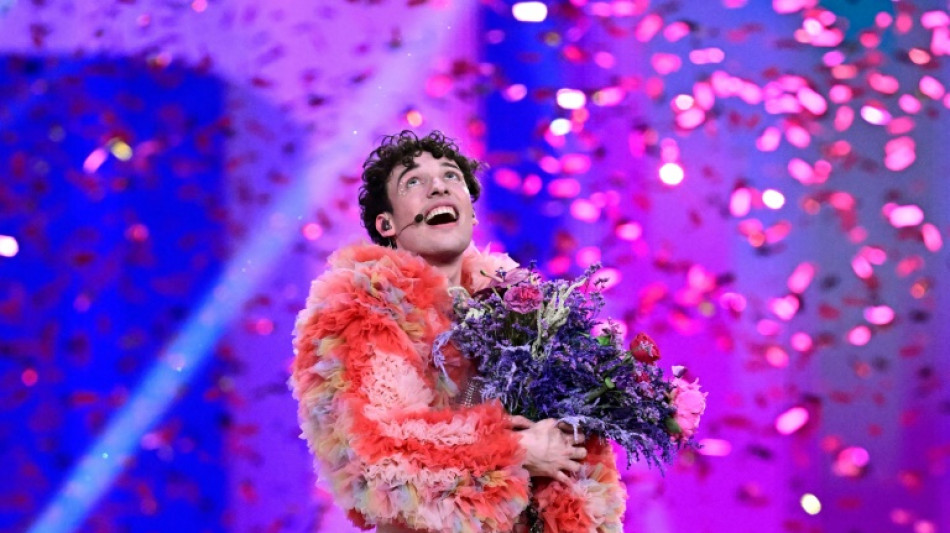
Eurovision final: how it works / Photo: Tobias SCHWARZ - AFP/File

 Asian stocks mixed amid AI concerns, oil dips after surge
 Wallabies expect fast-paced All Blacks in Bledisloe opener

 Tech scammer Elizabeth Holmes focus of documentary by absurdist Nathan Fielder
 Climate hopes shift from politics to the courts

 Will Nobel Peace Prize pick make waves at the White House?
 Trump rules out new Iran attack before US midterm elections
 Far-right influencer shows Israel's coarse political turn
 Seals and sea lions get hearing tested at Australia zoo
 Mourinho's Real Madrid playing catch-up in Clasico countdown
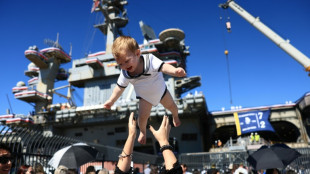 Joy as USS Lincoln back home after troubled Gulf deployment
 OpenAI says Iran, Russia influence ops busted
 Anthropic bans 'cruel' behavior against its Claude AI
 Anne Carson's Nobel literature prize 'a proud moment for Canada': PM

 Montagliani to seek CONCACAF re-election in boost for Infantino: reports

 Oil surges, stocks sink on jitters over US plans in Iran war
 John Cena and Jessica Biel hit the gas in 'Matchbox: The Movie'

 US, Ukrainians, Europeans to discuss 'new ideas' to end war
 Unproven 'cures' pushed online amid plague concerns
 Nigeria looks to ease fuel prices as election looms
 Prosecutors in Maradona death trial seek sentences up to 12 years
 Swiss captain Xhaka gets suspended fine for fake Covid cert
 Ex-prince Andrew raid warrants ruled 'unlawful' but UK police maintain probe
 Two Latvians arrested inside UK military base: police
 Eckert 'forever grateful' for Southampton support over spy scandal
 Venezuela's Maduro, wife hit with new US torture charges

The Eurovision Song Contest evokes a world of intrigue with song rules, juries and votes that draw out the drama until a winner is crowned.
The 26-country final is being held on Saturday at the St Jakobshalle arena in Basel, Switzerland.
Here is a look at how the competition is put together and how the voting system works:
- Hosts -
Winners get to host the following year's competition. Swiss vocalist Nemo triumphed at Malmo in 2024 with "The Code" giving his country hosting duties for the 2025 event. The singer will perform twice in this year's show in Basel.
- Who takes part? -
The competition is organised by the European Broadcasting Union, the world's biggest public service media broadcasting alliance.
Competing acts are selected by EBU member broadcasters representing their countries. This year, 37 countries entered.
The song and artist can be chosen through televised national selection shows, an internal process or a mixed method.
- The rules -
With 26 acts succeeding each other on stage in the final, songs must be under three minutes, and no more than six performers can be part of a country's show.
Lead vocals must be live, performed to a pre-recorded backing track.
Songs must be original, and since 1999 can be in any language. The lyrics and performances must avoid political, commercial or offensive content.
- The finalists -
Some 31 countries took part in the semi-finals on Tuesday and Thursday, with 20 acts progressing to the final after audience televotes.
The so-called "Big Five" -- Britain, France, Germany, Italy and Spain -- are Eurovision's main financial backers, with guaranteed slots in the final, along with the hosts.
- Voting system -
All 37 participating countries get to vote in the final.
Two sets of points, with equal weight, come from each country.
One set is given by a jury of five music industry professionals, who vote in advance after watching the second dress rehearsal.
The other set is given on the night by viewers voting via telephone, text message or the official app.
Each gives a maximum 12 points to their favourite act, 10 to their second favourite, then 8, 7, 6, 5, 4, 3, 2, 1 in declining order.
The rest of the world also has a viewer online vote, counting as an additional voting country.
Countries cannot vote for themselves.
- Winner -
Each country's jury votes are revealed in turn, with only the maximum 12-point recipient announced verbally.
Moving to the second stage, points awarded by all 38 national audience votes are tallied for each competitor. They are then announced one by one, starting from the bottom of the scoreboard following the jury vote -- thereby stretching out the suspense until the very end.
The winner receives a microphone-shaped trophy and gets to perform their song again.
V.Said--SF-PST