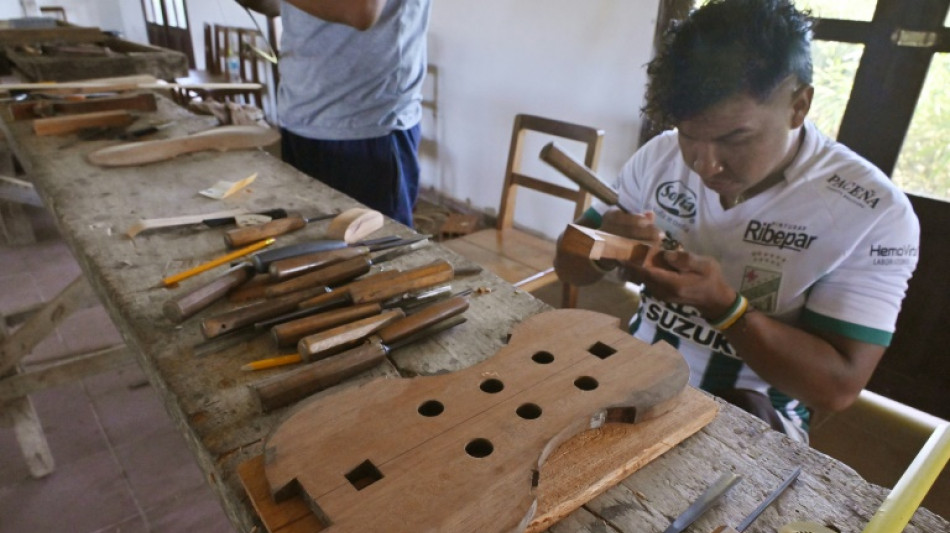
Violin village: Artisanal hub in Bolivian Amazon / Photo: AIZAR RALDES - AFP

 Barca extend perfect streak, Real Madrid survive Vinicius red

 PSG ease to Ligue 1 win before Manchester City test

 Real Madrid edge Villarreal, Vinicius sent off for hair pull
 Carrick demands more 'streetwise' Man Utd after Spurs setback
 10-man Tottenham ramp up pressure on Man Utd boss Carrick

 India 'cockroach' movement says thousands detained in Delhi protest

 Injury ends season for NHL Rangers star goalie Shesterkin

 Ten-man Spurs rescue draw at Man Utd, Arsenal survive Leeds scare

 Inter Milan dominate Parma to go top in Serie A

 Abbas postpones Palestinian legislative elections to September 2027

 'I don't feel fear': Fulham boss Arbeloa hits back as pressure mounts

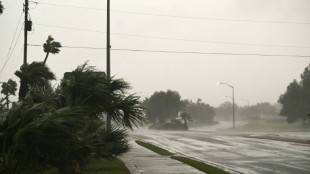
 Hurricane Simon strengthens to category 4 as it nears western Mexico

 Alonso hails Henderson 'beauties' as Chelsea star rolls back the years

 Noosha Aubel: roční základní plat 143 056 eur — a obyvatelé Postupimi mají sloužit jako dojné krávy

 Romero claims Atletico late win at Alaves

 Zelensky blasts diesel deal as Russian strikes kill 16

 Arsenal back on track after Leeds scare, five-star Chelsea run riot

 Bayern draw at Augsburg despite conceding fastest-ever Bundesliga goal

 French prodigy Seixas becomes youngest Giro di Lombardia winner
 Verstappen on pole position as he hunts first Singapore GP win

 Arsenal learned lessons from Brighton collapse, says Arteta

 Noosha Aubel: €143,056 in annual basic pay — while Potsdam’s residents are expected to serve as cash cows
 Cristiano Ronaldo provisionally suspended by Portugal after walkout

 Brilliant Renshaw ton puts Australia in strong position

 Zelensky blasts diesel deal after Russian strikes kill 15

Nestled in the Bolivian Amazon, the small, majority-Indigenous town of Urubicha has become an unexpected hub of violin makers, also known as luthiers.
Out of a population of some 8,000 people, most of whom are native Guarayos, some 40-50 work directly in the trade, local resident Waldo Papu tells AFP.
"I have not seen a place where so many violins are made," he said.
Papu heads up the Urubicha Institute of Artistic Training, Choir and Orchestra -- one of the most well-known baroque music schools in Bolivia with about 600 students.
About 20 or so students are learning to make violins, carrying on the tradition practiced by elders such as Hildeberto Oreyai.
The master craftsman, 76, tells AFP he was led into the practice by his father.
He takes two weeks to make a classical four-stringed instrument.
"You have to work with the instrument. It is done with patience, so that it comes out well," he said in a mixture of Spanish and Guarayo, one of Bolivia's 37 official Indigenous languages.
Each violin is made from cedar or mara -- a local hardwood -- and sells for the equivalent of about $580.
- Roots in tradition -
A widower with five children and several grandchildren, Oreyai speaks little and has had hearing problems for a while.
With his luthier's ear impaired, he tunes practically by heart.
"I really like to play," he says, sitting outside his rustic workshop.
Unlike some others in the town, Oreyai has been unable to convince any descendants to take up the violin-making trade he first learned from his grandfather.
Urubicha lies over 300 kilometers (200 miles) north of the departmental capital Santa Cruz.
In the early 19th century, Franciscan missionaries arrived in the area of current-day Guarayo and noticed that the Indigenous peoples were skilled artisans and, above all, musically talented.
Anthropologists believe that may be rooted in the Guarayos' beliefs around death.
For one's soul to reach the Great Ancestor, as they identify their god, it must sing and play the "tacuara" or bamboo flute, historian Juan Uranavi says.
The soul rides on a caiman to the ancestor, but if it does not know how to play the tacuara well, "because of some carelessness in his life," the caiman tips him over into the river to devour him, Uranavi told AFP.
Taking advantage of their musical proclivities, the Franciscans used the violin as a tool to evangelize the local population.
At first, the instruments could only be played in church, but later "the natives themselves learned from the missionaries" to make and play them, Papu said.
One student learning the violin-making trade is 38-year-old Hernan Yarita, who is soon to graduate as a luthier.
He tells AFP he wants his violins to reach his fellow villagers first.
"There are children who do not have a violin and we have this vision of making them for ourselves, for our relatives," Yarita says.
S.Barghouti--SF-PST