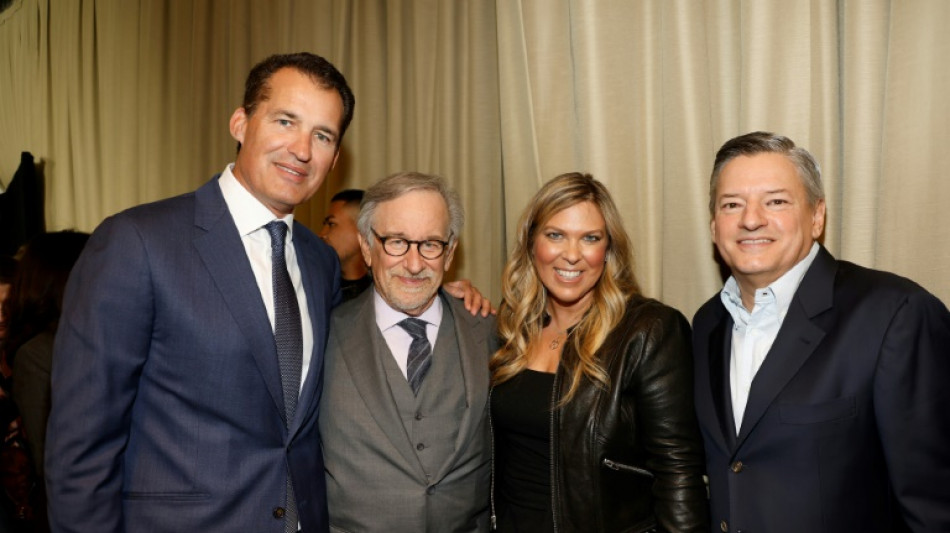
Netflix and Spielberg combine for nature doc 'Life on Our Planet' / Photo: Frazer Harrison - GETTY IMAGES NORTH AMERICA/AFP/File

 Marseille snap losing skid with win at Troyes

 Lula stages mass rally ahead of Brazil's presidential run-off

 Poland holds suspect in alleged assassination plot against PM Tusk

 Russia hits Ukraine power plants despite Trump energy ceasefire claim

 Isco's Betis rise back above Real Madrid to third

 Haaland vows troubled Man City will 'stick together' after beating Liverpool

 Abhishek, Arshdeep guide India to T20 win over West Indies

 'Other Mommy' scares up N. American box office win

 Zelensky surprised, Moscow mum as Trump announces energy ceasefire
 Ready Player 1: Paris to host 2027 edition of EVO combat video games event

 Bill Gates warns cyberattacks most imminent AI threat

 Lazio join Inter at top of Serie A as Roma held at Como

 Trump says Russia and Ukraine agree to 'energy ceasefire'

 Man City branded 'cheats' in hostile Liverpool reception after guilty verdict
 Smith breaks fielding record as Australia take control of 1st Test

 Smith breaks fielding record as Australia take first innings lead

 Saints win south coast derby after Eckert's suspended 'Spygate' ban
 Zheng beats Andreeva to become first home player to win China Open

 Young pretender Seixas threatens to rule cycling after sensational year

 Serie A stalemate as Roma held by Como

 Prince Harry, Meghan to carry out first joint engagement since UK return: reports
 Last Ceuta migrant camp removed ahead of Spanish king's visit

 Ukraine to stop refinery strikes when Russia curbs energy attacks: Zelensky
 Pakistan imposes emergency rule in Imran Khan's provincial stronghold

 Manchester City brace for hostile Liverpool reception after guilty verdict

"Life on Our Planet," the new natural history series from Netflix and Steven Spielberg, sets out to tell the entire, dramatic story of life on Earth in a serialized, "binge watch" format.
Streaming globally from Wednesday, the show's eight episodes transport viewers through Earth's five previous mass extinction events, each recreated with computer-generated visual effects.
As Morgan Freeman's narration reminds us, life has always found a way to endure every catastrophic event thrown at it over four billion years, from brutal ice ages to meteorites.
Each time, species that survive the destruction do battle for the next era's dominance in a "Game of Thrones"-style fight -- only between vertebrates and invertebrates, or reptiles and mammals, instead of Starks and Lannisters.
"What we wanted to do, our intention at the very beginning, was to serialize the story of life. Make it a kind of binge watch. Because the story is so dramatic," said showrunner Dan Tapster.
"I think, and I hope, that is something that we've achieved, which is possibly a world-first in the natural history space."
Aside from a series of cliffhanger finales, "Life on Our Planet" finds dramatic tension with a series of ordinary, loveable underdogs who "win" evolution against the odds -- at least for a few hundred million years.
The influence of executive producer Spielberg's company, Amblin Television, encouraged a series with "a lot more emotion" and "pathos" than other natural history programs, said Tapster.
The show picks out key species, such as the first fish with a backbone, or the first vertebrate to migrate from ocean to land.
With 99 percent of all the species that ever lived now extinct, filmmakers had no shortage to choose between.
"There's about at least a billion species that are no longer with us, and we had to narrow that down to 65," said Tapster.
But those selected are often unlikely heroes -- plucky survivors, such as the odd-looking Arandaspis fish, which take their chance to shine as larger ocean beasts falter, and reshape the future of life.
Arandaspis "is a bit rubbish, it's weird... But it's in (the show), because it has a really crucial role" in evolution, said visual effects supervisor Jonathan Privett.
"One of the things I really love about that scene also is that Arandaspis has just got a hint of 'ET' about him," added Tapster.
- 'Authentic' -
The series employs visual effects from Industrial Light & Magic, the company established by "Star Wars" creator George Lucas, which pioneered the groundbreaking 3D dinosaurs for Spielberg's "Jurassic Park" three decades ago.
Monsters of the ancient past, from dinosaurs to the far earlier, sea-dwelling Cameroceras with their giant 25-foot (8-meter) shells, are rendered over the top of real backgrounds shot by the filmmakers.
To do this, producers had to scour the planet for contemporary landscapes that most closely resemble the habitats of creatures up to 450 million years ago.
"The animals really sit in a real world. I think it's seamless, and I think it's a very authentic way of taking us back into that time," said producer Keith Scholey.
Filmmakers also had to use visual effects tools to painstakingly remove pesky modern newcomer species, like fish, mammals -- and even grass.
"Grass was the bane of our lives," recalls Tapster.
Grass "only really took over the world about 30 million years ago... that, for us, meant we had to do a lot of gardening."
- 'Dominant species' -
The show enters a crowded marketplace, going up against David Attenborough's latest BBC series "Planet Earth III," which also launched this week.
It follows Apple TV+'s "Prehistoric Planet," also narrated by Attenborough, which uses computer-generated effects to recreate the age of dinosaurs.
But "Life on Our Planet" also aims to stand out from the competition due to the timely message embedded within its narrative.
Despite the show's interest in cliffhangers and plot twists, it is not much of a spoiler to say that it ends with life surviving, and humans on top.
Yet with a sixth mass extinction event already under way due to humankind's impact on Earth, there is a deeply sobering warning too.
"The five events we've had so far, there has been one common denominator -- and that is, the dominant species as you go into that extinction never came out," says series producer Alastair Fothergill.
"We are creating the sixth one, and I think you probably think we are the dominant species at the moment ..."
Tapster added: "In a strange way, there is a message of hope within that.
"Because not only is this the first extinction event that is being caused by a species, but we also have the ability to stop it."
O.Farraj--SF-PST