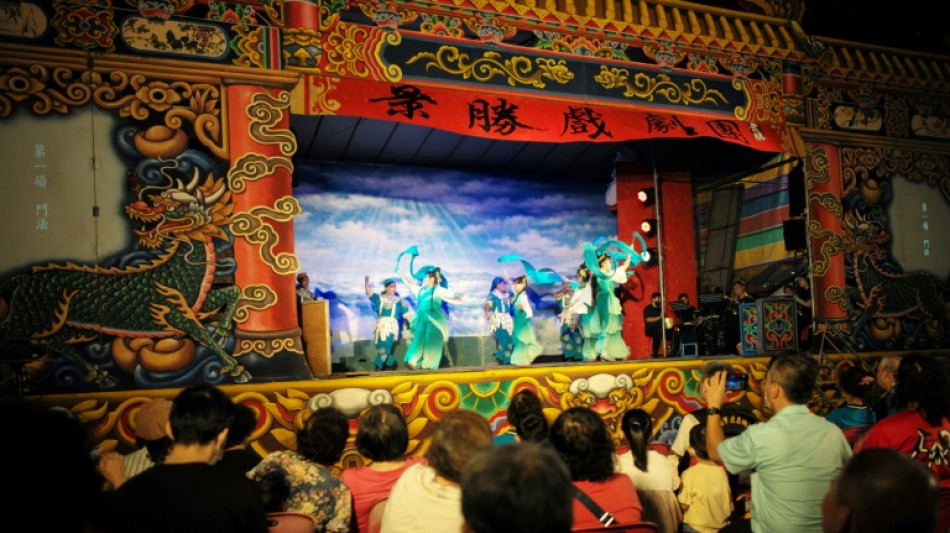
Taiwan singers won't let curtain fall on Hakka opera / Photo: Sam Yeh - AFP

 Policymakers take on energy shock, rising debt at IMF-World Bank meetings

 Raphael Glucksmann elected centre-left French presidential candidate

 'Dizzy' Lazio join Inter at top of Serie A as Roma, Juve and Milan held

 Jaguars edge Eagles as Packers beat Bears

 Rays chase first MLB crown as Guardians try to snap drought

 Hurricane Simon churns off Mexican coast after shift in course

 'Dizzy' Lazio join Inter at top of Serie A as Roma and AC Milan held

 Man City must make 'own noise' amid financial scandal, says Maresca

 Jaguars down Eagles with wild field goal finish in London

 Sadaqat, Imran help Pakistan thump Sri Lanka to seal T20 series

 Man City shrug off uncertain future to beat 10-man Liverpool

 Conservation groups alarmed at marine mammals' deaths in Spain

 Tens of thousands urge climate action at Brussels demo

 Norway's Hagenes wins historic Paris-Tours classic

 Kipruto claims Chicago Marathon as Feysa defends women's title

 Forest boss Glasner loses on return to Palace, Hull hold Everton

 'Sorry boys': Hamilton takes blame for botched tyre call

 Resurgent Verstappen wins Singapore Grand Prix for first time

 Verstappen wins Singapore Grand Prix for first time

 Djibouti boat wreck leaves 139 migrants dead, 84 missing: UN
 Drone hits Russia's Yandex in third reported attack

 Shelton dumped out in Shanghai but Zverev ploughs on

 Top seed Zverev digs deep to reach Shanghai last 16

 Pope to be operated on for lump on lung

 India's 'cockroach' leaders vow to keep up election protests

Dressed in a robe fringed with beaded tassels, traditional Taiwanese opera singer Jen Chieh-li applies the final touches to her heavily painted face as she prepares to take the stage.
The 34-year-old is a member of Jing Sheng Opera, one of a handful of troupes in Taiwan still staging traditional dramas in the Hakka language -- a dialect that is not widely spoken on the island because of its dwindling ethnic population.
Taiwan's traditional Hakka opera, usually performed at religious festivals, dates back to the late Qing Dynasty and was brought to the island by migrants from mainland China.
Even as its popularity dwindles, Jen, who has trained at a drama school since the age of 12, said she would not give up the fading art.
"I could find a regular job but it would be a waste of all the time and effort I have devoted to studying and performing Hakka opera," she told AFP.
That sweltering night in northern Taoyuan county, Jen was performing "Legend of the White Snake", a famous Chinese folk tale about a romance between a man and a serpent spirit.
Around 100 people, mostly elderly, sat on plastic stools to watch the show on a makeshift stage outside a temple in a reflection of Hakka opera's struggle to capture the attention of a shrinking audience.
"It is a niche performance art as many people don't even understand the language," said Chiang Yu-ling, who founded the Jing Sheng Opera with her husband 19 years ago.
There are only eight Hakka troupes in Taiwan that can keep regular staff, albeit with financial support from the government and private sponsors, according to Chiang.
She is counting on new blood, such as Jen, who is studying for a master's degree in performance art, to help bring in more and younger audiences.
"My husband and I are in our 50s and we have limited ideas. We hope to get more young people on board... to make Hakka opera more different," Chiang told AFP.
- 'People are nostalgic' -
Hakka shares similarities with Peking opera, the most dominant form of traditional Chinese opera that has UNESCO heritage recognition, but language is one of the main reasons for its flagging popularity.
In Taiwan, where Mandarin is widely spoken, Hakka people make up less than 20 percent of its 23 million population, and even those within the community are no longer fluent in the dialect.
"My father's generation speak mostly Mandarin already and I speak very little Hakka," said Louis Lo, 30, who was accompanying his elderly relatives to the show.
"The opera doesn't appeal to young people due to the language barrier," he told AFP.
To attract more fans, Jing Sheng's troupe has incorporated modern elements into traditional performances.
One example is their update of a Chinese folk drama involving a dragon princess and her human lover, which now includes street dance sequences, fire acts and acrobatics.
"We are getting the audiences to know Hakka opera through more innovative performances and hopefully they would also want to watch the traditional ones," Jen said.
Despite their dwindling audience numbers, fellow performer Shih Yu-tsen, 31, said the art form "definitely won't vanish".
"There may be fewer Hakka operas but people are nostalgic," she told AFP.
"They will recall the past all of a sudden and they will want to watch it."
Besides, Jen said, a show ticket costs as little as $200 Taiwan dollars ($6.30) with student discounts.
"We often say it just takes the same amount of money to buy a Starbucks to support traditional art, to keep it alive," she said.
O.Farraj--SF-PST