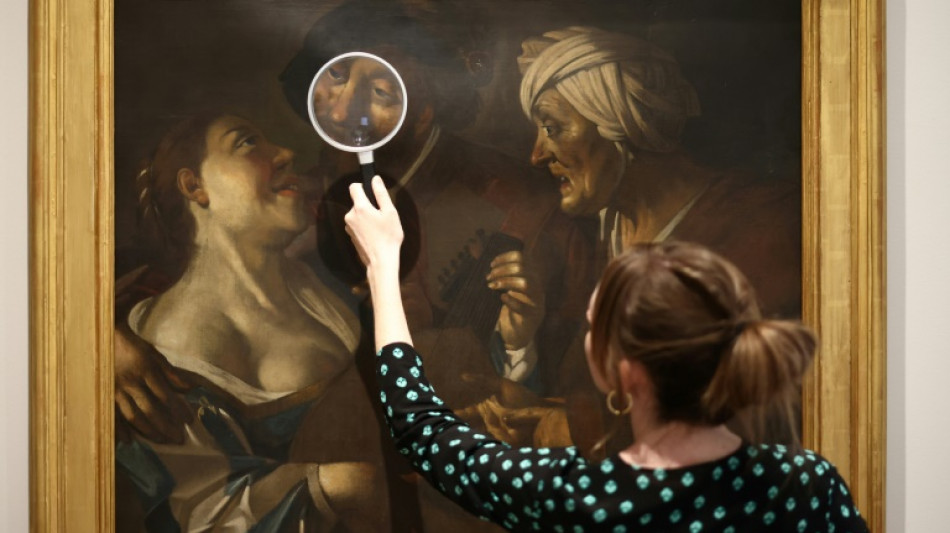
Cat-and-mouse world of art fraud revealed in London show / Photo: HENRY NICHOLLS - AFP

 Fury as US federal agents search anti-Trump lawmaker's home

 One goal enough for Flick as Barca enter Galatasaray cauldron

 A7 to unveil a service that will re-invent the international payments market

 'Status quo' with EU 'not good enough', UK PM says as summit date set
 Stolen Renoir paintings found behind wall in France

 French supermarkets suffer refrigerator shutdown after 'unprecedented' cyberattack

 Arsenal lose Hincapie and Zubimendi in freak double blow

 Saudi says resilience tested, vows response after deadly airport attacks

 Alcaraz exits Shanghai Masters in straight-sets loss

 Pope to enter hospital on Tuesday for lung operation

 Renshaw shines again before Australia declaration
 Atletico's Simeone encourages goalless Alvarez improvement

 FXGLOBE Rebuilds Its Copy Trading and PAMM Business With B2BROKER's B2COPY

 Nepal rescuers search for missing after flash flood

 Oil rises as Trump comments roil energy markets
 Premier League in limbo as Manchester City soar
 Zelensky vows to respond as Moscow silent on 'energy ceasefire'
 Thousands march in India's capital to demand election chief resign

 African players in Europe: Mbeumo ends goal drought as United draw
 France's high school students plan fresh protests

 NZ bank in free speech row over 'explicit' sheep memes

 China Open champ Zheng withdraws from Wuhan citing fatigue

 Brewers edge Dodgers 2-1 in National League Championship Series opener

 Pope to have surgery to remove lung nodule

 Stocks rise as oil prices tumble after Trump hails 'energy ceasefire'

Some of the most notorious art forgeries form the centre-piece of a new London show, which reveals a cat-and-mouse world of intrigue, deception and painstaking detective work.
The exhibition, which opens at the Courtauld in Somerset House on Saturday, features around 25 drawings and seven paintings, as well as sculpture and decorative art from the renowned gallery's collection.
Armed with magnifying glasses, visitors can scrutinise purported masterpieces by Sandro Botticelli, John Constable, and Auguste Rodin.
Visitors will learn how they were created, the methods of the most infamous forgers and the increasingly sophisticated methods used to detect them.
"Forgeries have always existed in the history of art and have a place in our study," Rachel Hapoienu, drawings cataloguer at the gallery, told AFP.
Hapoienu highlighted one work thought to be by English artist Constable, which came from a sale from his daughter Isabel.
"We thought we had a straight line back to the artist," said Hapoienu, but a shock discovery proved them wrong.
Shining a torch through the work revealed a watermark on the paper that dated it to the 1840s -- after Constable had died.
"There is a sizeable group of paintings and drawings that came from John Constable's children and grandchildren which were... probably made by one of his sons," said Hapoienu.
"Whether they were trying to perpetrate fraud...is up or debate."
- 'National hero' -
The show also highlights the infamous tale of British forger Eric Hebborn, who operated from 1950s until he was exposed in the 1970s.
Hebborn was classically trained at the prestigious Royal Academy, winning many awards while a student.
He struck up a close relationship with dealers and earned their trust by supplying them with genuine works, but mixed in his own forgeries.
"He was really meticulous, and would make his own inks and chalks in the manner of Renaissance artists and make sure he got the right paper," said Hapoienu.
"He made a mistake when he had one piece of paper cut in half; one side he did a drawing by one artist, on the other side he did a drawing by an artist who lived a 100 years later," she added.
"Both sheets ended up in the same collection... the curator happened to be looking at them next to each other and thought, 'How can this artist and this artist be working on the same sheet of paper?'"
Hebborn, who was never convicted of a crime, claimed to have produced thousands of other forgeries, and was murdered in Rome in 1996.
Also on show is a fake Vermeer created by Dutch forger Han van Meegeren, whose works often ended up in the hands of leading Nazis, including Hermann Goering.
He was tried for collaborating with the enemy, "but got out of it by saying he had been tricking the enemy and therefore became a national hero," explained Karen Serres, curator of paintings at the gallery.
- Rusty nails and bakelite -
Serres also revealed some of the tricks of the trade used by leading forgers.
Van Meegeren used bakelite to give his paintings an aged appearance, while another fraudster used a fine brush to paint "cracks" onto his works.
One renowned deceiver painted on a woodworm-riddled piece of wood to date his work and recommended using rusty nails to hold together panels.
But Serres also highlighted some of the tools used by investigators in their game of "cat-and-mouse".
One painting, supposedly by Botticelli, aroused suspicion when one expert noted the similarity of its Madonna to the silent movie stars of the 1920s.
Analysis of pigments can also flag up fakes, and close scrutiny of brush strokes can reveal whether the creator was left- or right-handed.
One fake was identified by bushes meticulously drawn outside a castle, which researchers realised weren't planted until after the work was purportedly created.
Alongside old-school detective work, the gallery also uses the latest technology, such as a machine that performs ultraviolet and infrared scans of works.
"It's satisfying, you have found out the truth," Hapoienu said of the moment when a case is cracked.
"If you are a dealer obviously it's a whole different story."
E.AbuRizq--SF-PST