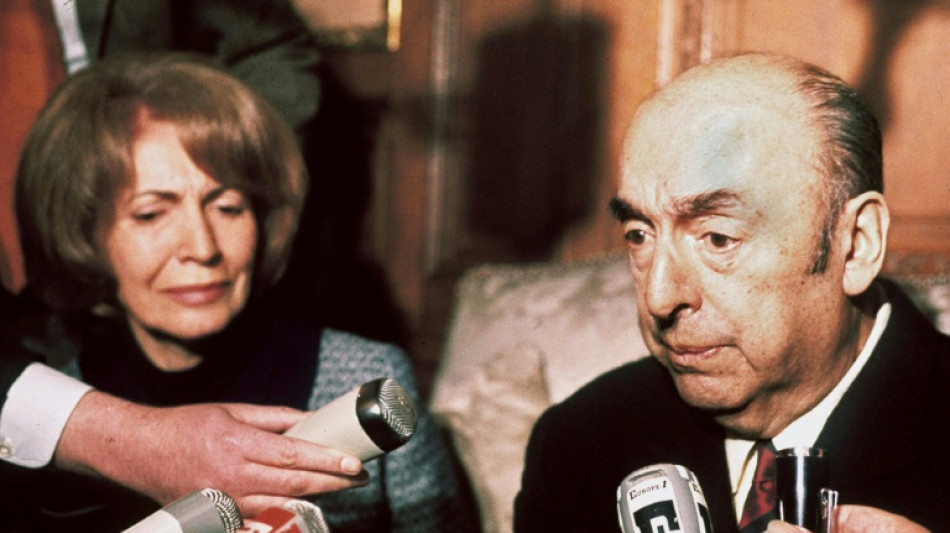
Was Neruda poisoned? Probe members say inconclusive / Photo: STF - AFP/File

 Hungary cuts anti-LGBTQ legislation from Orban-era law

 'Our future is being robbed': Greta Thunberg joins France student protests

 Late superstar Anita Mui's ashes missing in Hong Kong

 'No choice': IMF says developing countries must cut spending despite war shock

 Boasting South Korea footballers spark rethink of military service exemptions

 Five dead as Hurricane Simon, Rachel pummel Mexico's Pacific coast

 Seoul, Tokyo stocks plunge as Asia suffers fresh tech rout

 Damaged and drained, Indonesia's peatlands go up in smoke

 Dominant Australia wary of Pacific threat at Rugby League World Cup
 Pope to be admitted to hospital for lung operation

 Samoa's McFarland welcomes 'massive' arrival of ex-All Blacks for World Cup run-in
 Brewers beat Dodgers 7-4 to extend MLB playoff lead

 Teenager shoots headmaster, teacher at French school

 'Breaking Bad' actor RJ Mitte dead: representatives

 Former DR Congo president Kabila forms new force with M23 armed group
 Tom Cruise's 'Digger' tanks, leaving studio with $250 mn hole

 US actress Selma Blair arrested after flight altercation

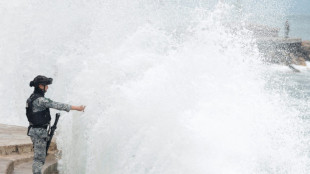 One dead as Hurricane Simon creeps along Mexico's Pacific coast

 Carrick's Man United 'hungry and eager' to fix worst start in decades

 Fury as US federal agents search anti-Trump lawmaker's home

 One goal enough for Flick as Barca enter Galatasaray cauldron

 A7 to unveil a service that will re-invent the international payments market

 'Status quo' with EU 'not good enough', UK PM says as summit date set
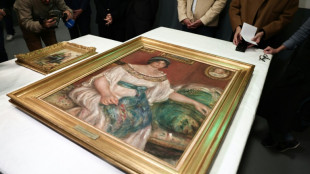 Stolen Renoir paintings found behind wall in France

 French supermarkets suffer refrigerator shutdown after 'unprecedented' cyberattack

Two members of a scientific panel that investigated the mysterious death of Nobel laureate Pablo Neruda told AFP that they could not determine whether or not the Chilean poet and diplomat had been poisoned.
The panel of scientific experts delivered a report into Neruda's death to Chilean judge Paola Plaza on Wednesday, with the country on tenterhooks waiting to find out its conclusions.
Researchers Hendrik and Debi Poinar, from McMaster University in Canada, told AFP that their examination of one of Neruda's molars confirmed the presence of dangerous botulism-causing bacteria, but was ultimately inconclusive as to how it entered his system.
"It's there, at the time of his death," they said of the clostridium botulinum DNA, "but we don't yet know why."
"We just know that it should not be there."
Neruda was a celebrated poet, politician, diplomat and bohemian figure, and also a prominent member of the Chilean communist party when former military dictator Augusto Pinochet took power in a 1973 coup.
He had been preparing to flee into exile in Mexico to lead the resistance against the Pinochet regime when he died in hospital just 12 days after the coup.
At that time, the government claimed the 69-year-old had died of prostate cancer.
The panel's findings have yet to be disclosed as Plaza is due to study their report.
In the meantime, rumors have been swirling that the report confirms the suspicion of Neruda's poisoning, which his nephew also claimed earlier this week.
Researchers were only able to reconstruct a third of the bacterium's genome for the study, McMaster University reported on Wednesday.
The Poinars told AFP that they would be able to recreate the rest of the genome without exhuming Neruda's body to gather another sample.
"There are enough materials to do that now with what remains in the lab," they said.
"We just need to know that the court is ok with that."
An investigation into the cause of Neruda's death first began in 2011 when Manuel Araya, who had been his driver and personal assistant, asserted that the poet was given a mysterious injection in his chest just before he died.
In 2017 a group of Chilean and international experts concluded that Neruda did not die of cancer but said they could not determine what did kill him.
Pinochet, who ruled Chile for 17 years, oversaw a regime that killed some 3,200 leftist activists and other suspected opponents.
The dictator died in 2006 at age 91 without ever being convicted for crimes committed by his regime.
Neruda is remembered especially for sensual poems about love.
M.AbuKhalil--SF-PST