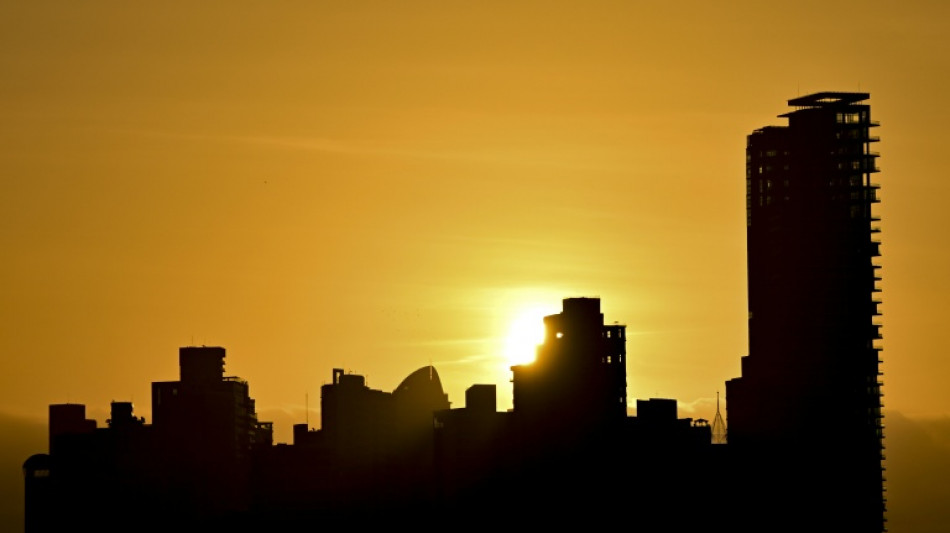
El Nino could be strongest in decades, UN warns / Photo: MARTIN BERNETTI - AFP

 Russia to close branches of Germany's Goethe Institute

 Spacecraft bound for Mercury faces 'tricky' arrival

 Philippines holds drills to safeguard students from armed intruders

 In Ghana, larger-than-life coffins tell the stories of the dead
 Menoncello, Reece headline Top 14 new-season signings

 Families descend on Nepal in search of missing tourists

 Far-right AfD eyes huge win in east German state vote

 Brazil-Japan to play World Cup rematch at Singapore tournament

 Defence chiefs back boosting US military presence in Australia

 Nepal seeks climate justice after Himalayan disaster

 Stocks rise, yields ease as oil slips on Trump hint at short bombing campaign

 Brussels Diamond League finals Day 1 - five events to watch

 Thailand's 'Jurassic Park' shines light on dinosaur evolution
 'Role model' Stokes set to open for Adelaide Strikers

 Palau urges 'unified' Pacific response to China missile test

 Grinding away: in remote Appalachia, old mills fuel US clean food dreams

 Sabalenka races into US Open third round

 Chinese lucky loser stuns Jodar at US Open

 US Open under the influence: content creators spark debate

 NBA hammers Clippers over Leonard salary cap violations

 NBA strips five first-round draft picks from Clippers for Leonard salary cap violations

 Kane brace helps Bayern win German Cup opener

 Migrant plight, local anger divide Ceuta one month after influx

 Outrage as Maltese tycoon acquitted of reporter's murder

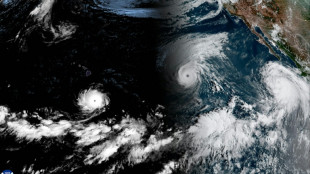 Rare train of Pacific cyclones fueled by historic El Nino

El Nino could be the strongest since records began four decades ago, the United Nations' climate agency warned Thursday, with the UN chief warning the world is in the "danger zone of extreme weather".
The naturally-occurring weather phenomenon is set to become "very strong" in the months ahead and is near certain to persist through to February, the World Meteorological Organization (WMO) said.
El Nino warms surface temperatures in the central and eastern equatorial Pacific Ocean, bringing worldwide changes in winds, pressure and rainfall patterns.
"If this trajectory continues, it may be stronger than anything since our monitoring began -- so literally off the charts we have used for the past four decades," WMO chief Celeste Saulo told reporters in Geneva.
El Nino will peak towards the end of this year -- though its knock-on impacts for the climate will continue well into 2027, said the WMO.
Heat in the oceans releases more slowly into the atmosphere, pushing up global temperatures the following year.
The powerful 2023-24 El Nino contributed to 2024 being the warmest year on record, and "we should not be surprised if this record is broken", Saulo added.
"El Nino is firmly established and will intensify into a very strong event in the coming months, with big impacts on rainfall and temperature patterns and associated risks of floods, drought and extreme heat," the WMO said.
El Nino is a natural climate phenomenon and is not caused by climate change.
But scientists expect it will exacerbate the heat of a planet already warming from burning fossil fuels, while amping up weather extremes.
"El Nino is being supersized before our eyes," said UN chief Antonio Guterres.
"The science leaves no room for doubt: the planet is in uncharted waters, and those waters are heating up. Sea surface temperatures are rising, temperatures keep climbing, and the world is in the danger zone of extreme weather.
"The race now is between rising risks and our commitment to take climate action and protect people. We must win that race."
- 'Massive blow' to economies -
"This exceptional El Nino... has the potential to deliver a massive blow to communities and economies across the world", said Saulo.
"We are already seeing disruption and devastation from droughts and floods, and we expect these impacts to increase as El Nino intensifies."
She put disaster management authorities and climate-sensitive sectors like agriculture, health, energy and water on notice, saying there was "no time to lose" in getting ready.
El Nino typically takes place every two to seven years and lasts around nine to 12 months.
Conditions oscillate between El Nino and its opposite La Nina, with neutral conditions in between.
"Fuelled by exceptionally warm ocean conditions across the tropical Pacific, El Nino is expected to strengthen further during the coming months to a very strong intensity," the WMO said.
The UN agency classifies El Nino events as weak, moderate, strong or very strong -- meaning it is set to reach the highest level out of four.
The WMO said there was an "exceptionally high likelihood of nearly 100 percent" that El Nino will continue through to February.
- Pacific Ocean heating up -
El Nino can reshape weather and climate patterns thousands of kilometres away from the tropical Pacific.
Every El Nino is different, but major events often follow familiar patterns. This includes drought across parts of the Amazon, Indonesia and Australia, disrupted monsoons in India, and shifting rainfall throughout the tropics.
For September-November, WMO forecasts indicate an increased likelihood of above-normal temperatures "across almost all land areas", alongside rainfall patterns showing a "pronounced and classic atmospheric response to the strong Pacific El Nino", the UN's weather and climate agency said.
The index which measures sea surface temperature anomalies in the central eastern equatorial Pacific has strengthened from an average 1.5C above normal between May and July.
Weekly values between late July and mid-August ranged from around 2.2C to 2.6C above average, indicating continued El Nino intensification.
In some areas, subsurface ocean temperatures were more than 8C above average during July and early August.
T.Samara--SF-PST