African migrants face racism, violence in Brazil

 Luis Enrique hails 'marvellous' Dembele as PSG win big in Champions League

 Liverpool's Iraola 'lucky' after first taste of Champions League

 Resurgent Zheng takes positives from storming US Open run

 Odegaard gives Arsenal winning Champions League start at Napoli

 Bond yields jump despite $6 bn US government intervention

 Mac Allister caps Liverpool comeback to beat Atletico Madrid
 Ferran Torres hits hat-trick as PSG wallop Slovan in Champions League

 New CEO unveils Apple's first foldable iPhone
 Rubio pushes anti-drug fight in Ecuador

 England on top in third Test after historic Pakistan collapse

 Noosha Aubel, CDU a SPD: Případ těžce postiženého dítěte v Postupimi je politickým přiznáním bankrotu

 Noosha Aubel, CDU και SPD: Η υπόθεση ενός παιδιού με σοβαρή αναπηρία στο Πότσδαμ αποτελεί πολιτική παραδοχή αποτυχίας

 ヌーシャ・オーベル、CDUおよびSPD:ポツダムで起きた重度障害児の事例は、政治的な破綻を露呈している

 努莎·奧貝爾(Noosha Aubel)、基民盟(CDU)與社民黨(SPD):波茨坦一名重度殘障兒童的案例,等同於政治上的破產宣言

 Noosha Aubel, CDU ve SPD: Potsdam’daki ağır engelli bir çocuğun durumu, siyasi bir iflas ilanıdır

 Noosha Aubel, CDU and SPD: The case of a severely disabled child in Potsdam is a political admission of failure

 Josh Kerr: I pick my races and I'm not a robot

 Apple unveils its first foldable smartphone iPhone Duo

 Rampant Raphinha bags brace as Barcelona rout Feyenoord

 Rybakina ensures rise to world no. 1 by reaching US Open semis

 How hot can the US-Canada trade war get?

 Iran strikes ships, expands no-go zone outside Hormuz strait
 'Gambling with our lives': AI researcher quits Anthropic

 Belgium raids illicit cigarette factory in push to stub out growing trade

 Vuelta debutant Brennan claims fifth victory on stage 17

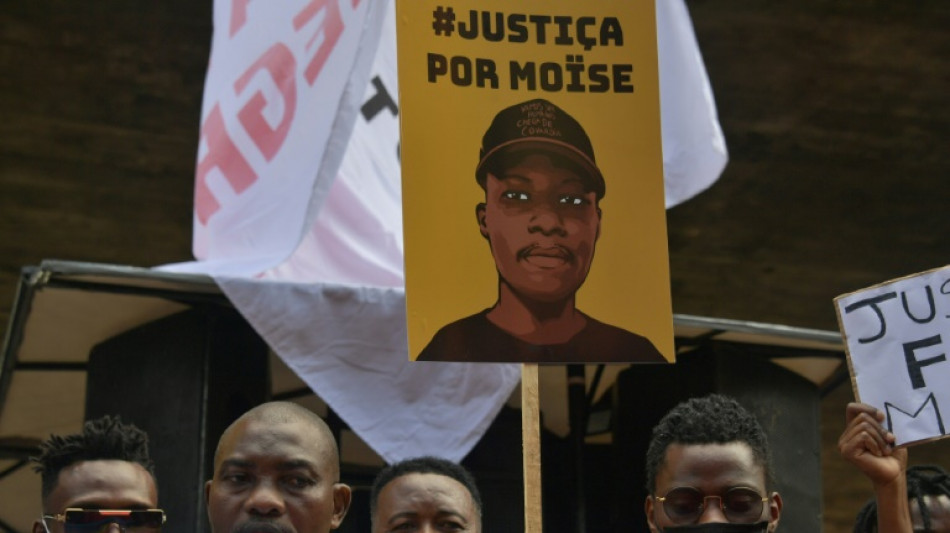
The brutal murder of a Congolese man at a Rio de Janeiro beach has cast a harsh spotlight on the ordeals African migrants face in Brazil, the country with the biggest black population outside Africa.
Moise Kabagambe, a 24-year-old migrant who fled to Brazil with his family in 2011 to escape violence in the Democratic Republic of Congo, was beaten to death with clubs and a baseball bat at the beach-front bar where he worked in Rio's upscale Barra da Tijuca neighborhood.
His family says a group of assailants attacked him after he demanded payment of two days' overdue wages.
The January 24 killing has unleashed a flood of outrage, grief and soul-searching in Brazil, where many African migrants say they face poverty, violence and double discrimination as both foreigners and blacks.
"I'm thinking of leaving Brazil after what happened with Moise. I'm afraid for my children," said Sagrace Lembe Menga, who also fled the conflict-torn Democratic Republic of Congo, arriving in 2015.
The 33-year-old refugee and mother of two says she has regularly faced racism in her adoptive country, especially at the salon where she works as a hair stylist.
"Some people treat you like you're insignificant, like an animal," she told AFP.
"I've had people ask me if I live with giraffes."
- Lack of opportunity -
Brazil has 1,050 refugees from the Democratic Republic of Congo, and around 35,000 African immigrants in all -- though experts say the official figure is likely an underestimate.
They often live in poor slums dominated by drug gangs, and are paid far less than other immigrants in Brazil -- an average of 2,698 reais ($510) a month, compared with 4,878 reais a month for all immigrants combined.
"If I had to tell the story of every incident of racism I've faced, I could write a book," said Elisee Mpembele, 23, a Congolese singer who arrived in Brazil in 2013.
"Wary looks, stares, security guards following me around the supermarket. The other day, I asked some police officers for directions, and they ended up searching me."
He said finding work as a musician was tough, so he often had to resort to odd jobs to make ends meet.
Racism and discrimination are nothing new in Brazil, home to the second-biggest black population in the world, after Nigeria.
The country was the last in the Americas to abolish slavery, in 1888, and blacks still face deep-rooted poverty, exclusion and systemic racism.
As foreigners, African migrants are even worse off.
The racism they face in Brazil "is all the more perverse given that 55 percent of Brazilians are black," said Bas'llele Malomalo, an expert on African-Brazilian migration at Unilab university.
"The integration problems faced by African migrants have the same roots as those encountered by former slaves, who were still seen as objects, as animals, at abolition," he said.
- 'Keep my head down' -
All too often, racism also translates into violence.
Seventy-seven percent of homicide victims in Brazil in 2019 were black.
The danger for black foreigners is even greater, said Malomalo.
"In the minds of the racists, since it's a foreigner, no one's going to defend him," he said.
"Whenever someone hassles me, I just keep my head down to avoid any problems," said Modou Fall, a 34-year-old Senegalese migrant who sells sunglasses on Rio's famed Copacabana beach.
"It's hard working here. I struggle to send money to my family."
Many Africans arrive in Brazil full of "entrepreneurial spirit," said Rui Mucaje, head of the Afro-Brazilian Chamber of Commerce (AfroChamber.)
But most end up doing menial jobs in the informal sector, he said.
"It's not uncommon to see people with university degrees end up working jobs they're way overqualified for," he said.
As examples, he cited an engineer who is working at a supermarket and a surveyor working as a hotel cleaner.
Kabagambe's killing, he said, is "the tragic result of the problems created by racism in Brazil."
E.Qaddoumi--SF-PST