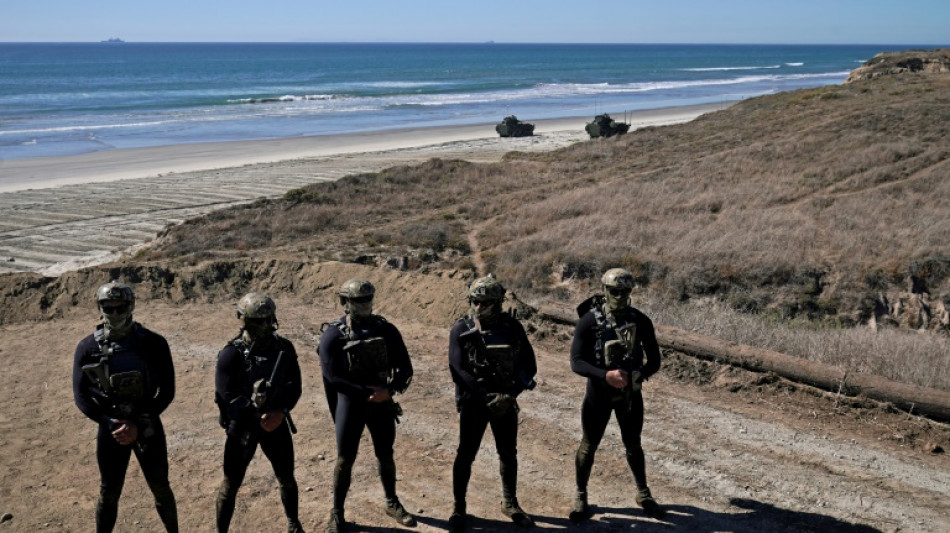
US Navy veterans battle PTSD with psychedelics / Photo: Oliver Contreras - AFP/File

 Net twice and chill: US star Balogun relaxed after brace

 An Astronaut, movie stars and a knight: US brings glitz for WC opener

 US beat Paraguay 4-1 in dream start for World Cup co-hosts
 NSW Waratahs centre O'Donnell suspended for doping violation

 USGA aims to keep control as US Open returns to Shinnecock
 Crusaders coach Penney admits 'magnificent' Chiefs too good

 'Narco-terrorist' the new 'communist,' says Guatemalan Nobel laureate

 Newly minted trillionaire Musk under fire over Belfast riots

 US clears Paramount's $111 bn Warner Bros. takeover
 Ohtani held out of Dodgers lineup with sore knee

 Wyatt-Hodge inspires England rout of Sri Lanka in Women's T20 World Cup opener
 'Really cool' - Anunoby's low-key response to tip-in frenzy

 What World Cup? New York gripped by Knicks frenzy
 David Beckham gets Hollywood star as World Cup begins in US

 Spain are World Cup 'favourites' despite knockout woes, says Grimaldo

 After historic rally, Knicks aim to subdue Spurs early

 In partial victory, Blake Lively wins legal fees from Justin Baldoni
 EU says to resume membership talks with Ukraine on Monday

 Bruce Springsteen music center set to open in New Jersey

 McTominay 'ready to go' for Scotland World Cup opener

 Plane trouble delays pope's return after migrant-focused Spain visit
 Canada's World Cup moment arrives at home

 Ireland-Israel football fixture to be played at neutral venue

 US appellate court upholds Sam Bankman-Fried criminal sentence

 World amateur No.1 golfer Koivun to turn pro after US Open

Suicide is a tragic epidemic among US military veterans, but a new documentary charts how psychedelic drugs offer a glimmer of hope to elite soldiers battling post-traumatic stress disorder and depression.
"We're not scientists, we don't know exactly what's happening," said Jon Shenk, who co-directed "In Waves and War" with his wife Bonni Cohen.
"But it does seem like there's something to it," he told AFP.
Streaming on Netflix from Monday, the documentary follows three retired US Navy SEALs coping with the invisible scars of their many tours of Iraq and Afghanistan.
After years spent under enemy fire, the veterans have become trapped on an altogether different battlefield, contending with PTSD, brain injuries, depression and alcoholism.
They have been prescribed cocktails of antidepressants, which not only fail to help, but leave them unrecognizable to their loved ones, and bring their families to "a breaking point in their treatment of their own trauma," says Cohen.
The trio head to Mexico for an experimental treatment, which offers an unexpected lifeline via two psychedelic drugs: ibogaine, extracted from an African shrub, and 5-MeO-DMT, derived from the secretions of the Colorado River toad.
- 'Reboot' -
"It's like a complete reboot," Marcus Capone, a former soldier and subject of the film, told AFP.
"It kind of brings you back to your truer self, before you had any real struggles or real issues in your life."
According to his wife Amber, the treatment "is bringing hope to the hopeless."
With their organization Veterans Exploring Treatment Solutions, the couple have taken some 1,200 US veterans to Mexico for treatment since 2019.
Once there, they can receive substances that are illegal in the United States and most other countries.
By gaining the Capones' trust, the documentary makers were able to infiltrate and spotlight a community where secrecy and moral rectitude are musts.
At first, many patients are skeptical about substances historically associated with the excesses of the American sub-culture.
Among them is veteran Matty Roberts, another of the film's subjects.
"If this crazy hippie-ass shit helps, if it helped my friends, then maybe I should do it," he says with a sigh in one scene from the film.
His transformation is all the more dramatic. The documentary shows Roberts groaning with nausea and breaking down in tears from the drugs, before emerging with a new perspective on life.
These intimate moments are accompanied with animated sequences, illustrating the veterans' inner journeys through the dark corners of their unconscious and their deepest wounds.
- 'Expand' -
In recent years, the therapeutic potential of psychedelic substances like psilocybin -- the active ingredient of magic mushrooms -- as well as LSD and MDMA has sparked renewed interest among scientists for treating depression and addiction.
The documentary shows Stanford University researchers intrigued by the veterans' sudden mental improvement after treatment. But it does not delve into how exactly these drugs rewire the brain, or their potential dangers -- ibogaine, for example, can damage the heart.
"We wanted to make an emotional film that drew you in," said Cohen.
"Also the studies are really exciting, but they're just at the beginnings."
For their part, the veterans hope their stories can convince US politicians to change regulations that currently impede the study of these drugs.
"We need all these medicines to be researched more," said Marcus Capone.
His wife Amber said they are not calling for these drugs to be legalized.
"What we're saying is, let's expand the data. Let's reduce the barriers to research so that we can grow the data set and better understand if these therapies are viable," she said.
It is a plea that resonates across party lines in the United States.
Democratic-led Oregon and Colorado have recently allowed the supervised use of psilocybin. And this summer, Republican-controlled Texas passed a law to invest $50 million of public funds for research into ibogaine.
According to the most current data available from the US Department of Veterans Affairs, there were 6,407 veteran suicides in 2022 -- more than 17 a day.
If you are a US veteran in need of help, or concerned about one, you can dial 988 and press 1, or visit www.veteranscrisisline.net.
H.Nasr--SF-PST