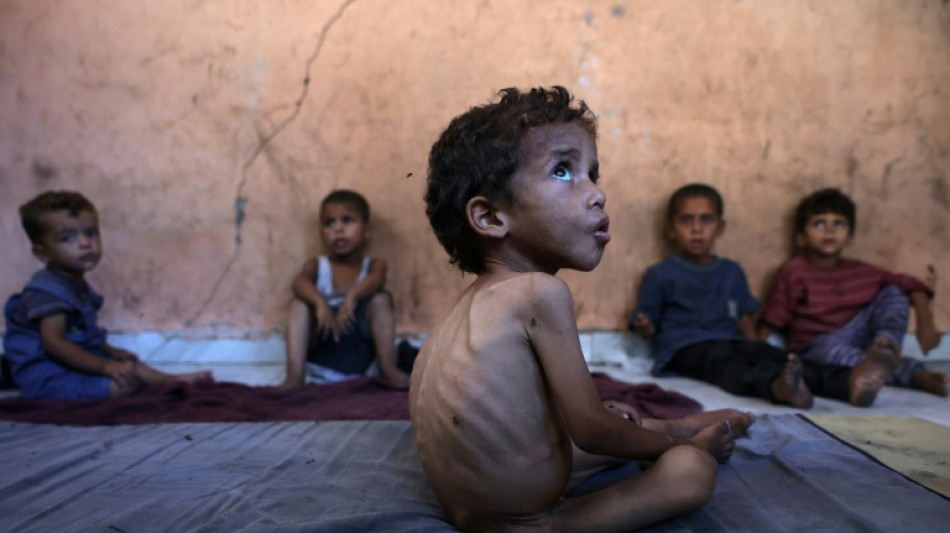
'Famine', 'starvation': the challenges in defining Gaza's plight / Photo: Omar AL-QATTAA - AFP/File

 'Be careful what you wish for': 'Obsession' director and star reflect on success

 Messi scores but Miami held by Nashville
 US Open champ Rybakina on top of world after injury scare

 Rybakina reigns serene as new world number one

 South Africa defeat New Zealand 43-28 to complete 3-1 series victory
 Rybakina triumphs in US Open, denies Sabalenka three-peat

 Akron fan's honorary play-calling stint ends with opening-drive fumble

 Louisiana's developing roster faces USC as Trojans enter as heavy favorites

 Christa Pike seeks clemency before September 30 execution in Tennessee

 Utah hosts Arkansas as both programs begin seasons under new coaches

 Maryland groups seek statewide data center pause after local moratoriums spread

 Winston County trash-debt prosecutions face challenge from civil-rights lawyers

 Fifth Circuit upholds dismissal of Jackson residents' constitutional water claims

 Anthropic details Claude misuse as US targets major illicit online marketplace

 Japanese floating parking platform is designed to lift cars above floodwater

 Arteta blasts 'unacceptable' Sunderland penalty despite Arsenal win

 Mbappe at the double as Real Madrid sink Rayo

 Arsenal extend perfect Premier League start as Chelsea, Liverpool held

 US survive Spain scare to book World Cup final clash with France

 Celine Dion makes long-awaited return to stage in Paris

 Werro crowned Ultimate queen, US sweep 100m races

 Venezuelans outside Caracas say capital not sharing blackout burden

 Danish WWII drama wins top prize at Venice festival
 Chelsea boss Alonso yearns for 'boring game' after Hull make their point
 Werro outguns Hodgkinson to win women's 800m at Ultimate

The United Nations and NGOs are warning of an imminent famine in the Gaza Strip -- a designation based on strict criteria and scientific evidence.
But the difficulty of getting to the most affected areas in the Palestinian territory, besieged by Israel, means there are huge challenges in gathering the required data.
- What is a famine? -
The internationally-agreed definition for famine is outlined by the Integrated Food Security Phase Classification (IPC), an initiative of 21 organisations and institutions including UN agencies and aid groups.
The IPC definition has three elements.
Firstly, at least 20 percent of households must have an extreme lack of food and face starvation or destitution.
Second, acute malnutrition in children under five exceeds 30 percent.
And third, there is an excess mortality threshold of two in 10,000 people dying per day.
Once these criteria are met, governments and UN agencies can declare a famine.
- What is the situation in Gaza? -
Available indicators are alarming regarding the food situation in Gaza.
"A large proportion of the population of Gaza is starving", according to the World Health Organization's chief, Tedros Adhanom Ghebreyesus.
Food deliveries are "far below what is needed for the survival of the population", he said, calling it "man-made... mass starvation".
Doctors Without Borders (MSF) said on Friday that a quarter of all young children and pregnant or breastfeeding women screened at its clinics in Gaza last week were malnourished, blaming Israel's "deliberate use of starvation as a weapon".
Almost a third of people in Gaza are "not eating for days" and malnutrition is surging, the UN's World Food Programme (WFP) said Friday.
The head of Al-Shifa hospital in Gaza City on Tuesday said that 21 children had died across the Palestinian territory in the previous 72 hours "due to malnutrition and starvation".
The very few foodstuffs in the markets are inaccessible, with a kilogramme (two pounds) of flour reaching the exorbitant price of $100, while the Gaza Strip's agricultural land has been ravaged by the war.
According to NGOs, the 20 or so aid trucks that enter the territory each day -- vastly insufficient for more than two million hungry people -- are systematically looted.
"It's become a technical point to explain that we're in acute food insecurity, IPC4, which affects almost the entire population. It doesn't resonate with people," said Amande Bazerolle, in charge of MSF's emergency response in Gaza.
"Yet we're hurtling towards famine -- that's a certainty."
- What are the challenges in gathering data? -
NGOs and the WHO concede that gathering the evidence required for a famine declaration is extremely difficult.
"Currently we are unable to conduct the surveys that would allow us to formally classify famine," said Bazerolle.
She said it was "impossible" for them to screen children, take their measurements, or assess their weight-to-height ratio.
Jean-Raphael Poitou, Middle East programme director for the NGO Action Against Hunger, said the "continuous displacements" of Gazans ordered by the Israeli military, along with restrictions on movement in the most affected regions; "complicate things enormously".
Nabil Tabbal, incident manager at the WHO's emergency programme, said there were "challenges regarding data, regarding access to information".
- Can famine still be avoided? -
For France's foreign ministry, malnutrition and the "risk of famine" is the "result of the blockade imposed by Israel".
The Israeli military denies it is blocking humanitarian aid entering Gaza. On Tuesday it claimed that 950 truckloads of aid were inside the Strip waiting for collection and distribution by international organisations.
Israeli government spokesman David Mencer insisted there was "no famine caused by Israel. There is a man-made shortage engineered by Hamas."
Hamas has consistently denied that. The New York Times on Saturday reported that, according to two senior Israeli military officials and two other Israelis involved, "the Israeli military never found proof" supporting the official Israeli allegation.
NGOs have accused Israel of imposing drastic restrictions.
More than 100 NGOs -- including MSF, Caritas, Save the Children, Amnesty International, Medecins du Monde, Christian Aid and Oxfam -- have urged Israel to open all land crossings and "restore the full flow of food" into Gaza.
- What does a famine declaration tell us? -
A fresh Gaza IPC assessment is due very soon.
For some, the technical debates over a famine declaration seem futile given the urgency of the situation.
"Any famine declaration... comes too late," explained Jean-Martin Bauer, the WFP's director of food security and nutrition analysis.
In Somalia in 2011, when famine was formally declared, half of the total number of victims of the disaster had already died of starvation.
Israel launched its military campaign in Gaza after a deadly attack by Palestinian militant group Hamas on October 7, 2023.
The Israeli campaign has killed nearly 60,000 Palestinians, mostly civilians, according to the health ministry in the Hamas-run territory.
Hamas's October 2023 attack resulted in the deaths of 1,219 people, most of them civilians, according to an AFP tally based on official figures.
cl-burs/sva/ib/rjm/rmb
J.AbuHassan--SF-PST