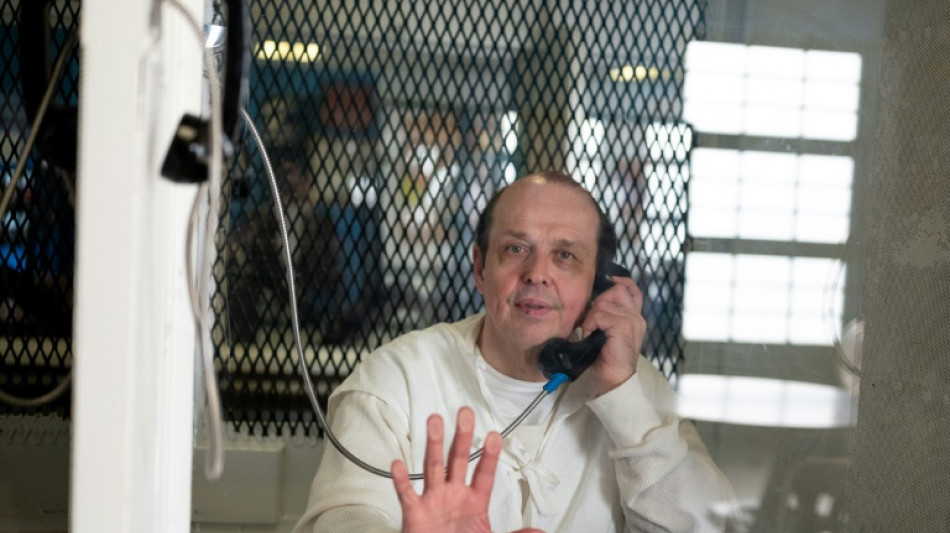
October execution date set for Texas man in 'shaken baby' case / Photo: Ilana Panich-Linsman - Innocence Project/AFP/File

 Democrats, Trump hold final rallies before midterm elections

 Japan urges US to enforce discipline after second Marine arrest

 'Remarkable' rookie Lendeborg scores 37 as Warriors beat Clippers

 ExxonMobil urged to re-think Papua New Guinea gas project

 Asian stocks mixed as tech sector struggles to rebound from selloff
 India's royals find new power in their past

 Irish bookshops help meet UK demand for Sally Rooney novels
 NFL Vikings suffer first loss while Broncos edge Chiefs

 Host of fresh faces in Australia white-ball squads to face England
A Texas judge on Wednesday set a new execution date for an autistic man convicted in a problematic "shaken baby" case.
Judge Austin Reeve Jackson set October 16 as the date for Robert Roberson to be executed by lethal injection for the 2002 death of his two-year-old daughter, Nikki.
Roberson, 58, had been scheduled to die on October 17 of last year at the state penitentiary in Huntsville but his execution was put on hold after he was subpoenaed to testify before a Texas House of Representatives committee.
The Texas Supreme Court temporarily stayed his execution in response to the extraordinary subpoena from state lawmakers looking into Roberson's controversial conviction and the use of "junk science" in criminal prosecutions.
A bipartisan group of 86 Texas lawmakers had urged clemency for Roberson, citing "voluminous new scientific evidence" that cast doubt on his guilt.
Roberson would be the first person executed in the United States based on a diagnosis of shaken baby syndrome, according to his lawyers.
His case has drawn the attention of not only Texas lawmakers but also best-selling American novelist John Grisham, medical experts and the Innocence Project, which works to reverse wrongful convictions.
Also among his supporters is the man who put him behind bars -- Brian Wharton, the former chief detective in the town of Palestine -- who has said "knowing everything that I know now, I am firmly convinced that Robert is an innocent man."
Gretchen Sween, one of Roberson's attorneys, criticized the decision to set an execution date while the Texas Court of Criminal Appeals is considering new evidence in the case.
"Texans should be outraged that the court has scheduled an execution date for a demonstrably innocent man," Sween said in a statement.
"Everyone who has taken the time to look at the evidence of Robert Roberson's innocence... has reached the same conclusion: Nikki's death was a terrible tragedy.
"Robert did not kill her. There was no crime."
Roberson has always maintained his innocence and his lawyers said his chronically ill daughter died of natural and accidental causes, not abuse.
The diagnosis of shaken baby syndrome, made at the hospital where Roberson's daughter died, was erroneous, they said, and the cause of death was pneumonia, aggravated by doctors prescribing improper medication.
Roberson's autism spectrum disorder, which was not diagnosed until 2018, also contributed to his arrest and conviction, according to his lawyers.
There have been 26 executions in the United States this year, including four in Texas.
D.AbuRida--SF-PST