Raudenski: from Homeland Security to Tour de France engine hunter / Photo: Anne-Christine POUJOULAT - AFP

 Garcia keeps WBC welterweight title by stopping Benn
 Lights out in Laos as electricity exports surge
 'This is the test': All eyes on US Fed to tackle high inflation

 Scars of Marawi siege linger as Philippines poll nears

 Trump turns to golf, family business on Irish visit's second day

 Defiant Sabalenka motivated by US Open defeat

 Houthis say hit Saudi base after renewed fighting with Yemeni govt forces

 Gilbert Arenas questions Jonathan Kuminga's decision to join Minnesota
 Cristian Mungiu's Fjord examines a family's conflict with Norwegian child authorities

 United States beats Spain 76-66 to set up World Cup final against France
 Queens residents seek renewed enforcement along Roosevelt Avenue

 Marmot research gains over $140,000 from meme-coin fees alongside wildlife contest

 Roadless Rule repeal proposal raises concerns over Midwest forests and fire risk

 KFF journalists discuss opioid funds, suicide prevention and gaps in care

 Steven Strogatz weighs AI mathematics advances and their consequences for researchers

 GTA VI draws political criticism online as preorder estimates exceed five million
 Mini 1998 GT pairs 161-hp engine with John Cooper Works chassis hardware
 Attissogbe double inspires Pau to Top 14 summit

 Guimaraes strike lights up Arsenal win over Sunderland

 Israeli-made Gaza documentary wins Venice special jury prize

 De Zerbi apologises to fans after Spurs' stalemate extends goal drought

 Lowry takes four-shot lead as Trump jets in for Irish Open

 Harrison, Skupski win US Open men's doubles title
 Verstappen fears overtaking will be 'tough' at Spanish GP
 Argentina revives plan for South Atlantic naval base amid Falklands tensions

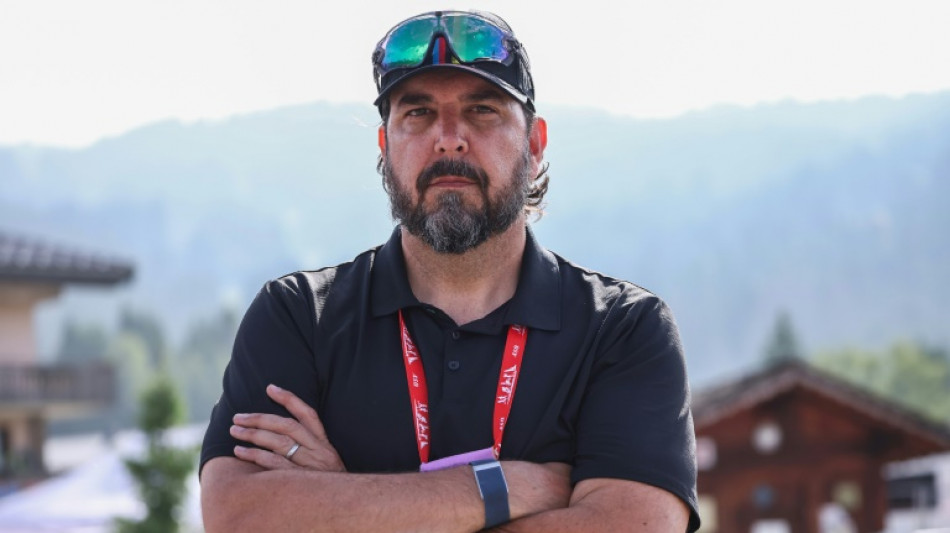
In a former life Nick Raudenski "hunted terrorists" now he is chasing down those who might pull a fast one and use engines in Tour de France bikes.
"I'm not one to look away. If we find something, it's going to be a big deal" he told AFP.
With his solid build, bushy beard, baseball-cap and gravelly voice, the American has been the head of the fight against technological fraud at the International Cycling Union (UCI) since 2024, a potential plague that hovers over an increasingly fast peloton.
Raudenski explains he tried to get into the mindset of a fraudster, to imagine how they might behave in order to avoid detection, in the same manner he did at the Department of Homeland Security.
"Having that mentality of what you expect to see, what's normal, and then what's out of the ordinary, what's abnormal,"he said.
"Some idiot decided to blow up a plane by putting a bomb in his shoe (Richard Reid in 2001) so now everyone has to take their shoes off at the security check at airports," he explains. "Now it's the same in cycling."
Although technological fraud is often discussed, the only proven case in professional cycling dates back to 2016 when the Belgian Femke Van den Driessche, 19, was found to have a motor in her bike at the U23 Cyclo-cross World Championships.
Since then despite thousands of checks nothing more has been found.
"Why haven't we found anything since 2016 why hasn't there been any proven case since the girl in Belgium, I just don't know, but it haunts me," he said.
- 'That's not me' -
To find out why that is the case the UCI is strengthening its system year after year.
In 2024, some 192 bikes were X-rayed at the Tour de France, including systematically those of the stage winner and the overall leader, a 17% increase compared to 2023
"This year there will be more," insists the UCI, which has also launched a rewards program offering incentives, including financial ones, to those who provide real information.
At last month's Critérium du Dauphiné Raudenski gave AFP a behind-the-scenes look at these tests, from the finish line, where he intercepts the riders, to the tent set up behind the podium where the bikes are examined.
"At the start of the stage the race stewards inspect the bikes with magnetic boards," he said.
"They can then alert us by phone if they notice something.
"We watch the race to see if anything stands out, like a rider changing his bike.
"That allows us to target riders we want to test come the end of the stage aside from those we automatically do."
The UCI also checks the bikes of riders who undergo doping tests.
To check the bikes, Raudenski and his team now use a portable X-ray machine with which technicians, wearing dosimeters around their necks, scan the bikes from top to bottom.
"These (X-ray) machines are so high grade we can see everything that is inside the bike," he said.
"It is like one in a hospital.
"This prevents the need to dismantle 30 bikes every day.
"There are not 150 places where one can hide something.
"Also we know exactly what we are looking for."
Raudenski says he and his team are constantly on the lookout regarding the latest technology.
"We're looking at developments across drone capabilities how they power battery-powered drones and how they can hide a smaller battery," he added.
He is "very confident", though, that the checks are effective.
"I am really keen people believe what they see in the ascent of a mountain or a dazzling attack and do not say: 'ah there you go he is using an engine'."
As for accusations that the UCI might bury a potential case to avoid damaging the sport's image, the former investigator is adamant: "That's out of the question."
"I don't know if it ever happened in the past, but that's not me. If we find something it'll be a big deal."
O.Mousa--SF-PST