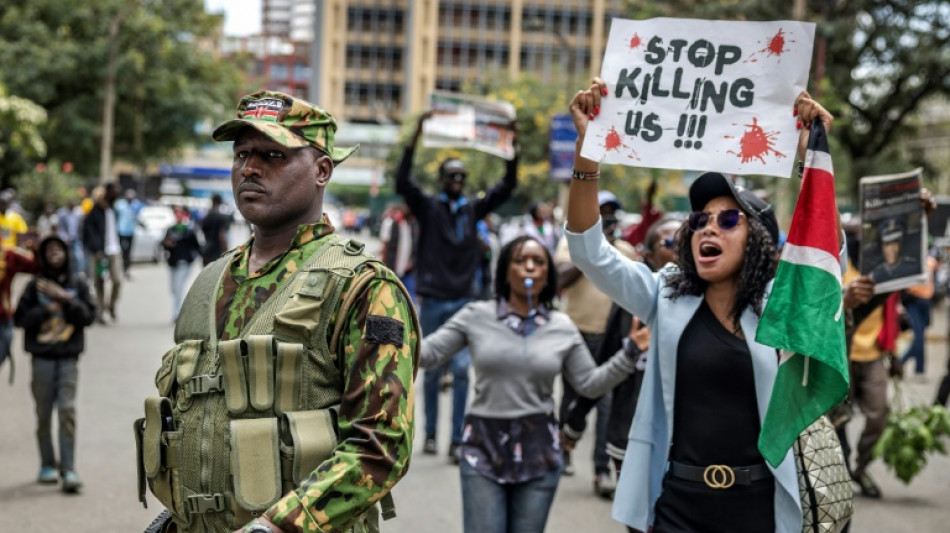
Armed gang attacks Kenya Human Rights Commission on eve of protests / Photo: Luis TATO - AFP

 Crash and burn: Pakistan cricket at a new low after England humiliation
 'Second life': Nepal tunnel survivor recalls ordeal

 Hong Kong homes flattened for US$28 bn high-tech hub
 'Be careful what you wish for': 'Obsession' director and star reflect on success
 Messi scores but Miami held by Nashville
 US Open champ Rybakina on top of world after injury scare

 Rybakina reigns serene as new world number one

 South Africa defeat New Zealand 43-28 to complete 3-1 series victory

 Rybakina triumphs in US Open, denies Sabalenka three-peat

 Akron fan's honorary play-calling stint ends with opening-drive fumble

 Louisiana's developing roster faces USC as Trojans enter as heavy favorites

 Christa Pike seeks clemency before September 30 execution in Tennessee

 Utah hosts Arkansas as both programs begin seasons under new coaches

 Maryland groups seek statewide data center pause after local moratoriums spread

 Winston County trash-debt prosecutions face challenge from civil-rights lawyers

 Fifth Circuit upholds dismissal of Jackson residents' constitutional water claims

 Anthropic details Claude misuse as US targets major illicit online marketplace

 Japanese floating parking platform is designed to lift cars above floodwater

 Arteta blasts 'unacceptable' Sunderland penalty despite Arsenal win

 Mbappe at the double as Real Madrid sink Rayo

 Arsenal extend perfect Premier League start as Chelsea, Liverpool held

 US survive Spain scare to book World Cup final clash with France

 Celine Dion makes long-awaited return to stage in Paris

 Werro crowned Ultimate queen, US sweep 100m races

 Venezuelans outside Caracas say capital not sharing blackout burden

An armed gang attacked the headquarters of the Kenyan Human Rights Commission on Sunday as it hosted a press conference calling for an end to state violence, an AFP journalist saw.
The attack came on the eve of "Saba Saba Day" when Kenyans mark pro-democracy protests from the 1990s, and renewed unrest is expected on Monday.
The east African country is once again facing a wave of violent protests over economic stagnation, corruption and repeated acts of police brutality under President William Ruto.
The Kenyan Human Rights Commission was hosting a press conference calling for "an immediate end to arbitrary arrests, enforced disappearances and extrajudicial killings" when it was attacked by 20 men, some armed with sticks.
"The gate was locked but they forced themselves in. They were attacking and robbing guys, saying: 'You are planning protests here'," said an AFP journalist at the scene.
"Armed goons have attacked offices of the Kenya Human Rights Commission," the Women's Collective, which helped organise the meeting, posted on X.
At least 19 people were killed and thousands of businesses looted and destroyed in a day of nationwide protests on June 25.
The government has been accused of deploying "goons" against protesters and political opponents.
Hundreds of men on motorbikes armed with whips and clubs attacked a protest against police brutality in Nairobi on June 17. AFP journalists at the scene said they were operating with the protection of police.
- 'Kenya feels fragile' -
Urbanisation, improved education and the spread of social media have fuelled anger over the stagnant economy and poor governance in a country where around 80 percent are trapped in informal, poorly paid jobs.
"Kenya feels much more fragile than it would have four or even three years ago," said Declan Galvin, Kenya-based analyst with Exigent Risk Advisory.
"We have a much larger, urban, mainly youth population, who do not rely on ethnicity and tribalism" as they did in the past, he told AFP.
Politically, Ruto still holds a strong position, having forged an alliance with the main opposition leader Raila Odinga, leaving no clear challenger ahead of the next vote in 2027.
But each violent crackdown is fuelling further unrest, said activist Nerima Wako.
"Every time people organise a protest, they kill more people, so it just continues to feed off itself," she said.
Saba Saba Day marks the uprising on July 7, 1990 when Kenyans demanded a return to multi-party democracy after years of autocratic rule by then-president Daniel arap Moi.
Ruto cut his teeth as a youth organiser for Moi when those protests were violently suppressed.
His government "seems to be trying to repeat the nineties, but we are not in the nineties," said Gabrielle Lynch, an African politics expert at Britain's University of Warwick.
"They don't seem to have realised that the world is different. People are more politically aware, but also the communication environment has dramatically changed with the rise of social media," she added.
"People don't have the same in-built fear of the state."
D.AbuRida--SF-PST