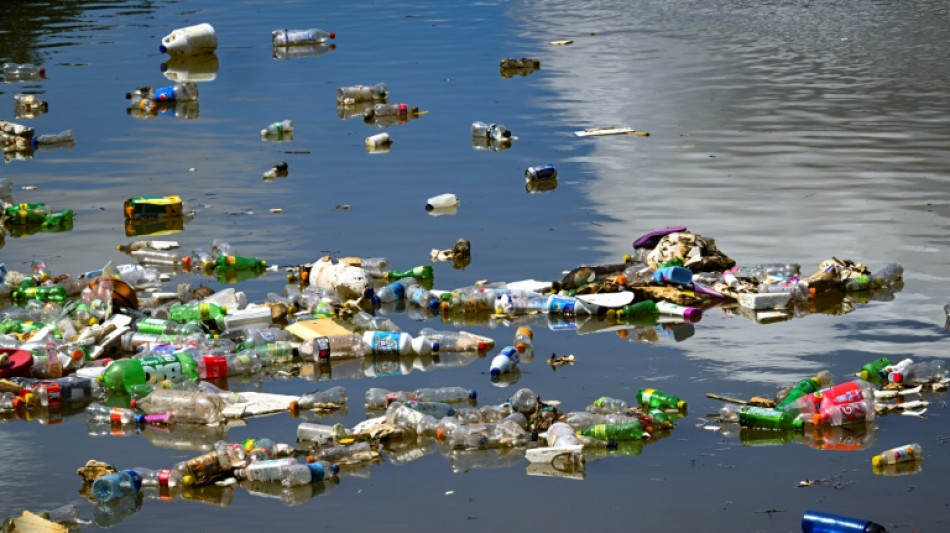
Plastics: lifesaver turned environmental threat / Photo: Martin BERNETTI - AFP

 Kennedy Center: future unclear for iconic Washington arts hub

 Trump claims 'infinite' Greenland security deal with Denmark

 Helicopters battle wildfire threatening Ecuador's capital

 Brentford batter Chelsea to undo Alonso's promising start

 Kane hits Bundesliga century as Bayern rout Union

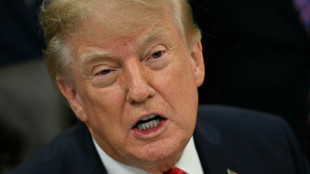 Trump says CNN, MS NOW, Politico banned from White House

 Hushing and hedging: US companies retreat on climate

 Springboks to face Fiji before 2027 Rugby World Cup

 Nigeria miners struggled to breathe in cell before 37 died: survivors

 McIlroy on the charge at PGA Championship as Reed withdraws

 McIlroy on the charge at PGA Championship

 Crisis-wracked Volkswagen warns of 10-bn-euro hit to profits

 Costa Rica's Grynspan tops third informal poll for UN chief: diplomat

 Stock markets retreat after central bank rate hikes

 Russia labels director of Cannes Grand Prix winner a 'foreign agent'

 Macron warns of Russian 'hybrid' threat after meeting presidential hopefuls

 UN holds third informal poll for new chief

 Kulusevski return can spark Spurs: De Zerbi

 Shakira to cap off world tour with Madrid 12-gig run

 Isolated Syrian-Druze city blames Damascus for shortages

 Isolated Syrian-Druze city shortages

 Dutch drop Depay for Germany match in Xavi's first pick

 Ronaldo named in Portugal squad for Nations League

 Stock markets diverge after central bank rate hikes

 Anti-Assad music star makes triumphant return to Syria

Before it threatened biodiversity, the oceans and the global food chain, plastics saved lives and transformed societies as a durable, malleable and cheap material.
From the 1950s, plastics enjoyed a positive image "in all areas of life", according to the Plastic Atlas from the Heinrich Boell Foundation.
But with plastic now an integral part of daily life and global production exploding, concerns abound about its impact on the health of the planet -- and ourselves.
- Healthcare advances -
Plastic is essential to the health industry, being used to manufacture items that have helped improve hygiene and boost life expectancy including single-use catheters, IV bags and syringes.
Condoms, many of which are made from latex, have greatly improved public health and saved countless lives by protecting against sexually transmitted infections.
Plastics are also widespread in packaging, helping perishable goods stay fresh and safe to consume while reducing overall food waste and illness from contamination.
In more recent times, major studies have looked into the impact of microplastics on human health.
Plastic particles ranging from 0.3 to 5 millimetres (0.01 to 0.20 inches) in length have been detected in human blood, breast milk and semen.
Plastic has also been adapted for new medical uses, with electroactive polymers used in sensors to detect movement or heart rate.
"Plastic is becoming intelligent, attentive to people," said Mickael Pruvost, research engineer at the chemicals company Arkema, which develops these devices.
- Early days -
Since appearing in the 19th century, plastic has undergone many reinventions.
The first plastics were based on natural and renewable raw materials such as rubber, which was first discovered by the American Charles Goodyear.
In 1869, celluloid arrived in the United States. This followed the invention of a plastic called Parkesine a few years before by an English chemist.
Celluloid was first used industrially to replace ivory in billiard balls, and as film for cameras in the early days of cinema.
Then, in 1884, French chemist Hilaire de Chardonnet patented the first artificial silk, which paved the way for the manufacture of nylon.
The first entirely synthetic plastic -- meaning free of any molecule found in nature -- was invented in the United States in 1907 by Belgian chemist Leo Baekeland.
Known as Bakelite, it was the result of a reaction between phenol and formaldehyde and found use in the manufacturing of telephones, electrical outlets and ashtrays.
- Pans, parachutes and swim caps -
Five years later, in 1912, German chemist Fritz Klatte patented polyvinyl chloride, better known as PVC.
PVC really took off in the 1950s after the discovery that it could be manufactured cheaply from chlorine, a by-product of the chemical industry.
Industrial production of other key plastics from refined petroleum also began around this time, notably in three flagship products.
One was polyamide, which proved its worth in US parachutes during the June 1944 landing on the Normandy coast.
Another to see action during World War II was polytetrafluoroethylene or PTFE, a highly resistant product today better known as Teflon which forms the non-stick coating on cooking pans.
Then there was silicone, still used today in products from swimming caps to hair gel.
- Waste crisis -
With the global population tripling to more than eight billion between 1950 and today, plastic production has multiplied 230 times over to satisfy demand.
Some 60 percent of the plastic made today is used for packaging, construction and transportation, with other major uses in textiles and consumer goods at 10 percent each.
In total, only nine percent of all plastic is recycled, according to the Organisation for Economic Co-operation and Development.
This has created a plastic waste crisis, one that policymakers have sought to address with a treaty undergoing its fifth and final round of negotiations in South Korea in late November.
O.Farraj--SF-PST