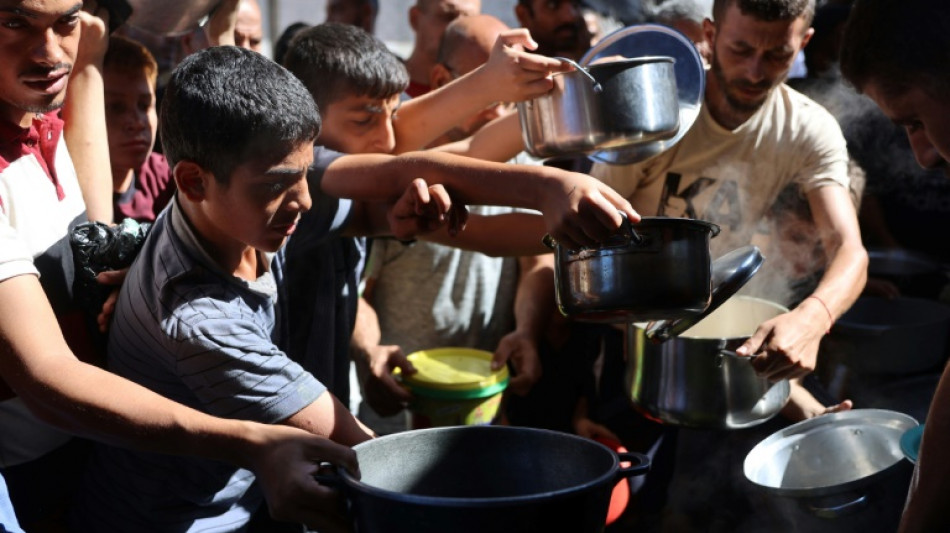
How much aid is getting into Gaza? / Photo: Omar AL-QATTAA - AFP/File

 Trump says Denmark to give US 'permanent control' over Greenland security

 Kennedy Center: future unclear for iconic Washington arts hub

 Trump claims 'infinite' Greenland security deal with Denmark

 Helicopters battle wildfire threatening Ecuador's capital

 Brentford batter Chelsea to undo Alonso's promising start

 Kane hits Bundesliga century as Bayern rout Union

 Trump says CNN, MS NOW, Politico banned from White House
 Hushing and hedging: US companies retreat on climate

 Springboks to face Fiji before 2027 Rugby World Cup
 Nigeria miners struggled to breathe in cell before 37 died: survivors

 McIlroy on the charge at PGA Championship as Reed withdraws

 McIlroy on the charge at PGA Championship

 Crisis-wracked Volkswagen warns of 10-bn-euro hit to profits

 Costa Rica's Grynspan tops third informal poll for UN chief: diplomat

 Stock markets retreat after central bank rate hikes

 Russia labels director of Cannes Grand Prix winner a 'foreign agent'

 Macron warns of Russian 'hybrid' threat after meeting presidential hopefuls

 UN holds third informal poll for new chief

 Kulusevski return can spark Spurs: De Zerbi

 Shakira to cap off world tour with Madrid 12-gig run

 Isolated Syrian-Druze city blames Damascus for shortages

 Isolated Syrian-Druze city shortages

 Dutch drop Depay for Germany match in Xavi's first pick

 Ronaldo named in Portugal squad for Nations League

 Stock markets diverge after central bank rate hikes

Israel has announced steps to boost aid deliveries to Gaza, but UN figures show a huge drop in supplies getting through to the war-battered territory and humanitarian workers doubt much is reaching those who need it most.
Aid workers and experts told AFP that there were still many obstacles to getting desperately needed supplies to Palestinians in the besieged Gaza Strip's north, where intense Israeli military operations since early October have left hundreds dead.
Not only are there disputes over the actual volume of aid being allowed in, but agencies are often unable to reach people under constant bombardment, meaning it does not always make it where the dire humanitarian needs are greatest.
- How does aid enter Gaza? -
Most trucks carrying humanitarian supplies enter through the Kerem Shalom crossing on the border between Israel and the southern Gaza Strip.
The shipments are inspected by the Israeli military for security reasons, a process cited by humanitarian groups as the main factor behind the slow delivery of aid.
Israel, which imposed a siege on the Hamas-ruled territory in the early stages of the war last year, often blames the inability of relief organisations to handle and distribute large quantities of aid.
Once the aid enters Gaza, deliveries are subject to coordination with COGAT, an Israeli defence ministry agency that oversees civilian affairs in the Palestinian territories.
Many aid groups regularly report difficulties in communicating and coordinating with COGAT.
The distribution of aid is further complicated by shortages of fuel for trucks, war-damaged roads and looting, as well as fighting in densely populated areas and the repeated displacement of much of Gaza's 2.4 million people.
Several humanitarian officials told AFP on condition of anonymity that almost half of the aid that enters Gaza is being looted, especially basic supplies.
According to the United Nations, 396 trucks have entered Gaza so far in October, far below previous months.
In September 3,003 trucks got through, following 3,096 in August and 4,681 in July, according to UN figures which Israel's COGAT regularly disputes.
Some foreign countries have opted for dropping aid from the air. COGAT said 81 packages were parachuted into the narrow coastal territory on Saturday.
But this effort as well as a short-lived maritime aid corridor have not been able to meet the increasing needs of Gazans after more than a year of war.
- What has Israel said? -
A joint statement issued Tuesday by the military and COGAT said Israel "remains committed to facilitating humanitarian aid".
It came as the United States, Israel's top arms provider, has warned it may suspend some of its military assistance if Israel does not quickly improve humanitarian access to Gaza.
The Israeli statement highlighted patient transfers between hospitals in Gaza and the delivery of 68,650 litres of fuel to medical facilities across the territory -- many of which have been put out of service during the war.
The military has also announced that 30 World Food Programme trucks were recently able to bring flour directly to northern Gaza, not via the southern Kerem Shalom crossing.
Tania Hary, head of Israeli rights group Gisha which monitors access into Gaza, said that "Israel has come under (diplomatic) pressure to allow more aid in, especially to the north".
She told AFP that only a ceasefire would enable humanitarian operations on the required scale.
"But short of that, genuine action and cooperation by the Israeli authorities could ensure the safe and free movement of aid," Hary said, but cautioned that she had seen no "genuine will" from the Israeli authorities throughout the war.
- What's the impact on the ground? -
Juliette Touma, spokeswoman for the UN agency for Palestinian refugees UNRWA, said there has been "no major change".
"What has come in is very, very little and is by far not enough in the face of the needs," Touma told AFP.
A displaced resident of the northern Jabalia area, a focus of the recent fighting, said the area "is being wiped out".
"If we don't die from the bombing and gunfire, we will die of hunger," said 42-year-old Umm Firas Shamiyah, demanding aid be sent to the north.
Sarah Davies, spokeswoman for the International Committee of the Red Cross, said that even if aid deliveries are boosted, the fighting makes it "very difficult to effectively distribute things to all those who need it".
A humanitarian worker whose group has a large presence on the ground said that some crucial items are banned by Israel.
"We're having great difficulty bringing in oxygen concentrates, generators and reconstruction equipment because the Israeli authorities consider them to be dual-purpose items that have both military and medical uses," he said.
"Some clinics are even running out of paracetamol," the common painkiller, the aid worker added.
"October has been catastrophic."
K.AbuTaha--SF-PST