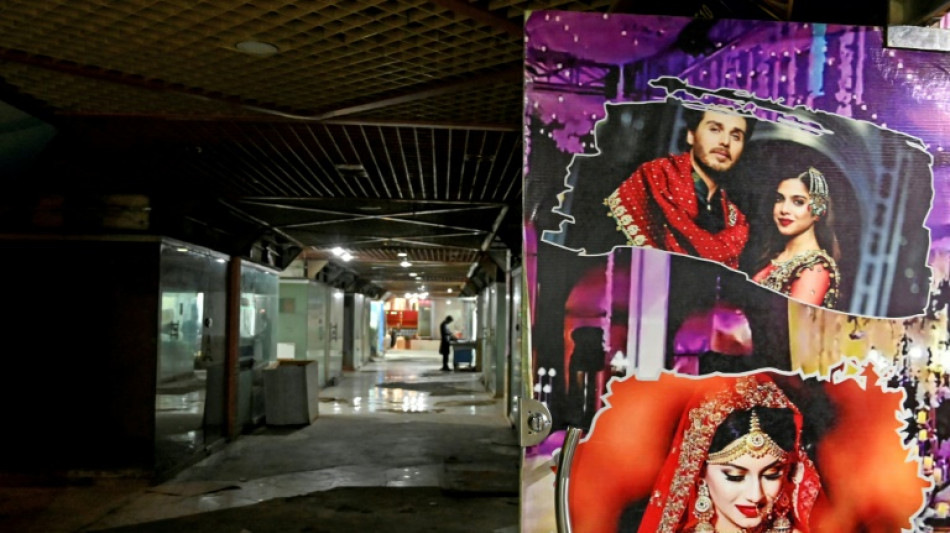
'Love match' apps rival traditional matchmaking in Pakistan / Photo: Aamir QURESHI - AFP

 Death toll from attack at police HQ in Pakistan rises to 31

 Trump says Denmark to give US 'permanent control' over Greenland security
 Kennedy Center: future unclear for iconic Washington arts hub

 Trump claims 'infinite' Greenland security deal with Denmark

 Helicopters battle wildfire threatening Ecuador's capital

 Brentford batter Chelsea to undo Alonso's promising start
 Kane hits Bundesliga century as Bayern rout Union
 Trump says CNN, MS NOW, Politico banned from White House

 Hushing and hedging: US companies retreat on climate

 Springboks to face Fiji before 2027 Rugby World Cup
 Nigeria miners struggled to breathe in cell before 37 died: survivors

 McIlroy on the charge at PGA Championship as Reed withdraws

 McIlroy on the charge at PGA Championship

 Crisis-wracked Volkswagen warns of 10-bn-euro hit to profits

 Costa Rica's Grynspan tops third informal poll for UN chief: diplomat

 Stock markets retreat after central bank rate hikes

 Russia labels director of Cannes Grand Prix winner a 'foreign agent'

 Macron warns of Russian 'hybrid' threat after meeting presidential hopefuls

 UN holds third informal poll for new chief

 Kulusevski return can spark Spurs: De Zerbi

 Shakira to cap off world tour with Madrid 12-gig run

 Isolated Syrian-Druze city blames Damascus for shortages

 Isolated Syrian-Druze city shortages
 Dutch drop Depay for Germany match in Xavi's first pick
 Ronaldo named in Portugal squad for Nations League

Pakistan's traditional matchmakers play a revered role in moulding daughters into potential brides, but marriage apps marketing themselves as halal are offering women a new route to finding a husband.
"When I saw my colleague happy after being married to someone she met online... I thought, since we have tried rishta aunties for four or five years, let's try this too," Ezza Nawaz, a textile designer in Lahore, told AFP.
Rishta aunties -- or traditional matchmakers -- polish up women and present them to the families of potential suitors, in a country where dating is considered dishonourable.
But in the last few years, marriage apps for Muslims have emerged in Pakistan promising so-called "love matches".
Some offer a "chaperone" option -- which provides a weekly transcript of sent and received messages to a chosen relative, satisfying families wary of their son or daughter connecting with strangers.
For Ezza, it was a success: just three months after meeting Waseem Akhtar on Muzz, she was married.
"We went on a couple of dates before we got our family involved. We took our time," she said.
More than 80 percent of Pakistanis have arranged marriages, according to a survey by Gallup and Gilani Pakistan, where families decide the union, sometimes settling an engagement without the bride and the groom even meeting.
Parents enlist the help of professional rishta aunties to help find a suitable family, with the first impression often based on how the young woman looks as she pours tea for her potential in-laws.
The app, however, says 1.2 million Pakistanis have signed up since it launched last year with an advertising campaign in major cities, and 15,000 people have already married.
Marriage apps describe themselves as "halal", or permissible in Islam, offering options to blur profile pictures for privacy and making clear the purpose is to reach a proposal.
But they continue to battle a stigma linking them to casual dating apps such as Tinder, which has been banned in Pakistan for being "immoral".
"I do not tell people how I met my wife until I am sure that the person would not judge us," said Waseem.
- Tradition dates modernity -
Marriage is viewed as a coming together of two families in Pakistan, where many live in multigenerational households.
Choosing your husband or wife yourself can be seen as a challenge to the deeply ingrained reverence towards elders and a threat to the traditional family structure.
Rishta aunties are therefore relied upon to find suitors from acceptable families -- a process that young women, who are widely expected to marry by the age of 25, can sometimes find demeaning.
"I was asked not to tell the guy's family that my hobbies are hiking or photography, but are cooking and cleaning... it made me angry," said Rida Fatima.
"They had the audacity to talk about how I looked, what I did, how much I earned, who my family is, how many brothers I have, what are my future aspirations. So every little thing is judged."
Fatima was presented with several potential matches through a rishta auntie appointed by her parents, but was asked to pay around $700 for an introductory meeting with a guy.
The rate fluctuates depending on whether the match has a foreign passport, she added.
Eventually, she ditched the process, becoming part of the 18 percent of Pakistanis who have a "love marriage" after meeting her husband by chance.
"No matter how the guy looks, even if he is bald or has a big belly, he wants a wife who looks like a model," said Muskan Ali, the managing director at a marriage consultancy in Karachi.
- Waste of time -
Rishta aunties do not feel threatened yet.
Their offices buzz with parents and their children crafting profiles on computers, as matchmakers strive to digitise their businesses with sleek websites and WhatsApp groups for client communication.
Consultants teach young women how to walk, talk and dress to best correspond to the wishes of their future in-laws.
Many traditional matchmakers like Fauzia Aazam, the head of a community of rishta aunties in Rawalpindi, reject marriage apps altogether.
"People waste time on these apps," she said.
"Chatting together all through the night, I just don't like it."
For Aisha Sarwari, a feminist author, the matchmaking process is about exercising "control" over daughters-in-law.
"I would say that we need to find a good middle ground, where the respect is equal on both sides and there is no sense of demeaning a human being just because they look a certain way or they are from a particular race," she told AFP.
Aneela, a digital media artist, whose name has been changed, tried her best to avoid being poured over by a matchmaker and turned to a marriage app, but found a new set of concerns.
"It is hard being on an app... men lie," she said, swiping through her profile at a cafe in Islamabad.
She later admitted to using a fake name and pictures on her profile so that men cannot identify her.
"The only option left is to go for an arranged marriage instead."
B.Khalifa--SF-PST