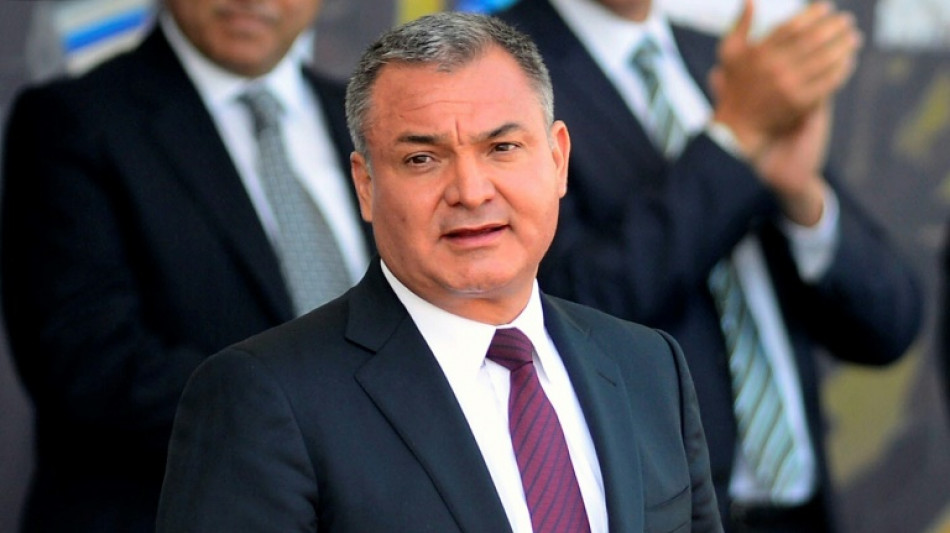
Mexico's ex-security chief sentenced to over 38 years in US prison / Photo: ALFREDO ESTRELLA - AFP/File

 Death toll from attack at police HQ in Pakistan rises to 31

 Trump says Denmark to give US 'permanent control' over Greenland security

 Kennedy Center: future unclear for iconic Washington arts hub
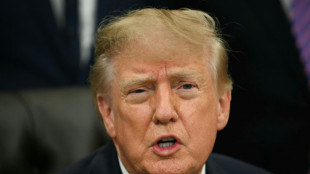 Trump claims 'infinite' Greenland security deal with Denmark

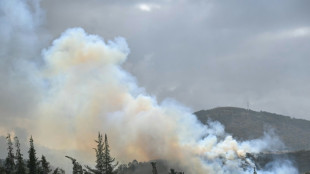 Helicopters battle wildfire threatening Ecuador's capital

 Brentford batter Chelsea to undo Alonso's promising start
 Kane hits Bundesliga century as Bayern rout Union
 Trump says CNN, MS NOW, Politico banned from White House

 Hushing and hedging: US companies retreat on climate

 Springboks to face Fiji before 2027 Rugby World Cup
 Nigeria miners struggled to breathe in cell before 37 died: survivors

 McIlroy on the charge at PGA Championship as Reed withdraws
 McIlroy on the charge at PGA Championship

 Crisis-wracked Volkswagen warns of 10-bn-euro hit to profits

 Costa Rica's Grynspan tops third informal poll for UN chief: diplomat

 Stock markets retreat after central bank rate hikes

 Russia labels director of Cannes Grand Prix winner a 'foreign agent'

 Macron warns of Russian 'hybrid' threat after meeting presidential hopefuls
 UN holds third informal poll for new chief

 Kulusevski return can spark Spurs: De Zerbi

 Shakira to cap off world tour with Madrid 12-gig run

 Isolated Syrian-Druze city blames Damascus for shortages
 Isolated Syrian-Druze city shortages

 Dutch drop Depay for Germany match in Xavi's first pick

 Ronaldo named in Portugal squad for Nations League

Mexico's former top security official Genaro Garcia Luna was sentenced to more than 38 years in a US prison on Wednesday for aiding the very drug cartels he was tasked with dismantling.
Garcia Luna, 56, was convicted at a high-profile trial in New York last year of taking millions of dollars in bribes to allow the Sinaloa Cartel to smuggle tons of cocaine.
District Judge Brian Cogan sentenced Garcia Luna, who served as secretary of public security under president Felipe Calderon from 2006 to 2012, to 460 months in prison and a $2 million fine at a hearing in federal court in Brooklyn.
Prosecutors had sought a life sentence.
"Today's sentencing of Genaro Garcia Luna is a critical step in upholding justice and the rule of law," US Attorney Breon Peace said in a statement.
"His betrayal of the public trust and the people he was sworn to protect resulted in more than one million kilograms of lethal narcotics imported into our communities and unleashed untold violence here and in Mexico," Peace said.
Garcia Luna's month-long trial shone a spotlight on the corruption of the highest-ranking Mexican government figure ever to face trial in the United States.
It also opened a window on the vast resources of the Sinaloa Cartel under Joaquin "El Chapo" Guzman, who is now serving a life sentence in a US penitentiary.
At his trial, prosecutors said Garcia Luna, who held high-ranking security positions in Mexico from 2001 until 2012, was the cartel's "partner in crime."
That included his time as the architect of then-president Calderon's crackdown on Mexico's drug gangs between 2006 and 2012.
But instead of stopping the smuggling, Garcia Luna took millions of dollars in bribes from the Sinaloa Cartel to allow safe passage of narcotics shipments.
According to prosecutors, Garcia Luna tipped off drug traffickers about law enforcement operations, targeted rival cartel members for arrest and placed other corrupt officials in positions of power.
Garcia Luna served as chief of the Mexican equivalent of the FBI from 2001 until 2006, when he was elevated to secretary of public security, essentially running the federal police force and most counter-drug operations.
- 'Supercop' -
Nine of the 26 witnesses who testified against Garcia Luna, known as a "super cop," were accused drug traffickers extradited from Mexico and collaborating with US prosecutors in exchange for possible leniency in their own trials.
They included high-level cartel bosses Jesus "Rey" Zambada, Sergio Villarreal Barragan and Oscar "Lobo" Valencia.
They claimed to have paid millions of dollars to Garcia Luna collectively, and through Arturo Beltran Leyva, who ran his own drug cartel and served as a go-between with Garcia Luna in exchange for protection.
Garcia Luna, a mechanical engineer by trade, moved to the United States in 2012 and was detained in Texas in December 2019.
He was convicted of multiple charges including engaging in a criminal enterprise that included conspiracy to import and distribute cocaine.
The world's biggest narcotics organization at one time, the Sinaloa Cartel moved multi-ton loads of cocaine each month from producing countries in the Andean region up through Mexico and on to streets in Europe and North America.
P.Tamimi--SF-PST