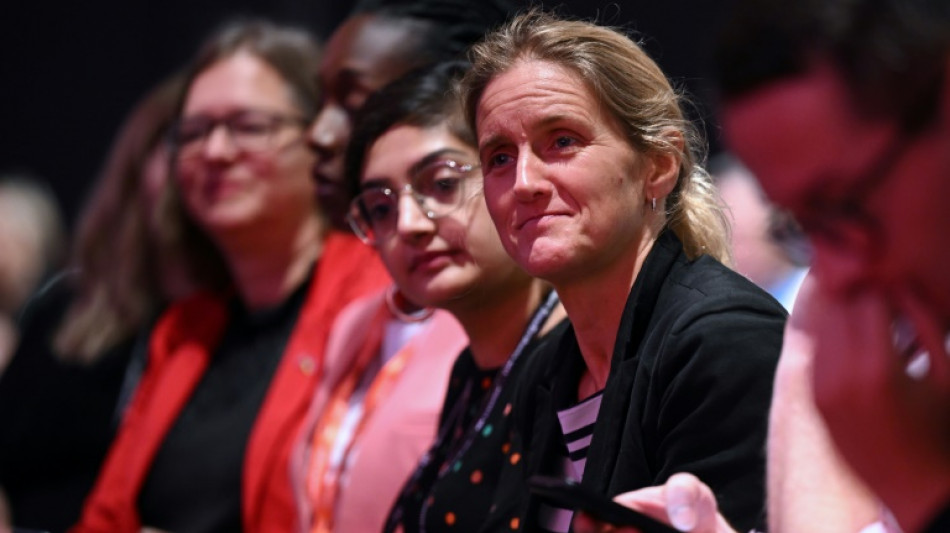
New assisted dying bill introduced in UK parliament / Photo: Oli SCARFF - AFP

 Death toll from attack at police HQ in Pakistan rises to 31

 Trump says Denmark to give US 'permanent control' over Greenland security

 Kennedy Center: future unclear for iconic Washington arts hub

 Trump claims 'infinite' Greenland security deal with Denmark

 Helicopters battle wildfire threatening Ecuador's capital

 Brentford batter Chelsea to undo Alonso's promising start

 Kane hits Bundesliga century as Bayern rout Union

 Trump says CNN, MS NOW, Politico banned from White House

 Hushing and hedging: US companies retreat on climate

 Springboks to face Fiji before 2027 Rugby World Cup

 Nigeria miners struggled to breathe in cell before 37 died: survivors

 McIlroy on the charge at PGA Championship as Reed withdraws

 McIlroy on the charge at PGA Championship

 Crisis-wracked Volkswagen warns of 10-bn-euro hit to profits

 Costa Rica's Grynspan tops third informal poll for UN chief: diplomat

 Stock markets retreat after central bank rate hikes

 Russia labels director of Cannes Grand Prix winner a 'foreign agent'

 Macron warns of Russian 'hybrid' threat after meeting presidential hopefuls
 UN holds third informal poll for new chief

 Kulusevski return can spark Spurs: De Zerbi

 Shakira to cap off world tour with Madrid 12-gig run

 Isolated Syrian-Druze city blames Damascus for shortages

 Isolated Syrian-Druze city shortages

 Dutch drop Depay for Germany match in Xavi's first pick

 Ronaldo named in Portugal squad for Nations League

A UK lawmaker was Wednesday to introduce into parliament legislation that would legalise assisted dying, setting up the first vote on the emotive issue in almost a decade.
Euthanasia is illegal in Britain, but if Labour MP Kim Leadbeater's bill becomes law it would give terminally ill people "choice" at the end of life.
It would also align Britain with some European countries where assisted dying is in place to varying degrees.
Assisted suicide is banned in England, Wales and Northern Ireland, with a maximum prison sentence of 14 years.
In Scotland, it is not a specific criminal offence but assisting the death of someone can leave a person open to a charge of murder or other offences.
Previous attempts to legalise it have been voted down, but public opinion is shifting and attempts to change the law are under way in Scotland, which has a separate legal system and powers to set its own health policy.
An assisted dying bill was last debated -- and defeated -- in the House of Commons in 2015.
Since then, surveys have shown increased support for helping terminally ill people end their lives and Prime Minister Keir Starmer pledged to make parliamentary time for the subject during his Labour party's successful election campaign in July.
The debate has been given impetus by a campaign led by high-profile TV broadcaster Esther Rantzen, who has terminal cancer.
Leadbeater said the current law, which "hasn't changed for more than 60 years," can be "cruel and unjust, not only to terminally ill people but to their families and loved ones, too.
"(I) strongly believe that we should give people facing the most unbearable end to their life a choice about what that end is like," she wrote in the Guardian earlier this month.
Opponents of the legislation include the UK's highest-ranking Roman Catholic cleric, Cardinal Vincent Nichols, who has urged followers to write to MPs to oppose the proposed change.
- 'Dangerous' -
Alistair Thompson, from anti-euthanasia group Care Not Killing, said changing the law could set Britain on a "very dangerous route", citing Belgium and the Netherlands which has extended assisted dying to minors.
"We know that introducing an assisted suicidal euthanasia bill would put a lot of people under pressure to end their lives prematurely," he told AFP.
The precise details of Leadbeater's legislation are believed to be similar to a separate bill proposed recently in the upper chamber House of Lords.
That bill would allow terminally ill people with six months or less to live to end their lives with the approval of two doctors.
MPs are expected to debate and vote on Leadbeater's legislation on November 29.
She is introducing it as a private member's bill, meaning it is not part of the government's legislative agenda.
Starmer's administration has promised its 400-plus lawmakers in the 650-seat parliament a free vote, making predictions of the outcome difficult.
The legislation would only apply to England and Wales.
A bill to make assisted dying legal in Scotland was introduced in the Scottish Parliament earlier this year.
The Isle of Man and Jersey -- self-governing British Crown Dependencies which are not part of the UK -- are also moving towards passing laws to give terminally ill people the right to die.
Belgium, along with the Netherlands, in 2002 became the first EU countries to allow euthanasia.
Spain in 2021 authorised euthanasia and medically assisted suicide for people with a serious and incurable illness, followed by Portugal in 2023.
H.Jarrar--SF-PST