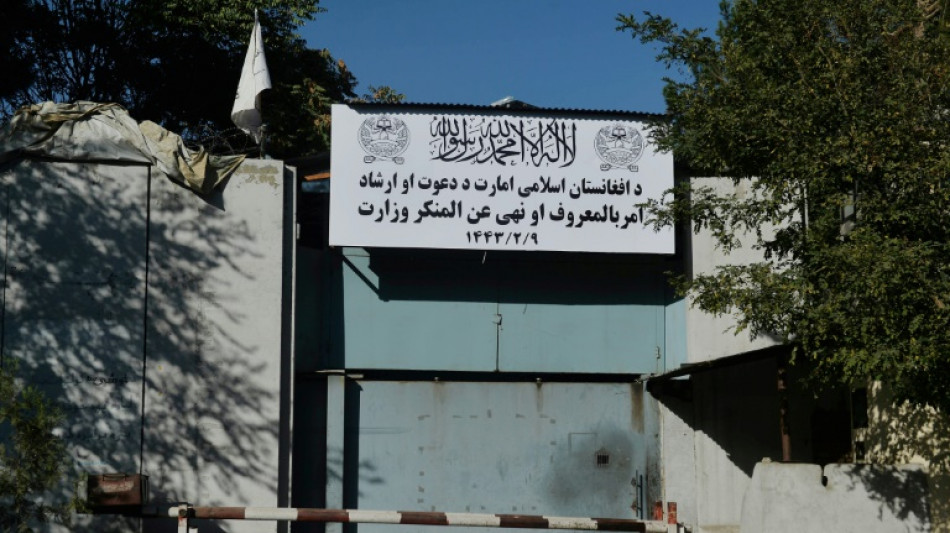
Afghan Taliban vow to implement media ban on images of living things / Photo: Hoshang Hashimi - AFP

 Death toll from attack at police HQ in Pakistan rises to 31

 Trump says Denmark to give US 'permanent control' over Greenland security
 Kennedy Center: future unclear for iconic Washington arts hub

 Trump claims 'infinite' Greenland security deal with Denmark

 Helicopters battle wildfire threatening Ecuador's capital

 Brentford batter Chelsea to undo Alonso's promising start
 Kane hits Bundesliga century as Bayern rout Union
 Trump says CNN, MS NOW, Politico banned from White House
 Hushing and hedging: US companies retreat on climate
 Springboks to face Fiji before 2027 Rugby World Cup
 Nigeria miners struggled to breathe in cell before 37 died: survivors

 McIlroy on the charge at PGA Championship as Reed withdraws
 McIlroy on the charge at PGA Championship

 Crisis-wracked Volkswagen warns of 10-bn-euro hit to profits

 Costa Rica's Grynspan tops third informal poll for UN chief: diplomat

 Stock markets retreat after central bank rate hikes

 Russia labels director of Cannes Grand Prix winner a 'foreign agent'

 Macron warns of Russian 'hybrid' threat after meeting presidential hopefuls

 UN holds third informal poll for new chief
 Kulusevski return can spark Spurs: De Zerbi

 Shakira to cap off world tour with Madrid 12-gig run

 Isolated Syrian-Druze city blames Damascus for shortages

 Isolated Syrian-Druze city shortages
 Dutch drop Depay for Germany match in Xavi's first pick

 Ronaldo named in Portugal squad for Nations League

Afghanistan's Taliban morality ministry pledged Monday to implement a law banning news media from publishing images of all living things, with journalists told the rule will be gradually enforced.
It comes after the Taliban government recently announced legislation formalising their strict interpretations of Islamic law that have been imposed since they swept to power in 2021.
"The law applies to all Afghanistan... and it will be implemented gradually," the spokesman for the Ministry for the Propagation of Virtue and the Prevention of Vice (PVPV) Saiful Islam Khyber told AFP, adding that officials would work to persuade people that images of living things are against Islamic law.
"Coercion has no place in the implementation of the law," he said.
"It's only advice, and convincing people these things are really contrary to sharia (law) and must be avoided."
The new law detailed several rules for news media, including banning the publication of images of all living things and ordering outlets not to mock or humiliate Islam, or contradict Islamic law.
Aspects of the new law have not yet been strictly enforced, including advise to the general public not to take or look at images of living things on phones and other devices.
Taliban officials continue to regularly post photos of people on social media and Afghan journalists have told AFP they received assurances from authorities after the law was announced that they would be able to continue their work.
The information ministry did not immediately respond to AFP's request for comment.
"Until now, regarding the articles of the law related to media, there are ongoing efforts in many provinces to implement it but that has not started in all provinces," Khyber said.
He added "work has started" in the southern Taliban stronghold of Kandahar and the neighbouring Helmand province, as well as northern Takhar.
Before the recent law was announced, Taliban officials in Kandahar were banned from taking photos and videos of living things but the rule did not include news media.
"Now it applies to everyone," Khyber said.
- Journalists summoned -
In central Ghazni province on Sunday, PVPV officials summoned local journalists and told them the morality police would start gradually implementing the law.
They advised visual journalists to take photos from further away and film fewer events "to get in the habit", a journalist who did not want to give his name for fear of reprisal told AFP.
Reporters in Maidan Wardak province were also told the rules would be implemented gradually in a similar meeting.
Television and pictures of living things were banned across the country under the previous Taliban rule from 1996 to 2001, but a similar edict has so far not been broadly imposed since their return to power.
Since 2021, however, officials have sporadically forced business owners to follow some censorship rules, such as crossing out the faces of men and women on adverts, covering the heads of shop mannequins with plastic bags, and blurring the eyes of fish pictured on restaurant menus.
When the Taliban authorities seized control of the country after a two-decade-long insurgency against foreign-backed governments, Afghanistan had 8,400 media employees.
Only 5,100 remain in the profession, according to media industry sources.
This figure includes 560 women, who have borne the brunt of restrictions the United Nations have called "gender apartheid", including being ordered to wear masks on television.
In Helmand, women's voices have been banned from television and radio.
Afghanistan has slipped from 122nd place to 178th out of 180 countries in a press freedom ranking compiled by Reporters Without Borders (RSF).
Z.Ramadan--SF-PST