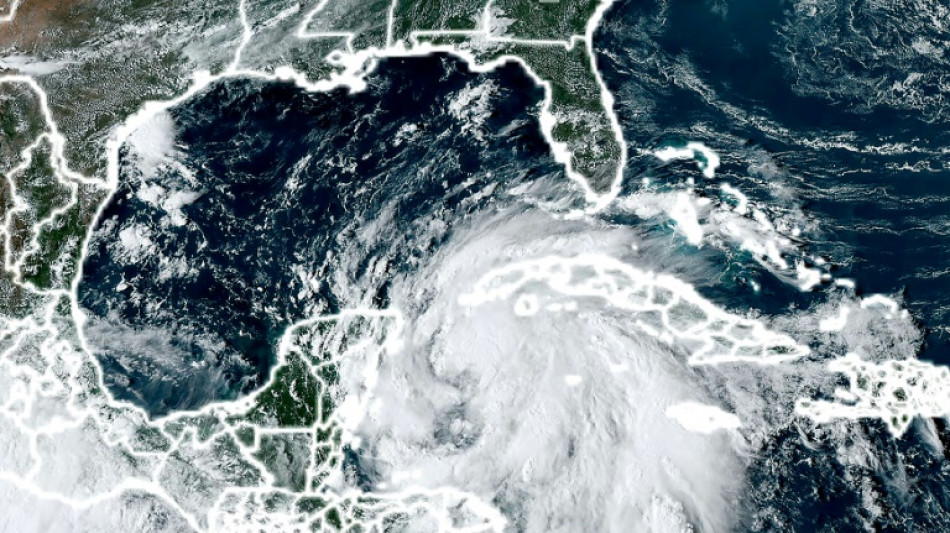
Climate change made deadly Hurricane Helene more intense: study / Photo: - - NOAA/AFP

 Ed Sheeran returns to stage after Palestinian controversy

 Asian Games to open in Japan after troubled build-up

 Drone owners rush to offload devices ahead of Beijing ban

 Trump's beef policies irk Texas ranchers, testing their loyalty

 Nvidia, OpenAI CEOs to attend Xi dinner at White House

 Anthropic picks Accenture for in-house AI safety evaluation
 Balogun returns as Monaco beat Lens to continue strong Ligue 1 start

 'Pause' on overt repression in Venezuela, but reforms still needed: HRW

 Global stocks mixed as yen falls despite Bank of Japan rate hike

 Cuba hit with seventh major blackout of the year

 Murray out with concussion so Wentz will start for Vikings

 UN chief 'deeply regrets' US visa refusal to Abbas for annual meeting

 England quick Carse to face no charges over alleged nightclub assault

 Mancini brings nine newcomers into the first squad of his Italy comeback

 Czechs level Davis Cup tie against USA as South Korea eye Finals

 New France boss Zidane confirms Mbappe as captain after naming first squad

 California governor signs order to explore AI 'kill switch'

 Head leads run spree as Australia win Zimbabwe ODI series

 In-form Raphinha wants to finish career at Barcelona

 Warren Buffett steps down as Berkshire Hathaway chairman

 Carrick confident Man Utd can 'work through' tough time

 Mbappe ends Nike partnership to join Swiss brand On

 Liverpool boss Iraola puts Bournemouth love affair on hold

 'A disaster' if Man City do not win says Maresca after flawless start

 Kerry James Marshall: American 'blackness' painter celebrated in Europe

Hurricane Helene's torrential rain and powerful winds were made about 10 percent more intense due to climate change, according to a study published Wednesday by the World Weather Attribution (WWA) group.
Although a 10 percent increase "might seem relatively small... that small change in the hazard really leads to big change in impacts and damage," said climate scientist Friederike Otto, who heads the research organization.
The study also found that fossil fuels -- the primary cause of climate change -- have made hurricanes like Helene 2.5 times more likely to occur.
In other words, storms of Helene's magnitude were formerly anticipated once every 130 years, but now the probability is closer to once every 53 years, on average.
To conduct the study, researchers focused on three aspects of Hurricane Helene: precipitation, winds and the water temperature of the Gulf of Mexico -- a key factor in its formation.
"All aspects of this event were amplified by climate change to different degrees," Ben Clarke, a co-author of the study and researcher at Imperial College London, told a press conference.
"And we'll see more of the same as the world continues to warm," he continued.
The research by WWA, an international group of scientists and meteorologists who study the role of climate change in extreme weather events, comes as the southeastern US state of Florida prepares for the arrival of another major hurricane, Milton, just 10 days after it was hit by Helene.
- Destruction -
Helene made landfall in northwestern Florida on September 26 as a Category 4 hurricane with winds up to 140 mph (225 kph).
The storm then moved north, causing heavy rain and devastating floods in several states, including North Carolina, where it claimed the highest death toll.
The authors of the study emphasized that the risk posed by hurricanes has increased in scope beyond coastal areas.
Bernadette Woods Placky, chief meteorologist at NGO Climate Central, said Helene "had so much intensity" that it would take time for it to lose strength, but the "storm was moving fast... so it could go farther inland pretty quickly."
This study utilized three methodologies to examine the three aspects of the storm, and was conducted by researchers from the US, the UK, Sweden and the Netherlands.
To study its rainfall, researchers used an approach based on both observation and climate models, depending on the two regions involved: one for coastal areas like Florida, and another for inland areas like the Appalachian mountains.
In both cases, the study found precipitation had increased by 10 percent because of global warming, which is currently at 1.3 degrees Celsius above pre-industrial levels.
To study Helene's winds, scientists looked at hurricane data dating back as far as 1900.
They determined Helene's winds were 11 percent stronger, or 13 mph (21 kph), as a result of climate change.
Lastly, the researchers examined the water temperature in the Gulf of Mexico, where Helene formed, finding it was around 2 degrees Celsius above normal.
This record temperature was made 200 to 500 times more likely due to climate change, the study asserts.
Warmer oceans release more water vapor, providing more energy for storms as they form.
"If humans continue to burn fossil fuels, the US will face even more destructive hurricanes," Clarke warned in a statement.
T.Khatib--SF-PST